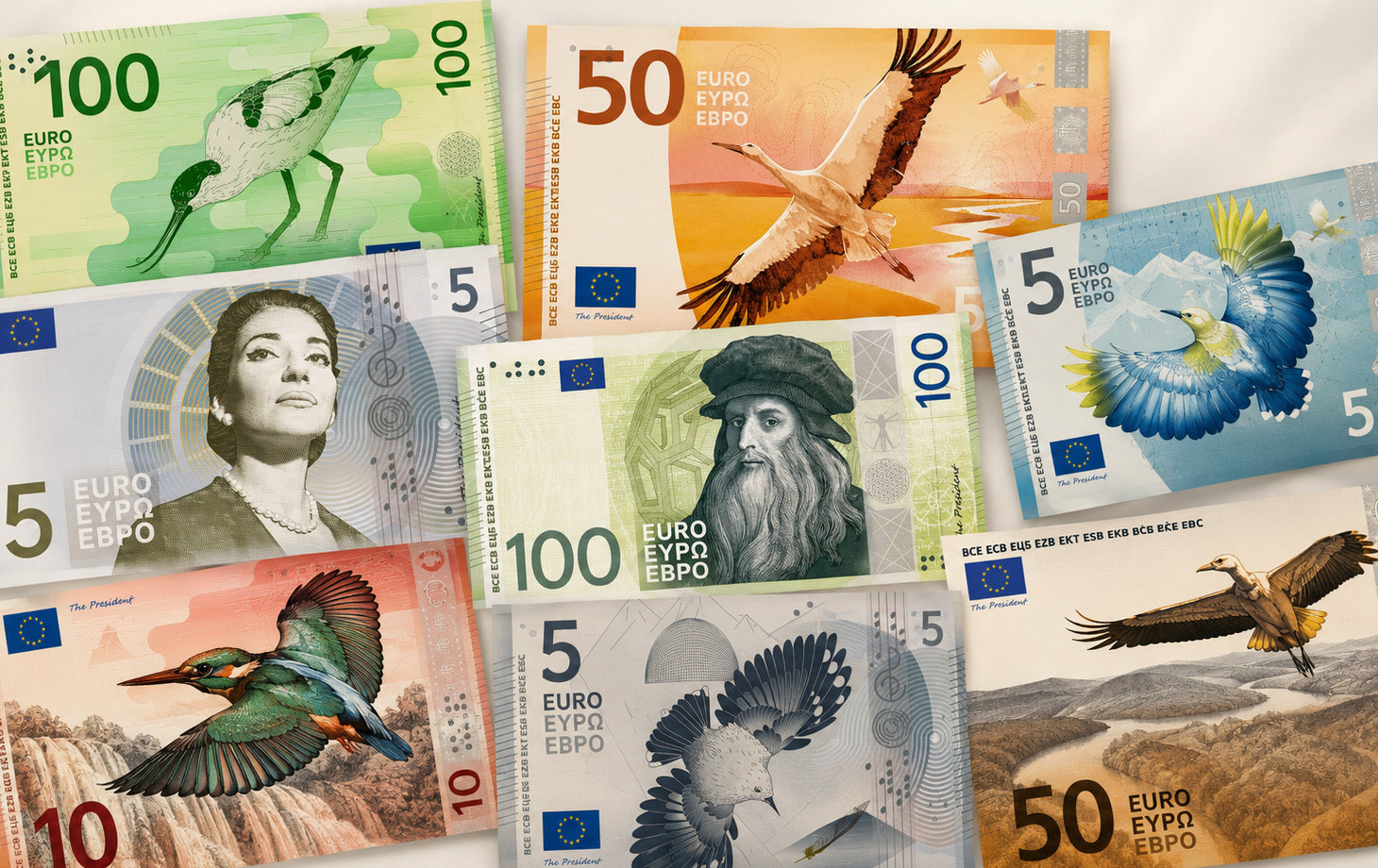
The European Central Bank is set to roll out one of the biggest revamps of euro banknotes in recent decades. The following took part in the vote on the future design: 9.96 million people, and ten projects have reached the final stage across two themes — «European Culture» and «Rivers and Birds». The ECB plans to finalise the design by the end of 2026, although the new banknotes will not appear in people’s wallets until the early 2030s.
- 9.96 million people took part in the ECB’s survey on the new design of the euro.
- Ten design projects have been shortlisted for the final — five for each of the two themes.
- The first topic is devoted to European culture and famous historical figures.
- The second is centred on Europe’s rivers, birds and nature.
Almost 10 million people voted in favour of the euro’s new design
The ECB conducted a Europe-wide online survey from 23 July to 21 September. In total, the following people expressed their views: 9.96 million participants from Europe and other countries.
The younger demographic was particularly active in the survey: around two-thirds of the responses came from people aged under 35. To ensure a more representative result, the ECB commissioned a separate survey of a sample of the euro area population in parallel. However, the bank has not yet does not publish rankings of individual design projects. The results of the vote will be just one of the factors taken into account in the final selection, alongside the recommendations of the expert jury and the technical assessment of the banknotes.
«European Culture»: Leonardo da Vinci and Maria Callas could feature on banknotes
The first concept is called «European Culture: Shared Cultural Spaces».
The ECB has already identified potential themes for each denomination. The obverse sides may feature well-known Europeans:
- €5 — opera singer Maria Callas;
- €10 — Ludwig van Beethoven;
- €20 — Marie Skłodowska-Curie;
- €50 — Miguel de Cervantes;
- €100 — Leonardo da Vinci;
- €200 — writer and pacifist Bertha von Suttner.
The other aspects of this concept focus on cultural spaces: street performances, festivals, schools and universities, libraries, museums and public squares.
An alternative option — the birds and rivers of Europe
The second topic was titled «Rivers and Birds: Sustainability through Diversity». Here, rather than portraits of famous people, nature and birds take centre stage. The banknotes are arranged to depict a journey of sorts, from the river’s source to the sea.
The €5 note features a mountain stream and a rock climber; the €10 note, a waterfall and a fisherman; the €50 note, a white stork above a winding river; and the €100 note, a river mouth and a shoveler. The €200 note is to feature a seascape with a northern oyster.
The reverse side of such banknotes may feature images of the European Parliament, the European Commission, the ECB, the Court of Justice of the European Union and other European institutions.
This is not yet the final design of the banknotes
An important point: the images now published — unauthorised future euros. The shortlist includes ten different design proposals — five in each thematic category. It is from among these that the ECB is currently carrying out the final selection.
The Governing Council of the ECB plans to take a decision on the future design of banknotes around the end of 2026. After that, the design will still need to be adapted for actual production: safety features will need to be incorporated, accessibility for people with visual impairments will need to be checked, the materials will need to be tested, and preparations will need to be made for mass production.
Why change the euro at all?
The modern history of euro banknotes began over 20 years ago. The first series was introduced in 2002, whilst the second – the Europa series – began to be gradually introduced into circulation in 2013. The ECB explains that the current redesign is not merely driven by a desire to refresh the appearance of the banknotes.
They want to make a new series more difficult to counterfeit, more environmentally friendly, more accessible to people with visual impairments, and more in line with contemporary European identity. It is therefore more accurate to speak not of the first change in the euro in 20 years, but of the next generation of European banknotes.
When will the new euro notes enter circulation?
Even once the winner has been chosen, there will be no immediate replacement of the banknotes. The ECB expects the new generation of banknotes to gradually enter circulation in the early 2030s. The current banknotes will not become invalid on the day the new ones are issued. They will continue to circulate alongside the new series.
So, Europe is already effectively deciding what money will look like in the next decade, but the ECB will not give its final answer — Leonardo da Vinci or birds flying over European rivers — until the end of the year.