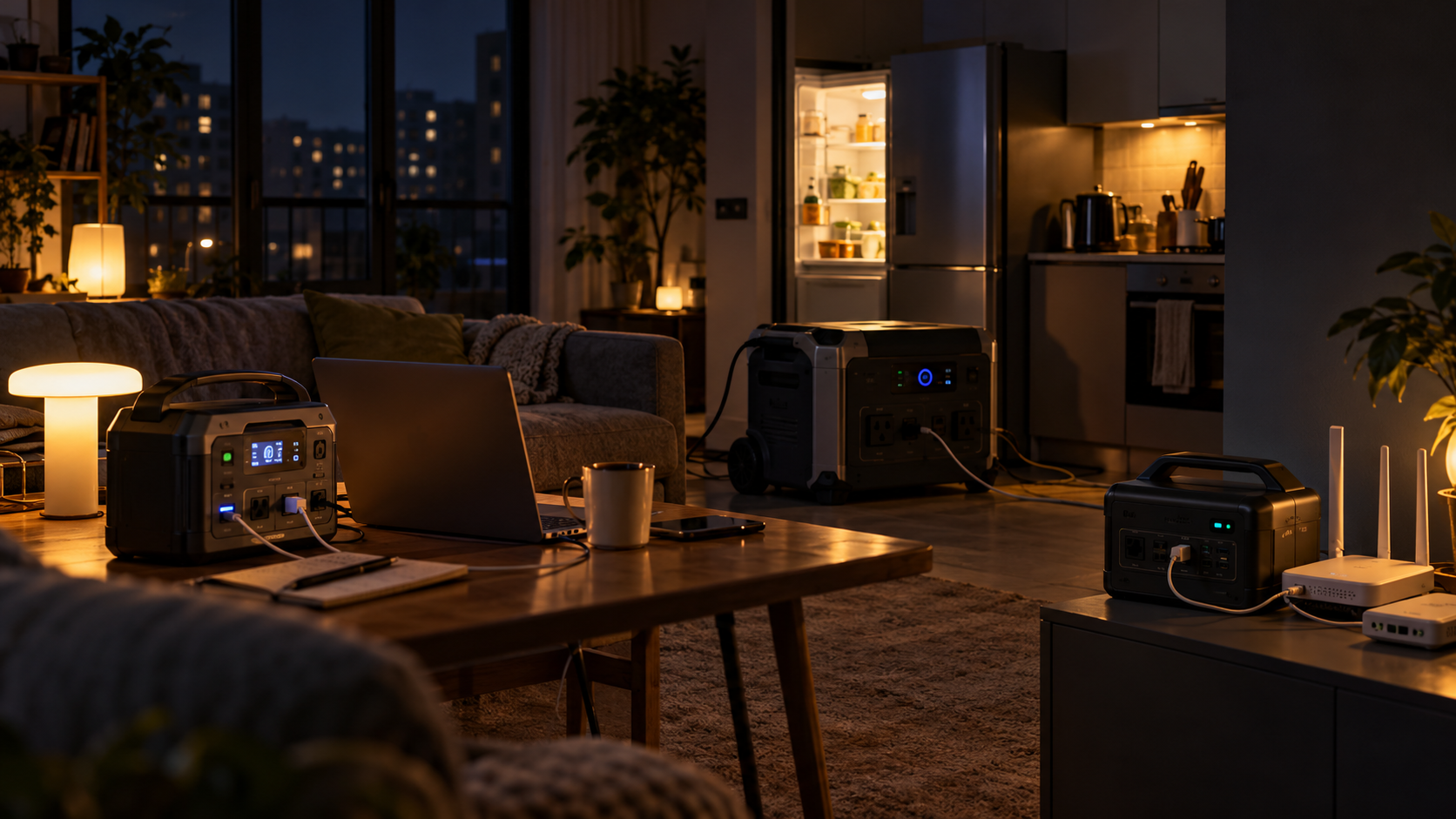
Power cuts in Ukraine have made portable power stations one of the most essential devices for the home. But is it worth paying extra for an EcoFlow when FOSSiBOT offers twice the capacity for a comparable price? Will the compact BLUETTI be enough to power a fridge, which power station should you choose for a gas boiler, and how many hours will your home internet last without electricity? We’ve compared popular models from five manufacturers, looking at their specifications, pros, cons and prices in Ukraine as of 26 October 2026.
Briefly about the main points
- A power station with a capacity of 250–600 Wh is often sufficient for a router, an ONU terminal and a laptop.
- For a fridge, television or gas boiler, you should consider models with a capacity of 1,000–1,500 Wh.
- For prolonged power cuts lasting 8–12 hours or more, power stations with a capacity of 2,000 Wh or more may be more practical.
- All the stations discussed here can be charged from a standard mains supply — solar panels are not essential.
What to look out for before buying a charging station
The most common mistake buyers make is to focus solely on the wattage stated in the device’s name. In fact, there are two different specifications that are important for a backup power supply.
Capacity, in watt-hours (Wh), determines the energy reserve. It affects how long the station will be able to supply electricity to connected appliances. For example, a 2048 Wh model will usually run for about twice as long as a 1024 Wh model under the same load.
The rated power, in watts (W), indicates the load that the power station is capable of supplying simultaneously. A model with an output of 600 W can power a laptop, a router and a small television, but is not designed to power a standard 2000 W electric kettle.
Other important factors include the type of battery, the ability to recharge quickly between power cuts, a pure sine wave for sensitive equipment, and the ability to operate in backup power mode.
For regular home use First and foremost, one should consider stations equipped with LiFePO₄ (LFP) batteries, which are designed to withstand thousands of charge cycles. However, longevity depends not only on the battery chemistry, but also on temperature, operating conditions and the quality of the battery management system.
Comparison of charging stations: specifications and prices in Ukraine
For comparison, we have selected seven models with different capacities — ranging from compact units for working and accessing the internet to powerful devices capable of powering several household appliances during a prolonged power cut.
| Model. | Capacity | Power | Approximate price |
|---|---|---|---|
| EcoFlow RIVER 3 Max | 572 Wh | 600 W | 24,999 UAH |
| BLUETTI AC70P | 864 Wh | 1,000 W | 28,999 UAH |
| Jackery Explorer 1000 v2 | 1,070 Wh | 1,500 W | 28,999 UAH |
| EcoFlow DELTA 3 Plus | 1,024 Wh | 1,800 W | 39,999 UAH |
| Anker SOLIX C1000 | 1,056 Wh | 1,800 W | 40,149 UAH |
| FOSSiBOT F2400 | 2,048 Wh | 2,400 W | 48,684 UAH |
| EcoFlow DELTA 3 Max | 2,048 Wh | 2,400 W | 61,999 UAH |
Prices — these are examples of offers from Ukrainian retailers as at 26 October 2026 and do not represent guaranteed minimum market prices. Prices, specifications, warranties and availability may vary.
The most noticeable difference is the cost of the energy capacity. For example, the FOSSiBOT F2400 offers 2,048 Wh for around 49,000 hryvnias, whilst the EcoFlow DELTA 3 Plus has half the capacity and costs around 40,000 hryvnias.
However, a larger battery does not always mean a better value for money. For a user who only needs to charge their laptop and keep their home internet connection running, a large power station may prove to be unnecessary.
EcoFlow: fast charging and expandability

EcoFlow DELTA 3 Plus
1,024 Wh · 1,800 W · around 40,000 UAH
One of the model’s advantages is that it charges quickly from a standard socket. According to the manufacturer, the station can be fully charged in approximately 56 minutes in the appropriate mode.
EcoFlow is particularly useful for flats where electricity is only available for a few hours between power cuts. The battery’s fast-charging capability allows these intervals to be used more effectively.
The DELTA 3 Plus supports mobile control, features a pure sine wave and a backup power mode. For users who plan to extend the runtime at a later date, support for compatible additional batteries is a key advantage.
The more compact EcoFlow RIVER 3 Max has a capacity of 572 Wh and an output of 600 W. It is better suited to laptops, routers, televisions and other low-power devices.
Advantages: fast charging, mobile app, wide range of models, expandability within compatible series.
Disadvantages: a relatively high price per unit of capacity, and additional batteries increase the overall cost of the system.
BLUETTI: a practical choice for a flat

BLUETTI AC70P
864 Wh · 1,000 W · approximately 29,000 UAH
The AC70P sits midway between compact power stations and kilowatt-class models. It is sufficient for powering a laptop, home communications, lighting and some household appliances.
The BLUETTI AC70P uses a LiFePO₄ battery, supports mains charging at up to 950 W and has two USB-C ports, each delivering up to 100 W.
A key advantage is its relatively light weight of 10.7 kg. The station can be moved from room to room or taken with you.
For higher power requirements, the manufacturer offers the BLUETTI AC180, which features a 1,152 Wh battery and a 1,800 W inverter. This model is suitable for a fridge, a television and a gas boiler, provided they are compatible.
Advantages: a good balance between capacity, power and dimensions; LiFePO₄; fast charging; pure sine wave.
Drawbacks: The AC70P has a lower rated power output than units rated at 1,800–2,400 W; its energy reserve may not be sufficient to power multiple devices simultaneously.
Anker SOLIX: a backup power supply for working from home

Anker SOLIX C1000
1,056 Wh · 1,800 W · around 40,000 UAH
The power station is designed for use at home and in the workplace, where it is important to maintain a power supply to computers, network equipment and other electrical appliances.
The SOLIX C1000 supports fast charging from the mains and can fully recharge the battery in around an hour in UltraFast mode. It is possible to connect a compatible additional battery, which increases the energy capacity to 2,112 Wh.
The UPS function ensures a switchover to battery power with a specified response time of up to 20 ms. This is sufficient for most domestic appliances, but the uninterrupted operation of a particular computer or server depends on the sensitivity of its power supply unit.
Advantages: high power, fast charging, expandability, mobile control.
Drawbacks: the price, the relatively small standard capacity for prolonged power cuts, and the need to purchase an additional battery separately.
Jackery: a compact power station with a powerful inverter

1,070 Wh · 1,500 W · approximately 29,000–35,000 UAH
Jackery offers over 1 kWh of capacity whilst weighing relatively little — around 10.8 kg. This makes the model an attractive option for people who need to carry the power station around frequently.
The Explorer 1000 v2 features a lithium iron phosphate battery, a pure sine wave inverter and supports fast charging. The manufacturer claims up to 4,000 charge cycles whilst retaining at least 70% of its original capacity.
A power rating of 1,500 W is sufficient for many household appliances, but the connection of devices with a high inrush current must be checked separately.
Advantages: lightweight for its class, sufficient power, fast charging, long-lasting battery.
Disadvantages: lower rated power than models in the 1,800–2,400 W range; a capacity of around 1 kWh is insufficient for providing a sustained power supply to a house.
FOSSiBOT: plenty of power for a reasonable price

2,048 Wh × 2,400 W × approximately 49,000 UAH
The FOSSiBOT F2400 has approximately twice the energy capacity of kilowatt-class models, whilst its price remains comparable to that of some stations with a lower capacity.
The station is fitted with a LiFePO₄ battery and a pure sine wave inverter, and supports the connection of several devices at the same time. Charging from the mains at up to 1,100 W takes approximately two hours.
In Ukraine, it is useful to be able to adjust the charging power: 300, 500, 700, 900 or 1,100 W. This helps to reduce the load on the domestic electricity supply.
One drawback is its weight of around 22 kg. This station is more suited to permanent use in one place than to being moved around regularly.
Advantages: large capacity, 2,400 W power output, good value per kWh, charge control.
Drawbacks: considerable weight, slower charging from the mains compared to some EcoFlow models, the need to check the warranty terms and conditions of the specific retailer carefully.
How many hours will the charging station last during power cuts?
The operating time depends on the actual power consumption of the devices. For approximate calculations, the 80% nominal battery capacity can be used as the available energy after conversion losses.
The table below shows the approximate battery life under two constant loads:
| Station capacity | 100 W load | 200 W load |
|---|---|---|
| 572 Wh | 4.6 hours | 2.3 hours |
| 864 Wh | 6.9 hours | 3.5 hours |
| 1,024 Wh | 8.2 hours | 4.1 hours |
| 1,070 Wh | 8.6 hours | 4.3 hours |
| 2,048 Wh | 16.4 hours | 8.2 hours |
These figures are estimates rather than the results of laboratory tests on specific models. At very low loads, relative losses may be higher, and appliances with compressors and motors consume electricity unevenly.
If you need to keep your home internet connection
Wi-Fi router and the ONU optical terminal together can consume around 15–25 W. You don’t need to buy a large charging station to maintain connectivity for several hours.
A compact EcoFlow RIVER 3 or a small-capacity BLUETTI is often sufficient. An even more economical option might be a dedicated DC UPS for the router, which helps to minimise some of the energy conversion losses.
However, your home internet will only work if the provider’s equipment also has a backup power supply.
If you need to work on a laptop
For a laptop, router, monitor and desk lamp, you should consider a power bank with a capacity of 500–1,000 Wh.
With an average power consumption of around 100 W, a 1,024 Wh model can provide approximately eight hours of operation. If the laptop is charged via USB-C, connecting it directly to the corresponding port on the power station can sometimes reduce energy loss.
If you need to power the fridge
A fridge differs from a television or a laptop in that its compressor operates in cycles and can consume significantly more electricity when it starts up.
For a modern fridge, it is advisable to consider inverter-based power stations with a capacity of 1,000 W or more, having first checked the starting load. For prolonged power cuts, models with a capacity of 1,500–2,000 Wh will be more practical.
Assuming an average power consumption of 80 W, a unit with a capacity of 2,048 Wh can provide around 20 hours of operation. In practice, the actual result will depend on the temperature, how often the door is opened and the compressor setting.
If you need to maintain your gas boiler
In many gas boilers, electricity is used to power the circulation pump, the control system and the ignition system. Their power consumption can be approximately 80–150 W, but the exact figure should be checked in the product specifications.
It is not just the power output of the system that is important for boilers. Certain models require the phase, neutral and earth to be connected correctly. Even an inverter with a pure sine wave does not guarantee compatibility with all boilers.
You should therefore check that the equipment is compatible before purchasing it, and have a qualified electrician carry out the permanent installation.
Which power station offers the best value per kilowatt-hour?
The price per 1 kWh of rated capacity helps to understand exactly how much the customer is paying for the energy reserve.
Cost per 1 kWh of rated capacity
A comparison of charging stations based on battery price.
Thousand UAH per 1 kWh.
23,800 UAH
27,1 thousand UAH
33,600 UAH
38,000 UAH
39,100 UAH
43,700 UAH
Calculated based on indicative prices in Ukraine as at 26 October 2026.
A lower value indicates a lower cost per unit of the battery’s rated capacity.
This figure does not take into account energy loss, charging speed or additional features.
By this criterion, the FOSSiBOT F2400 appears to be particularly competitive. However, this assessment does not take into account charging speed, inverter losses, warranty service, durability, dimensions and additional features.
In particular, for a flat where there are frequent power cuts, the speed at which the battery recharges may be more important than the cost per kilowatt-hour.
Do you need to buy solar panels for the charging station?
Solar panels are not essential for home use. All the models discussed can be charged from a standard 220–230 V mains socket.
The principle is simple: whilst there is electricity available, the station charges from the mains. During a power cut, the stored energy is used to power the devices.
Solar panels are a sensible option where there is sufficient space, sunlight and the possibility of installing them safely. For example, in a detached house, they can reduce dependence on the electricity supply schedule.
For a flat dweller who charges their charging station between power cuts, buying a solar panel may prove to be an unnecessary expense.
Is it possible to connect a charging station to the whole flat?
Portable power stations are usually designed for direct connection to electrical appliances. It is also possible to supply part of an apartment’s electrical circuit from the power station, but only via a properly designed switching system.
You must not supply electricity to your home’s wiring via a cable with two plugs. This poses a risk of electric shock, fire and the supply of voltage to the external mains network.
For a fixed backup power supply, it is necessary to provide a suitable input switch, protection and to check that the unit is compatible with the building’s electrical circuit.
Nor should one automatically assume that any charging station is a fully-fledged UPS. The switchover time in UPS or EPS mode must be compared with the requirements of the specific equipment, particularly when it comes to servers, CCTV systems or medical devices.
Which charging station should you choose for different conditions?
| Usage scenario | What to consider |
|---|---|
| Router, ONU, smartphones | 250–500 Wh or a specialised DC UPS |
| Laptop and home internet | EcoFlow RIVER 3 Max |
| Laptop, television, small electrical appliances | BLUETTI AC70P |
| Universal portable station | Jackery Explorer 1000 v2 |
| A workspace and fast charging between power cuts | EcoFlow DELTA 3 Plus, Anker SOLIX C1000 |
| A fridge, a boiler and a few appliances | FOSSiBOT F2400, EcoFlow DELTA 3 Max |
| Prolonged power cuts in a detached house | A 2 kWh charging station or a stationary battery system |
For most flat dwellers, a station with a capacity of around 1 kWh may be a good starting point. It provides sufficient energy to power communications, work, lighting and some household appliances.
If. disconnection If they last for 8–12 hours at a time and you need to power not only the internet but also the fridge or heating, you should consider larger batteries.
However, you need to choose a power station based on your actual load requirements. A large battery is no substitute for a powerful inverter if you need to run energy-intensive appliances simultaneously. Similarly, a 2,400 W power station will not provide long-lasting autonomy if its battery is small.
Before making a purchase, it is worth drawing up a list of the electrical appliances you need, measuring their power consumption and determining the desired runtime. It is this calculation that will enable you to choose a power station without incurring unnecessary costs.