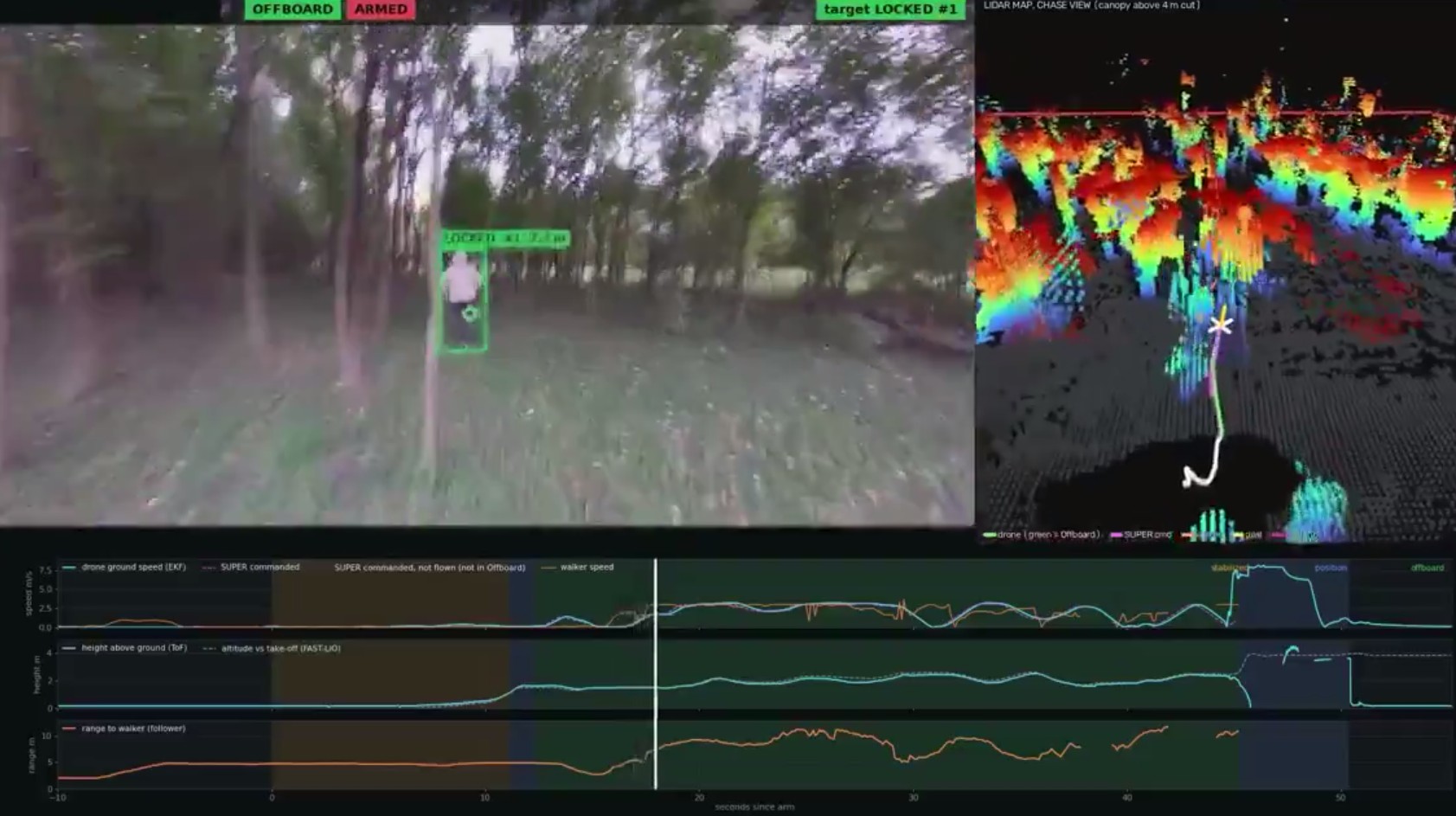
Researchers at Purdue University (USA) have demonstrated an autonomous drone capable of tracking a person running through a dense forest, without the need for satellite navigation or remote control by a pilot. The drone navigates autonomously between trees, detects obstacles and predicts the person’s movements when they temporarily disappear from the camera’s field of view. A video of the tests was released on 26 October by researcher Aniket Bera from Purdue University’s IDEAS Lab.
- An autonomous drone capable of tracking a person in a dense forest without GPS has been demonstrated in the US.
- The drone navigates its way through the trees and avoids obstacles on its own.
- The system predicts a person’s movements if they are briefly obscured by trees.
- Image and sensor data are processed directly on board the drone.
How an American drone tracks a person without GPS
The IDEAS Lab research team has developed an autonomous drone capable of performing complex manoeuvres beneath tree canopies, where satellite navigation signals are often weak or unavailable.
In the video released, the drone moves through the forest, following a person running between the trees. The system tracks the person in the image whilst simultaneously analysing the surrounding area to avoid collisions.
To determine its own movement, the drone uses cameras and inertial sensors. The software compares changes in the image with the data from the motion sensors, estimating the drone’s movement without the need for fixed coordinates GPS.
A specific part of the system is responsible for perceiving the surrounding environment and planning a safe route.
According to Aniketa Berry, the developers created not only the software but also the design of the drone itself, including the 3D-printed airframe and the on-board computing system.
The drone can predict a person’s movements, even when they are obscured by trees
One of the most challenging tasks for autonomous flight in a forest is not to lose sight of a person when trees and other obstacles come between them and the camera.
The developers have implemented motion prediction algorithms. These take into account a person’s previous movements and help the system determine where they might reappear after a brief loss of sight.
At the same time, the drone must avoid colliding with tree branches and trunks. To do this, it constantly assesses its surroundings and adjusts its flight path.
The demonstration video also shows a 3D map of the terrain, generated from sensor data. It allows obstacles and the vehicle’s movements to be visualised.
A key feature of the design is that the calculations are carried out directly on board. The drone does not need to transmit video to a remote server in order to receive control commands.
Does this mean it is impossible to escape from an autonomous drone?
Despite the possibilities demonstrated by American researchers, it is still too early to talk of guaranteed tracking of any individual.
The developers demonstrated how the prototype worked under specific conditions, but did not publish the full results of a series of tests carried out in different weather conditions, lighting conditions and vegetation densities.
It is also unknown what the maximum pursuit speed is, what the endurance is, and how reliably the drone can track a moving target during prolonged periods of obstructed visibility.
The demonstration therefore confirms that it is possible to track a person autonomously in a forest environment, but does not prove that such a system is capable of unerringly locating any target.
Can such drones be used for military purposes?
Autonomous navigation without GPS is important not only for scientific research. Such technologies can be used in search and rescue operations, forest monitoring, the surveying of hard-to-reach areas and the defence sector.
For military applications, it is particularly important that drones are able to navigate without a satellite signal or constant communication with the operator. This is one of the areas of development for autonomous systems capable of operating in the presence of electronic jamming.
At the same time, the use of algorithms to automatically track people raises questions regarding safety, the reliability of recognition and human control over the use of force.
A team from Purdue University has now unveiled a research platform. There is no evidence to suggest that this particular drone is armed or is already in use by the military.