Italian archaeologists have discovered the remains of a wooden chest containing personal belongings in ancient Pompeii, which had remained buried under volcanic ash for almost two millennia. Among the finds are children’s amulets, cosmetic items, a perfume bottle and 38 bronze coins, which the owners never retrieved following the eruption of Vesuvius. The discovery was announced on 29 October by the Archaeological Park of Pompeii. The discovery has enabled researchers to reconstruct details of the daily lives of the city’s inhabitants prior to the disaster of 79 AD.
- The remains of a cupboard dating back almost 2,000 years have been found in Pompeii.
- Cosmetics, crockery and perfume accessories were found inside.
- Among the finds is a child’s necklace with 24 amulets.
- Archaeologists also found 38 bronze coins.
- These artefacts remained buried following the eruption of Vesuvius in 79 AD.
What archaeologists found inside an ancient cupboard
Remains of furniture were discovered in one of the houses on Via dell’Abbondanza, which was one of the busiest streets in ancient Pompeii. The building is traditionally associated with a Roman named Cornelius Maxim, although the identity of its owner has not been definitively established.
The wooden cupboard itself has not survived intact. From the traces and fragments discovered during the excavations, archaeologists were able to reconstruct its design and determine what items were stored inside.
Among the items found were a pair of tweezers, a tool for mixing cosmetic pigments, a glass bottle for perfume or fragrant oils, an incense burner and a bronze lamp.
Lying nearby were cooking pots, glass and ceramic tableware, as well as an elegant little jug decorated with a pattern of pine scales.
A wooden box containing lead weights caught the researchers’ attention in particular. Archaeologists suggest that these may have been used in trade. This points to a possible link between one of the house’s inhabitants and commercial activity.
A necklace made up of 24 amulets might have been a child’s talisman
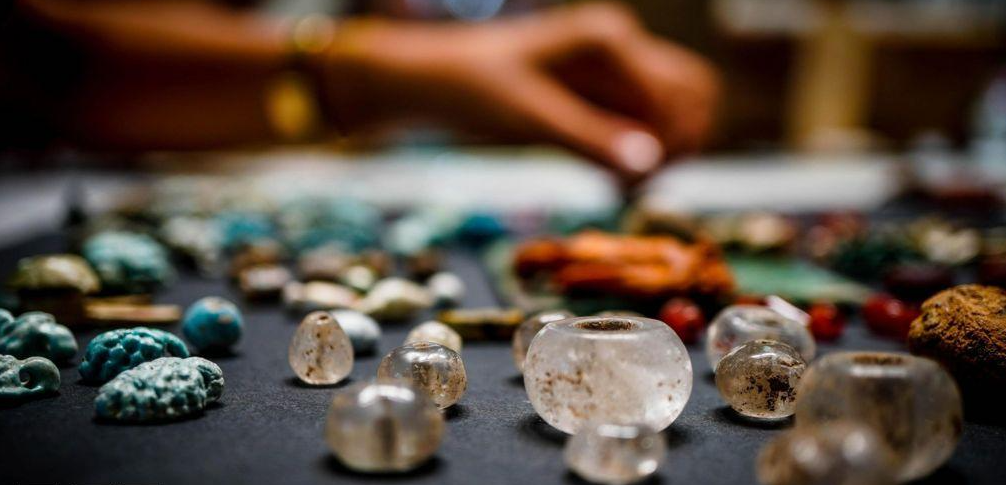
One of the most interesting finds was a necklace consisting of at least 24 small pendants.
They were made from bone, glass paste, faience and rock crystal. Some of the ornaments depict the ancient Egyptian god Bes, the Roman god Mercury, human hands and feet, bunches of grapes and pine cones.
In Ancient Rome, such ornaments were known as crepundia. They were given to children as protective amulets, and the pendants could make a distinctive sound when moved. This meant that adults could hear where a small child was. At the same time, the jewellery had symbolic and religious significance.
According to archaeologists, such necklaces were often kept even after the wearer had grown up — as a memento of childhood or of loved ones.
In Roman society, people often moved long distances. Consequently, personal belongings acquired in childhood could remain important mementos of their home for them.
38 coins were found in the cupboard; nobody had taken them
Another discovery was a small treasure 38 bronze coins. They were found in a woven basket made of plant materials, the remains of which have been examined. According to archaeologists, the preserved coins may indicate that the inhabitants of the house were unable to return for their belongings after the eruption of Vesuvius began.
The disaster occurred in the year 79 AD, when volcanic ash, pumice and molten lava buried Pompeii and the surrounding settlements. Many residents perished, and their homes, along with their everyday belongings, were buried under a thick layer of volcanic deposits.
At the same time, the researchers are unable to determine exactly what happened to the owners of the cupboard that was found. They may have fled or perished in the disaster.
The artefacts provided an insight into the daily lives of the inhabitants of Pompeii
The excavations are being carried out as part of the research and restoration of the central part of the ancient city. The façade of the building had been known to archaeologists since the early 20th century, but the latest work has made it possible to study rooms that had previously remained unexcavated.
In other parts of the building, evidence was found of renovation work that had been carried out shortly before the eruption.
Among the unusual finds are the remains of two young mice inside an amphora. This gives researchers further insight into the living conditions and challenges faced by the inhabitants of the Roman city.
Director of the Pompeii Archaeological Park Gabriel Zuchtriegel He emphasised that such discoveries enable us to study not only architecture and works of art, but also people’s everyday habits, work and personal memories. According to him, although it is impossible to identify the occupant of the house, the objects found help us to gain a better understanding of their life almost 2,000 years ago.