The constitutional crisis in Poland has intensified and has now spread beyond the judicial system. Following an attempt to remove the leadership of the Constitutional Tribunal, President Karol Nawrocki cut short a trip abroad, arrived at the court building in Warsaw during the night and accused his opponents of a «forcible takeover» of a state institution. The protests were accompanied by clashes with the police; two Polish ambassadors have announced their resignations; and Donald Tusk’s government insists that it is attempting to restore the rule of law following years of political interference in the judiciary.
- The crisis surrounding the Constitutional Tribunal has escalated in Poland.
- Navrotsky accused his opponents of a «forceful takeover» of the court.
- The protests in Warsaw were marred by clashes with the police.
- Two Polish ambassadors have resigned over the conflict.
- Tusk’s government is insisting on the restoration of the rule of law.
What happened outside the Constitutional Tribunal in Warsaw
The standoff escalated on the evening of 30 October, when the judge Anna Korwin-Piotrowska announced the temporary suspension from duty of the President of the Constitutional Tribunal Bogdan Svienchkovsky and his deputy Bartłomiej Sohanski.
The decision provides for a one-month suspension. According to Korvin-Piotrowska’s statement, she was to take over the management of the institution herself, as the judge with the most professional experience.
The reason given for this move was obstruction of the tribunal’s work, in particular, preventing judges elected by the current parliamentary majority from taking up their duties.
However, Svienchkovsky refused to recognise the decision. He stated that Korwin-Piotrowska had no legal authority, as the President had not accepted her oath of office.
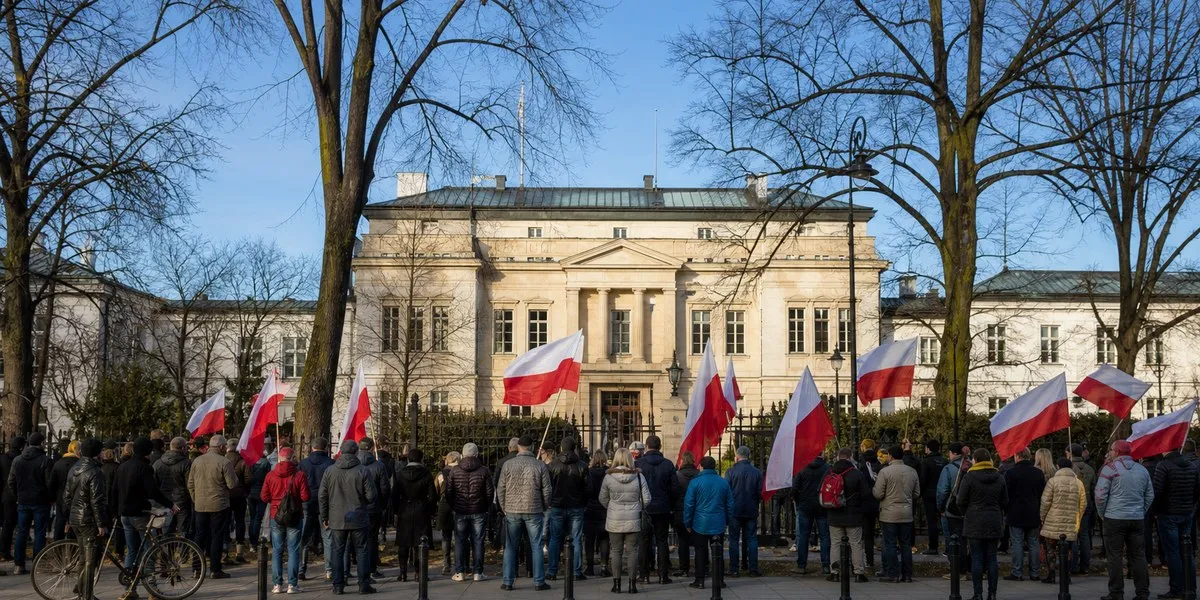
Hundreds of protesters soon gathered outside the building, including representatives of the opposition party «Law and Justice» (PiS), its leader Jarosław Kaczyński and other right-wing politicians.
Law enforcement officers have stepped up security at the tribunal following reports of a possible threat to the judges and staff of the institution.
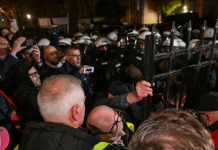
Some of the demonstrators tried to break through the barrier, whilst random objects were thrown at the police. According to the police, three people were arrested.
Law enforcement officers emphasised that their actions were aimed at ensuring security around the building, rather than at interfering with the court’s proceedings.
Navrotsky returned to Warsaw and announced the «seizure» of the tribunal
President Karol Navrotskyi He learnt of the escalation of the conflict whilst on a trip to Senegal. He decided to cut short his trip and return to Poland.
On the night of 31 October, the Head of State arrived at the Constitutional Tribunal accompanied by the first President of the Supreme Court, Zbigniew Kapinski.
A scuffle broke out as he made his way into the building. Government representatives claimed that Navrotskyi had used force against the judges who were standing by the entrance. The President’s Office, however, accused his opponents of attempting to prevent the Head of State from entering the building.
On the morning of 31 October, Navrotsky issued a statement in which he accused his opponents of violating the constitutional order and forcibly seizing a state body.
The President demanded that the police be withdrawn from the tribunal’s premises and announced that he would meet with representatives of the parliamentary parties later that day to discuss ways of resolving the crisis. According to Navrotsky, the situation poses a threat to Poland’s internal security.
At the same time, the Prime Minister Donald Tusk He rejected the allegations and emphasised that restoring the rule of law is his government’s duty.
Two Polish ambassadors have resigned due to the judicial crisis
The standoff has already had an impact on Poland’s diplomatic service.
On 30 October, the Polish Ambassador to China announced his resignation Jakub Kumoch. He explained his decision by referring to the events surrounding the Constitutional Tribunal, stating that he no longer saw any possibility of continuing his diplomatic work under the current circumstances.
On the night of 31 October, the ambassador to Romania took a similar decision Pavel Solokh.
He described the events in Warsaw as an attempt to unlawfully seize the tribunal and stated that he had announced the resignation of President Navrotsky and the Minister for Foreign Affairs Radoslav Sikorsky.
Both diplomats previously held senior posts in the administration of former President Andrzej Duda, who is associated with the PiS political camp.
The Polish Foreign Minister reacted critically to Kumoh’s decision, stating that the diplomat had abandoned his mission.
Consequently, the conflict surrounding the Constitutional Tribunal has led to personnel changes not only within the judiciary, but also within the Ministry of Foreign Affairs.
Why has the constitutional crisis in Poland been ongoing since 2015?
The current conflict has a ten-year history.
In 2015, following the Law and Justice Party’s rise to power, the new parliamentary majority appointed judges to the Constitutional Tribunal to posts, some of which had already been lawfully filled by the previous Sejm.
This marked the beginning of a long-running conflict over the independence of the Polish judiciary.
In 2021, the European Court of Human Rights found that there had been a breach in the composition of the tribunal. The Court held that the participation of an unlawfully appointed judge had infringed the right to a hearing by a court established in accordance with the law.
Judicial reforms PiS They also led to a conflict between Poland and the institutions of the European Union and were one of the reasons for the financial sanctions and the freezing of part of the European funding.
Following Donald Tusk’s return to power in 2023, the new government promised to restore the independence of the judiciary. However, these plans met with resistance from the presidential administration.
In 2026, the Sejm elected new judges to the Constitutional Tribunal; however, Nawrocki refused to allow some of them to take the oath of office.
Some of the newly elected judges took their oaths in parliament, but the tribunal’s leadership did not consider this procedure sufficient for them to begin their work.
It is precisely the question of the legality of their appointment that has become central to the current dispute.
Why do the parties have differing views on the legality of the suspension?
The government believes that the leadership of the Constitutional Tribunal is obstructing the work of the lawfully elected judges and is, in effect, paralysing the institution’s operations.
Anna Korwin-Piotrowska justifies the temporary suspension of Svienchkovsky and Sokhansky on the basis of provisions in the legislation which, under certain circumstances, allow a judge to be suspended from duty for a period of up to one month.
However, Navrotsky and representatives of PiS insist that Korwin-Piotrowska has not assumed the office of judge of the Constitutional Tribunal because she has not taken the oath of office before the President.
Consequently, they also dispute her right to make decisions regarding the management of the organisation.
There is also debate amongst Polish lawyers. Even some lawyers who had previously criticised the PiS’s judicial reforms have questioned the legal basis for this method of removal.
Therefore, claims of a «coup d’état» remain political allegations rather than an established legal fact.
The Public Prosecutor’s Office is calling for the lifting of immunity for the tribunal’s leadership
Alongside the political standoff, the public prosecutor’s office stepped up its activities.
Minister of Justice and Attorney General of Poland Waldemar Żurek reported that five motions had been tabled to lift judicial immunity.
Four of them concern Bohdan Svienchkovsky, and another concerns Bartłomiej Sohanski.
The Public Prosecutor’s Office has also forwarded the case files relating to possible offences for further consideration.
The mere submission of such motions does not imply that the judges are found guilty or that their immunity is automatically lifted.
Corwin-Piotrowska, for her part, announced her intention to hold a general meeting of the judges of the Constitutional Tribunal on 3 November, in particular to consider the institution’s budgetary matters.
Svenchkovsky stated that, together with the other judges, he would attempt to regain control over the tribunal’s work. He announced that the seven judges would meet on 31 October.
The US responded to the crisis
The events in Warsaw have attracted the attention of Poland’s international partners.
US Ambassador Thomas Rose described the situation surrounding the Constitutional Tribunal as extremely serious and warned against it escalating further.
The American diplomat drew attention to the differing accounts of events put forward by the parties to the conflict and emphasised the importance of the stability of Poland’s state institutions.
For Poland, which plays an important role in European security and in supporting Ukraine, the protracted constitutional crisis poses additional political risks.
The standoff is already hampering the work of one of the country’s main judicial bodies, exacerbating the conflict between the President and the government, and affecting the diplomatic service.
As at 31 October, the parties had not reached an agreement on the legality of the suspension of the Constitutional Tribunal’s leadership. Navrotsky insists on a return to the previous arrangement, whilst Tusk’s government supports measures aimed at changing the institution’s leadership.