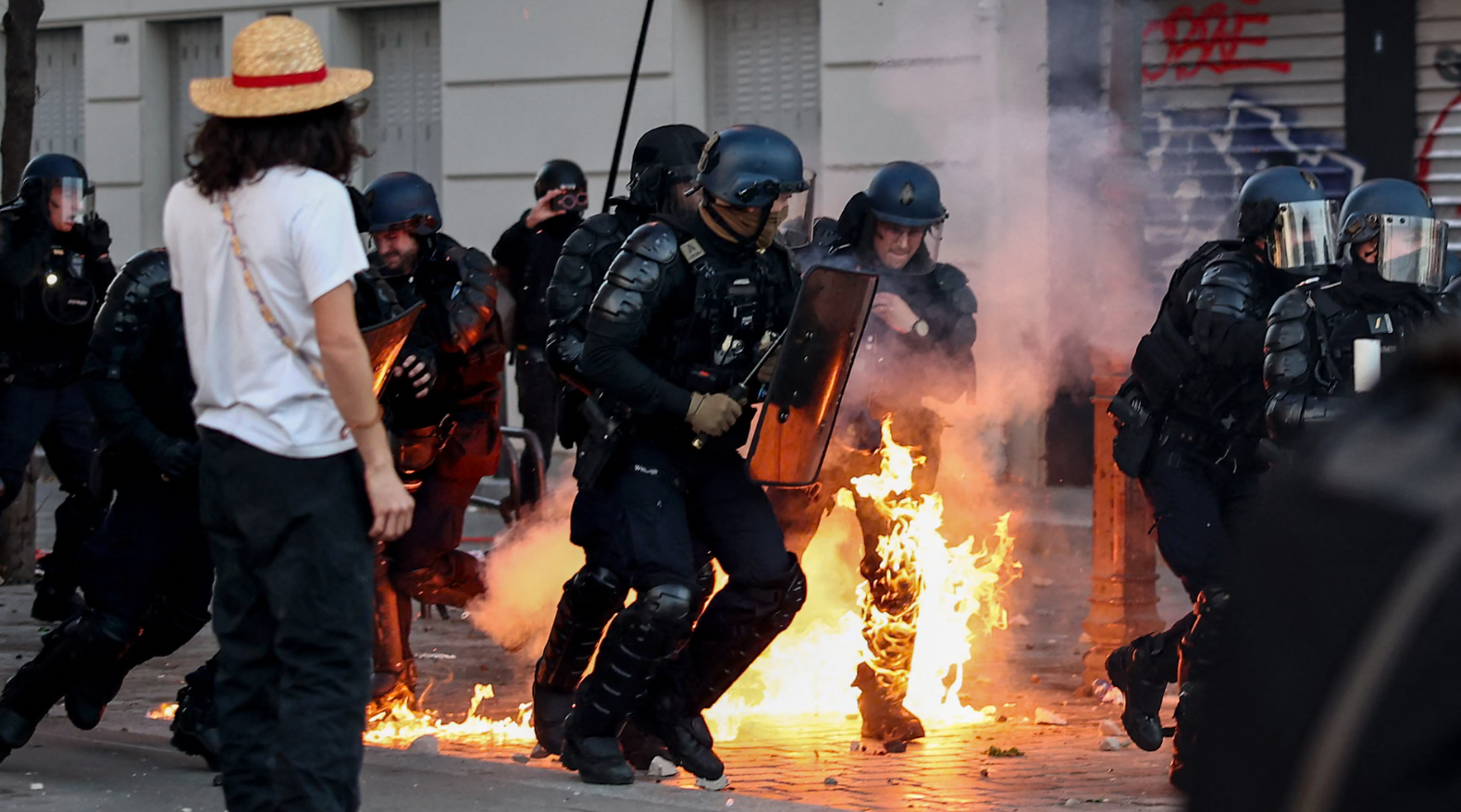
Large-scale protests against the rising cost of living, the housing crisis and the deterioration of public services have led to clashes with the police in several European countries. In France, following an attack on law enforcement officers with a flammable mixture, an investigation has been launched under the section of the law relating to attempted murder. In Germany, more than 100 police officers were injured during the unrest, whilst in Portugal, Switzerland and Albania, clashes took place between protesters and the security forces.
- In France, an investigation into an attempted murder has been launched following an attack on gendarmes.
- During the protests and on Halloween night, the French police arrested 779 people.
- In Frankfurt, more than 100 police officers were injured and 17 shops were damaged.
- In Portugal, law enforcement officers forcibly cleared tent camps set up by protesters against the housing crisis.
- In Switzerland and Albania, the demonstrations were also marred by clashes and arson attacks.
In Paris, a police officer was engulfed in flames following a Molotov cocktail attack
On Saturday, 31 October, around 320,000 people took to the streets of French cities, according to estimates by the Ministry of the Interior. The organisers estimate the number of participants at nearly 500,000. The demonstrators called for measures to tackle the high cost of living, boost people’s purchasing power and improve public services.
Most of the demonstrations were peaceful, but in the evening, riots broke out in Paris, Marseille, Lyon, Grenoble, Bordeaux and Toulouse. Groups of people wearing masks and hoods began attacking police officers and throwing stones and incendiary devices.
The most serious incident occurred in Paris, where homemade incendiary devices were thrown at a group of around 15 gendarmes and police officers. One of them exploded at the feet of a gendarme, causing his protective gear to catch fire.
The moment of the attack was captured on video and in photographs, which were circulated by the French media. According to preliminary information from the public prosecutor’s office, the injuries sustained by the law enforcement officers included second-degree burns.
Parisian The Public Prosecutor’s Office has opened criminal proceedings in connection with an attempted murder government officials. At the time the investigation was announced, the individuals directly involved in the attack were still being identified.
A total of 779 people were arrested in France during the protests and on Halloween night. The Minister of the Interior Laurent Núñez described the level of violence on the part of some of those involved in the riots as extreme.
At the same time, the overall scale of the riots proved to be smaller than on 17 October, when more than 2,600 people were arrested in France and thousands of shops were damaged as a result of the unrest.
In Germany, more than 100 police officers have been injured and dozens of shops have been damaged
On the same day, large-scale demonstrations took place in more than 30 cities across Germany. According to the organisers and the police, over 100,000 people took part.
The campaigns were organised by a youth movement Gen Z is in charge, which advocates for more accessible education, improved public services and a lower cost of living. Participants also raised the issues of the housing crisis and the prospects for the younger generation.
The most serious unrest took place in Frankfurt am Main. After the main demonstrations had ended, groups of masked people began smashing shop windows, setting fires and attacking police officers.
According to the police in the federal state of Hesse, 17 shops were damaged, five of which were burgled. More than 100 police officers were injured during the clashes, and 54 suspects aged between 13 and 29 were arrested.
German Minister of the Interior Alexander Dobrindt stated that those involved in the riots would be identified and brought to justice. His colleague from the state of Hesse, Roman Posek, reported that the police had been confronted by between one thousand and one and a half thousand aggressive individuals.
Clashes also broke out in Cologne, where the police used water cannons, and in Berlin, where bottles and fireworks were thrown at the police.
The organisers of Gen Z regelt have officially distanced themselves from the violence, emphasising that the riots were not part of the peaceful demonstrations.
In Portugal, the police forcibly dispersed protesters demonstrating against high house prices
In Lisbon, thousands of people took to the streets to protest against the sharp rise in property prices and rents.
Protesters are demanding that the Prime Minister’s government Luísa Montenegro to withdraw the draft bill, which provides for the simplification of procedures for evicting tenants and the removal of rent caps for new tenancy agreements.
Following Saturday’s protest, some of the participants set up a tent camp in Rossiu’s central square. At around 04:30 on Sunday, the police began forcibly dismantling it.
Law enforcement officers, some of whom arrived with police dogs, used shields and batons to disperse the protesters. A similar operation was carried out in Porto, where a small protest camp was also cleared.
The housing crisis remains one of the main causes of public discontent in Portugal. House prices in the country have more than doubled since 2017, whilst rents under new tenancy agreements have almost doubled.
Water cannons, tear gas and rubber bullets were used in Switzerland
Unauthorised demonstrations also took place in Zurich and Basel. The protesters marched under the slogan «We’re fed up here in Switzerland too».
In Zurich, following clashes, the police used water cannons, tear gas and rubber bullets. In response, the rioters threw stones, bottles and fireworks.
In the town, a police car was damaged, and rubbish bins and electric bikes were set alight.
In Basel, according to the local police, around 150 people gathered in the city centre at approximately 9.00 pm. During the disturbances, shop windows were smashed, building façades were damaged and bicycles were set alight. Isolated incidents were also reported in Geneva.
In Albania, protesters called for the Prime Minister’s resignation
In Tirana, the capital of Albania, another anti-government demonstration ended with attacks on police officers. The protesters demanded the Prime Minister’s resignation Eddie Rami, accusing the authorities of corruption and of being unable to resolve socio-economic problems.
Initially, the protest took place peacefully outside the Ministry of Education building. Later, groups of young people began throwing stones and bottles containing flammable liquid at the police, as well as setting fire to rubbish bins.
According to the Albanian Ministry of the Interior, around 350 people, including 200 police officers, have been injured during the protests that have been taking place in the country over the past few weeks. A total of 269 minors have been detained during this period.
The Albanian Public Prosecutor’s Office is also investigating reports of possible disproportionate use of force by police officers against demonstrators.