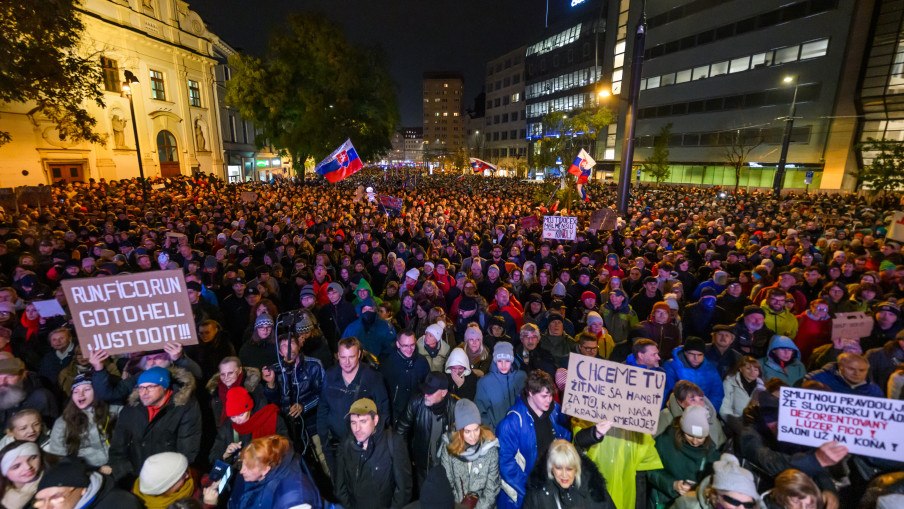
In Slovakia, thousands of citizens took to the streets in anti-government demonstrations, protesting against Prime Minister Robert Fico’s policies and his rapprochement with the Kremlin. The largest demonstration took place on 17 November in Bratislava, where, according to the organisers’ estimates, around 25,000 people gathered. The protests brought together opposition forces from various political camps in the run-up to the 2027 parliamentary elections.
- Around 25,000 people gathered at an anti-government rally in Bratislava.
- Demonstrations against Fico’s policies took place in dozens of towns across Slovakia.
- The opposition parties are aiming to oust the current governing coalition in the 2027 elections.
- The protests were timed to coincide with the 37th anniversary of the start of the Velvet Revolution.
The opposition has united against the Fico government
The largest demonstration took place on Slovak National Uprising Square in the centre of Bratislava. Protesters waved national flags, held up placards criticising the Prime Minister and chanted anti-government slogans. Mass gatherings also took place in Košice, Banská Bystrica and other cities across the country.
The parties «Progressive Slovakia», «The Democrats», «Freedom and Solidarity», the Christian Democrats and representatives of the Hungarian minority have joined in organising the protests. Despite their ideological differences, these political forces share a common goal — to defeat Fico’s coalition in next year’s parliamentary elections.
The leader of the largest opposition party, «Progressive Slovakia» Michał Szimeczka called on the government’s political opponents to unite, emphasising that it is only through joint action that a change of government can be achieved.
Closer ties with Russia are fuelling discontent among Slovaks
One of the reasons for the protests was the resumption of economic ties between Bratislava and Moscow. At the end of October, the Slovak Foreign Minister Juraj Blanár visited Russia for talks on stepping up bilateral cooperation.
Criticism of the government is also linked to its stance on the Russian invasion of Ukraine. Fico opposes military aid to Kyiv, Ukraine’s membership of NATO and the tightening of sanctions against Moscow.
Recently, the Slovak Prime Minister also spoke out against a new loan for Ukraine and financial guarantees from Bratislava.
At the same time, the opposition accuses the government of undermining democratic institutions, restricting civil rights and attempting to tighten its control over the media.
Protests on the anniversary of the Velvet Revolution
The demonstrations took place on the 37th anniversary of the start of the Velvet Revolution. It was the mass civil protests in November 1989 that brought an end to communist rule in what was then Czechoslovakia.
The current protests are taking place against a backdrop of parliamentary difficulties faced by the governing coalition. Last week, parliament rejected the government’s proposed amendments to criminal legislation, which has intensified the opposition’s calls for snap elections.