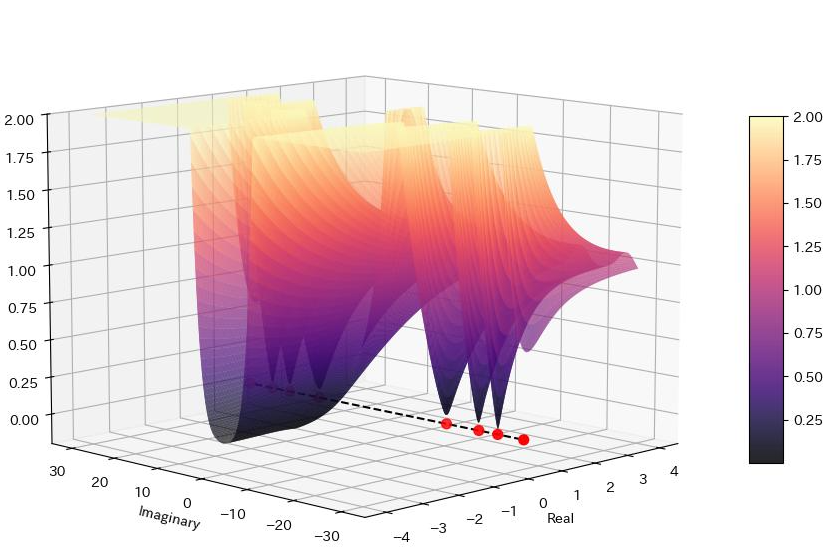
Levent Alpöge, a mathematician at Anthropic, has stated that, together with the artificial intelligence system Claude, he has found a proof of the Riemann Hypothesis — one of the most important unsolved problems in modern mathematics. If the result is confirmed, the discovery could have an impact on the development of computer algorithms, cryptography and fundamental science. The Clay Mathematics Institute is offering a prize of $1 million for a solution to the problem.
- A mathematician at Anthropic has claimed to have proved the Riemann Hypothesis using Claude.
- Scientists have been trying to solve this mathematical problem since as far back as 1859.
- The discovery could have an impact on the development of cryptography and computer algorithms.
- The proposed proof has not yet been independently verified by the mathematical community.
How artificial intelligence helped solve the problem of the century
According to Alpöge, Claude did not merely carry out mathematical calculations, but proposed new approaches to the problem and, in the final stages of the work, was significantly ahead of the researcher himself. The resulting proof turned out to be so extensive that it was published in Lean — a specialised language that enables a computer to verify mathematical proofs.
Back in August 2026, Anthropic reported, that Claude succeeded in raising the established lower bound on the proportion of non-trivial zeros of the zeta function on the critical line from 41.6 per cent to 67.2 per cent. This new achievement demonstrates just how quickly artificial intelligence is developing in the field of scientific research.
What is the Riemann Hypothesis in simple terms?
In 1859, a German mathematician Bernhard Riemann suggested the existence of a fundamental pattern relating to the distribution of prime numbers. These are numbers that are divisible, without a remainder, only by one and themselves: 2, 3, 5, 7, 11, 13, and so on.
Although prime numbers are distributed unevenly, their overall frequency can be predicted. The Riemann Hypothesis allows us to determine the limits of deviation from this prediction much more precisely, using the properties of the zeta function.
This is particularly important for mathematicians, as numerous scientific findings are already based on the assumption that the hypothesis is correct. Proving it would remove this uncertainty.
How can this discovery be put into practice?
A confirmation of Riemann’s hypothesis could have long-term implications for several areas of technology:
- Cryptography — the refinement of mathematical methods for analysing encryption algorithms.
- Programming — guaranteed performance estimates for specific algorithms in number theory.
- Computer calculations — the development of new methods for working with large numbers.
- Fundamental physics — further research into the links between number theory and quantum systems.
- Mathematics — the verification of results that previously depended on an unproven hypothesis.
At the same time, proving Riemann’s hypothesis does not automatically mean that banking encryption, cryptocurrency wallets or the RSA system can be cracked. This would require separate algorithmic breakthroughs.
Will the researcher receive a million dollars?
On the website Clay Mathematics Institute Riemann’s hypothesis remains unsolved. To be eligible for the prize, the proof must be published in a recognised scientific journal, gain widespread acceptance within the mathematical community and withstand at least two years of scrutiny.