
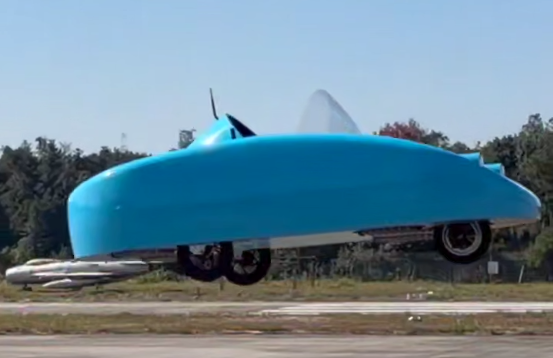
A prototype of the so-called «wingless flying car», which can travel on ordinary roads after landing, has been successfully tested in China. It is a single-seater vehicle with a multi-level system of vectorial channel fans, without external blades or conventional wings. The maiden flight took place on 21 November at the Kaihui airfield in Changsha, and the very next day the vehicle underwent further testing at a base in Yian.
Key points at a glance:
- A prototype «flying car» with no wings and no external propellers has been tested in China.
- The first flight took place on 21 November in Changsha, after which the aircraft underwent further tests in Yian.
- The maximum range is stated as 300 kilometres.
- Once it has landed, the vehicle can travel along the road just like any other vehicle.
- The developers say that this is the world’s first manned prototype with this technical configuration.
What is known about the new device?
The developer — Zhongfei Chuangzhi Manufacturing (Shenzhen) — describes its aircraft as the world’s first piloted prototype built using this technical design. The aircraft has neither wings nor external propellers: all the power units are concealed within the channel modules. According to the engineers’ design, this should improve safety, reduce noise and lower energy consumption during flight compared with traditional multi-rotor aircraft.
What specifications have the developers announced?
According to the published data, a single-seater The model has a maximum take-off weight of 280 kilograms and a payload of 120 kilograms. Its maximum speed on the ground is 80 km/h, and in the air it can reach up to 150 km/h. The flight range is stated as 300 kilometres, with a maximum altitude of 3,000 metres and a standard operating altitude of around 100 metres. Furthermore, the company claims that, after landing, the machine can immediately drive onto the road and operate as a ground-based vehicle.
What's next
Following its maiden flight, the prototype was transferred to the test facility in Iyani, where it underwent a series of additional tests under various operating conditions. The project has now moved on to the interim verification stage ahead of preparations for series production. The developers have also stated that they have already completed the technical design of larger models — with a maximum take-off weight of up to 5.5 tonnes and a payload of up to 2 tonnes. In the future, they plan to develop versions with 2–4, 6–8 and 12–15 seats. Potential areas of application include emergency logistics, medical evacuation, rescue operations, patrolling, and personal transport at low altitudes.