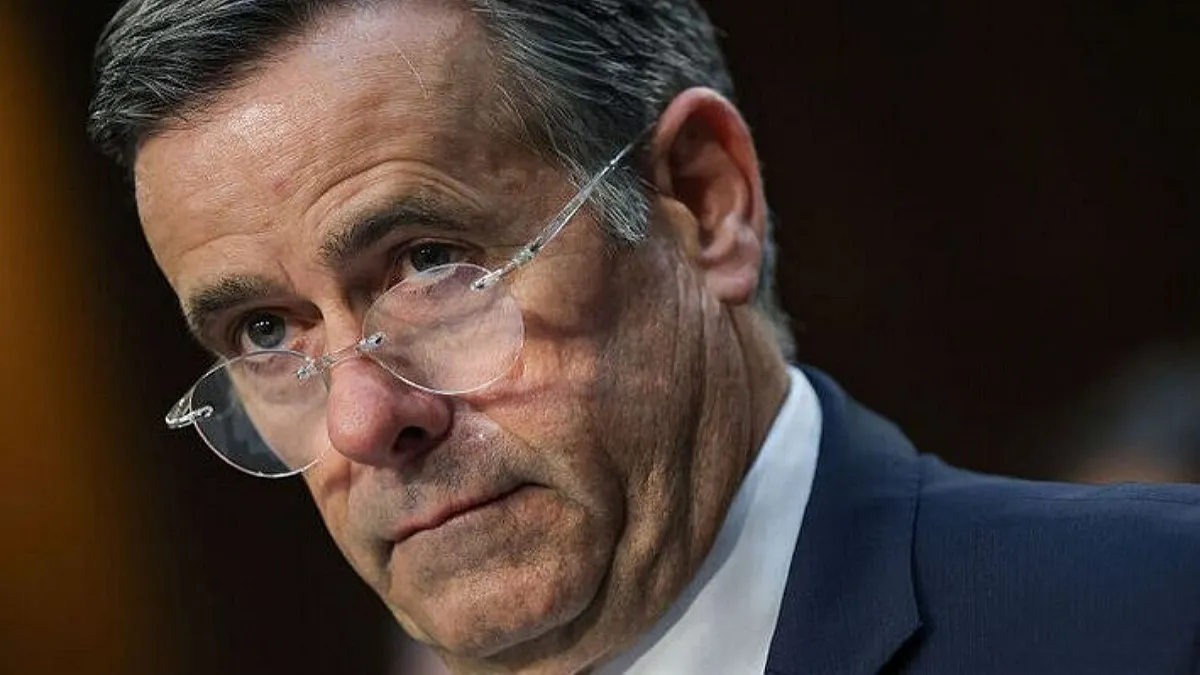
Donald Trump’s administration is preparing to significantly expand the role of CIA Director John Ratcliffe in efforts to bring Russia’s war against Ukraine to an end, according to the Financial Times. In Washington, discussions are also taking place regarding a possible scaling back of the roles of Special Envoys Steve Witkoff and Jared Kushner, whose months-long contacts with Moscow have so far failed to produce a breakthrough. At the same time, the wording that «Vitkoff and Kushner — that’s it», … it would be premature to say at this stage. According to the FT, Trump has not yet made a final decision. Kushner, in particular, may focus more on the Middle East, whilst Ratcliffe will have a greater say specifically on Russian-Ukrainian affairs.
- Trump may significantly strengthen the role of CIA Director John Ratcliffe.
- The influence of Witkoff and Kushner on the Ukrainian track may be reduced.
- No final decision has yet been taken at the White House.
- Retcliffe has already made a secret trip to Moscow and spoken to the FSB leadership.
Retcliffe has already sent a much stronger message to Moscow
A shift in American tactics began to become apparent as early as the end of August, when Ratcliffe carried out a rare, unannounced visit to Moscow.
The Kremlin has officially confirmed that Director of the CIA met with representatives of the Russian security services, but not with Vladimir Putin. Following the talks, Putin was immediately briefed on the outcome.
Retcliffe met, amongst others, with the director of the FSB by Oleksandr Bortnikov and conveyed to the Russian side a message that was fundamentally different from the one Moscow had become accustomed to hearing during negotiations with Witkoff.
The gist of the American message was that Russia’s position is not as strong as the Kremlin portrays it, and continuing the war could make the situation even worse for Moscow in six to twelve months’ time. Retcliffe called on his Russian counterparts to return to the negotiating table.
Washington’s assessment was that the advance of Russian troops had slowed and that the Russian economy was facing growing budgetary and fuel problems.
Putin never did meet with Retcliffe
During the Moscow mission A face-to-face meeting between Retcliffe and Putin was considered, but in the end it did not take place.
Director’s position CIA differed sharply from Putin’s own assessment. The Russian president is convinced that time is on Moscow’s side and that Ukraine can ultimately be forced to agree to territorial concessions.
According to the publication’s sources, who were familiar with the negotiations, Retcliffe, after visit believed that he had sent the necessary signal, but was unable to change the Kremlin’s stance.
What is more, following his visit, Russia stepped up its missile and drone strikes on Ukraine. One of the Washington Post’s sources suggested that Moscow might have perceived the US attempt to persuade it to negotiate as a sign of weakness.
Therefore, the mere fact that Retcliffe has appeared at the talks does not necessarily mean that the Kremlin is any closer to reaching a compromise.
Vitkoff was banking on his personal relationship with Putin
Steve Witkoff opted for a different approach right from the start.
The businessman and long-standing associate of Trump regularly travelled to Moscow and tried to build a personal channel of trust with Putin, on the basis that economic incentives, direct contacts and personal agreements may gradually bring the parties’ positions closer together.
By September, Witkoff had already visited Moscow eight times. On 5 September, he and Kushner spent over three hours in talks with Putin, and the following day they made their first official visit to Kyiv and met with Zelenskyy.
However, there was no breakthrough.
The main problem remains the same: Moscow continues to demand territorial concessions, particularly regarding the part of the Donbas that the Russian army has not yet captured, whilst Ukraine categorically refuses to cede any territory voluntarily.
The Financial Times now reports that frustration has been building in the White House over the lack of results, and The overlap in the remit of various US negotiators has created competition within the administration itself.
How does Retcliffe’s approach differ?
This is the most important part of the possible reorganisation.
Retcliffe enters the negotiations not as a business intermediary, but as head of US intelligence.
This means that his position is based on the following assessment:
- the true state of the Russian army;
- the pace of its progress;
- the Russian Federation’s economic reserves;
- the losses and opportunities of the Russian defence industry;
- the situation within the Kremlin elite;
- Moscow’s ability to continue the war in the long term.
Instead of the argument «what Russia will gain from the deal», Retcliffe is in fact putting forward a different one: «See what happens if there’s no deal».
It is precisely this that makes his negotiating style tougher than Witkoff’s approach.
At the same time, Retkliff’s tougher stance should not automatically be interpreted as the Trump administration shifting to a «pro-Ukrainian» position. The White House’s aim remains to reach an agreement, and Washington may continue to exert pressure on both sides in order to achieve this.
Retcliffe has already proposed a meeting between Trump, Zelenskyy and Putin
During the August mission, the head of the CIA also sought to ascertain whether the heads of the Russian security services were able to influence Putin and persuade him to return to serious negotiations.
Axios reported that Retcliffe raised the idea of a trilateral meeting between Donald Trump, Volodymyr Zelenskyy and Vladimir Putin.
It is precisely these intellectual channels that may prove crucial for such diplomacy. Bortnikov is a member of Putin’s inner security circle and has previously been involved in complex negotiations between the US and Russia, particularly regarding prisoner exchanges.
However, there is a fundamental problem: even if the heads of the security services understand the economic and military risks of a protracted war, there is no guarantee that they are prepared to persuade Putin to abandon his territorial claims.
Are Witkoff and Kushner really losing control?
Witkoff and Kushner’s trip to Moscow and Kyiv took place about ten days after the CIA director’s mission.
That is precisely why, in the American media, it was partly seen as an attempt to to give new impetus to their dialogue. The Wall Street Journal, as reported by other publications, also noted that Ratcliffe’s appearance signalled that the previous diplomatic manoeuvre might have run into difficulties.
However, there has not yet been a complete removal of Witkoff.
On the contrary, following the latest visit, the Kremlin stated that it hoped for a swift resumption of negotiations under US mediation, whilst Secretary of State Marco Rubio suggested that a roadmap for a return to the negotiating table could be drawn up within the coming weeks.
It is therefore more accurate to speak of the clash between two approaches within American diplomacy, rather than a permanent replacement of the team.
What a change in negotiator might mean for Ukraine
For Kyiv, Retcliffe’s arrival presents both potential benefits and risks.
The first advantage is a more realistic assessment of Russia’s capabilities. Judging by the data that has been made public, US intelligence does not share the Kremlin’s assertion that Russia’s military victory is inevitable. This reduces the risk that negotiations will be based solely on the premise that Ukraine must cede territory as quickly as possible.
The second is the possibility of exerting greater pressure on Moscow. Retcliffe has already made it clear to the Russian security forces that a prolonged war could worsen the situation for the Russian Federation.
But there is also a risk.
If Trump demands a quick result, even a tougher negotiator could use intelligence not only to put pressure on the Kremlin, but also to identify the minimum concessions that Washington will try to persuade Kyiv to make.
Therefore, the main change lies not so much in the fact that, who is more sympathetic towards Ukraine, as much as in the negotiation process.
Vitkoff held out the prospect of benefits for the Kremlin following the peace.
Retcliffe, judging by his mission in Moscow, explains, what the cost of continuing the war might be.
And if Trump does indeed place the CIA director at the centre of the Ukrainian negotiating track, this will mark the most significant shift in US strategy regarding negotiations with Moscow in recent months.