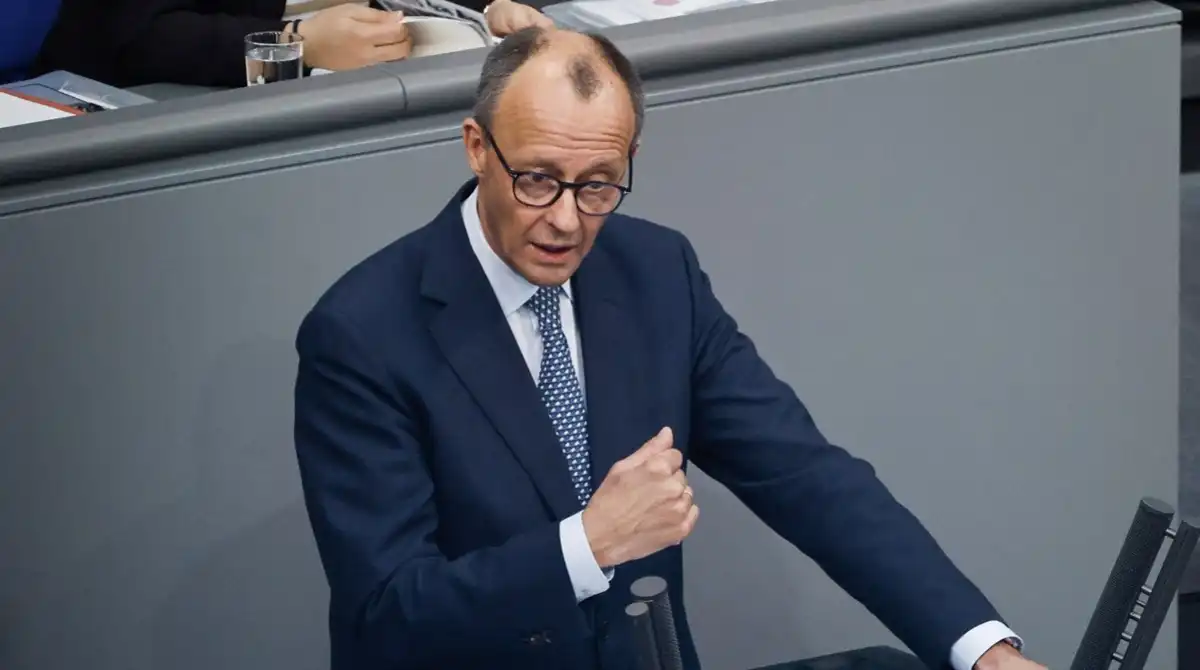
German Chancellor Friedrich Merz has put forward an initiative to restrict access to EU budget funding for member states that refuse to support Ukraine. In the absence of a unanimous decision by all 27 member states, Berlin is prepared to block the adoption of the EU’s next seven-year budget. The dispute centres on a new aid package for Ukraine and the distribution of the financial burden between net contributors and net recipients of EU funds.
Briefly about the main points
- Merz proposes restricting access to the EU budget for countries that do not provide aid to Ukraine.
- The ultimatum concerns Hungary, Slovakia, the Czech Republic and Bulgaria.
- Berlin is calling for all 27 member states to contribute to the €45 billion loan.
- Germany is prepared to block the EU budget for 2028–2034.
- Berlin’s initiative has already been backed by the Netherlands and Lithuania.
Berlin’s conditions for a new loan
The German Chancellor insists that all Member States’ contribution to the funding of Kyiv should be made a mandatory condition for access to the European Union’s multiannual budget for 2028–2034. This refers to a new loan for Ukraine totalling 45 billion euros: 25 billion euros are earmarked for military aid, with a further 20 billion euros to support the state budget.
«Support for Ukraine is a matter of our indivisible European security, and therefore the burden of this support must be shared amongst us all,» emphasised Friedrich Merz.
The Chancellor’s stance is a continuation of his the previous budgetary ultimatum, as set out in a letter to the President of the European Council, António Costa, on the eve of the EU leaders’ talks.
The stance of the four countries and pressure from donors
The main opponents of Berlin’s proposal are Hungary, Slovakia, the Czech Republic and Bulgaria, which are refusing to take on new financial commitments to support Kyiv. Merz He emphasised that the European Union comprises 27 Member States, not 23 or 24, hinting that a selective approach to common security is unacceptable.
Previously, the heads of government of some Central European countries, in particular Fico and Babiš, have already criticised the idea of linking aid to Ukraine to negotiations on the EU’s seven-year budget. At the same time, Germany’s initiative has been backed by the Netherlands and Lithuania, and the dispute itself highlights the divide between the bloc’s net contributors — Germany, Sweden, the Netherlands and Finland — and those states that receive more funds from the budget than they contribute. In parallel, at the bilateral level, Berlin is preparing a separate winter support package.