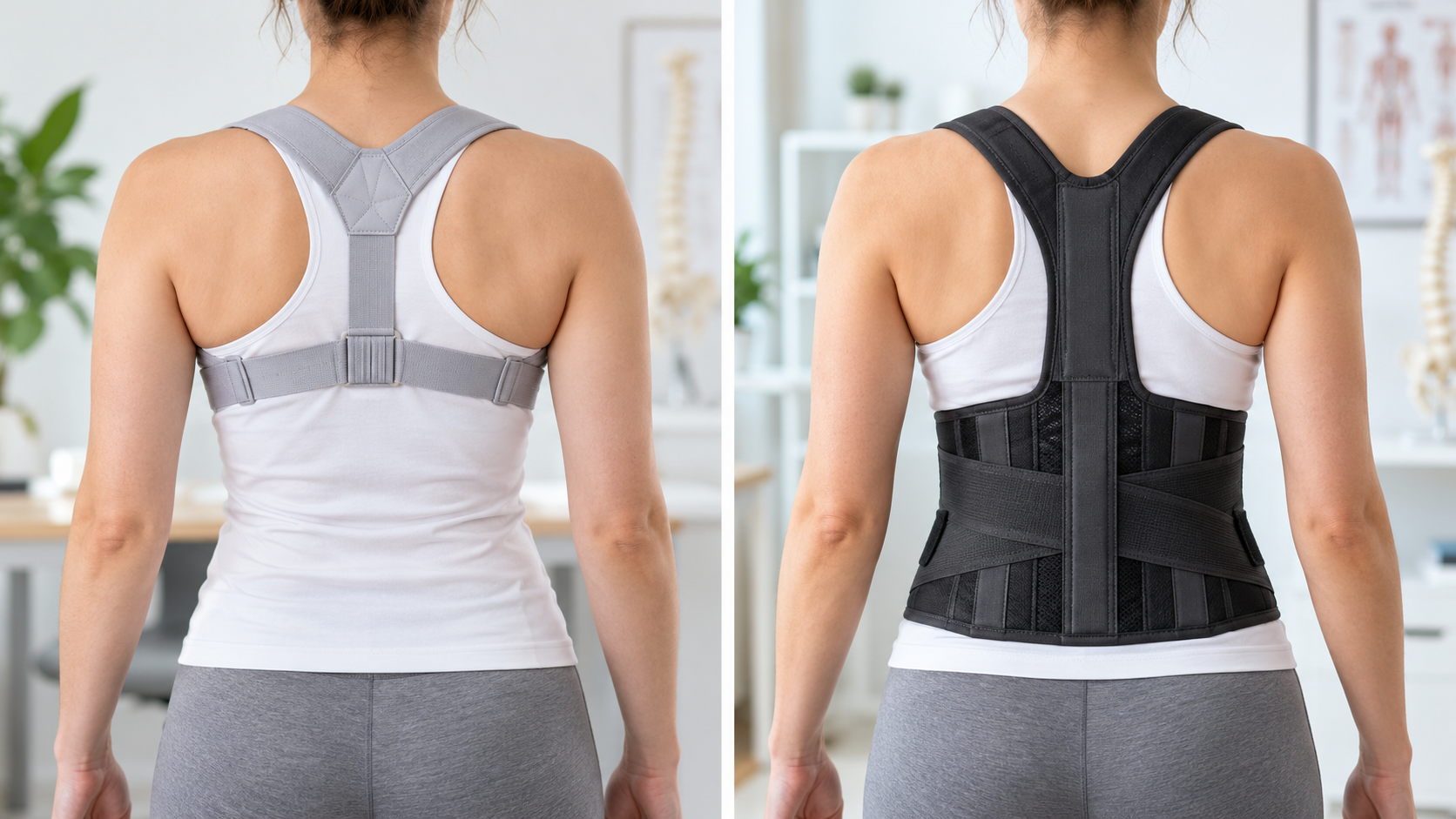
“Do I need a corset or just a posture corrector?” — a question that confuses even those who have already decided to do something about their back. Both products promise a “straight back”, but they are designed for completely different situations, and confusing them means wasting money and time without achieving any results.
The main difference: the purpose of use
Posture corrector — is a soft, elastic garment, usually in the shape of a “figure of eight” or a light waistcoat, which wraps around the shoulders and upper back. It does not rigidly immobilise the spine, but simply gently pulls the shoulders back, reminding the muscles of the correct posture. It is a training and preventative aid: it helps to develop the habit of keeping your back straight, but does not treat serious spinal curvatures on its own.
Corrective back brace — a whole new level of design. It fits more snugly around the torso, often features stiffening ribs, and is designed not merely to “remind” you of your posture, but to provide genuine support and relieve pressure on a specific section of the spine.
When is a posture corrector enough?
The corrector is suitable for situations where the aim is prevention or the treatment of minor functional problems, rather than a diagnosed spinal condition:
- a hunched posture caused by sitting at a computer;
- the habit of letting one’s shoulders slump forwards;
- mild tiredness in the back muscles after a long day’s work;
- Preventative care for schoolchildren and adolescents, as recommended by a doctor.
You shouldn’t wear a posture corrector round the clock, but rather for periods of a few hours at a time — your muscles need to learn to maintain good posture on their own, rather than getting used to relying solely on “a little help”.
When a corset is needed
A corset is prescribed when the problem is more serious than ordinary stooped posture:
- chronic lower back pain caused by physical strain or osteochondrosis;
- disc protrusions or herniated discs — as prescribed by a doctor;
- severe spinal curvatures requiring active correction;
- the rehabilitation period following back injuries.
When maximum hold is required
In certain cases — following spinal surgery, in the event of severe injuries or acute conditions — a doctor may prescribe a rigid lumbosacral brace. This offers the highest level of support of all the available options, and you should not choose it yourself — the decision is made by the doctor based on the diagnosis.
A comparison of two products
| Criterion | Posture corrector | Corrective corset |
|---|---|---|
| Degree of fixation | Soft, reminiscent | Moderate or strict |
| Main objective | Developing the habit of maintaining good posture | Genuine support and relief for the spine |
| A typical situation | Slouching, prevention | Osteochondrosis, hernia, injury |
| Who appoints | You can choose for yourself | It is advisable to follow your doctor’s advice |
Bottom line.
Mild discomfort and a habit of slouching are reasons to consider a posture corrector, whilst severe pain or a diagnosed spinal problem are signs that you should see a doctor and choose a brace with the appropriate level of support. It is easy to confuse these two products, but this will compromise the outcome — a posture corrector will not be able to cope with a serious condition, whilst a rigid corset may weaken your own back muscles unnecessarily.