Prolonged power cuts are forcing Ukrainians to seek alternative ways of powering household appliances, lighting and heating equipment. However, the efficiency of a home power supply system depends not only on the capacity of the batteries, but also on the correct calculation of the load, the compatibility of components and safe connections.
You can browse our range of charging stations, inverters and batteries, and purchase equipment for off-grid power supply from our online technology shop Venkon. The company has its own design, installation and after-sales service departments, which help to select technical solutions tailored to the needs of the property.
Which devices need to be fitted with a backup power supply?
Before purchasing equipment, it is worth determining which electrical appliances you would find it difficult to do without during power cuts. Attempting to ensure that all household appliances can operate independently at the same time may significantly increase the cost of the system.
The primary consumers include:
- fridge and freezer;
- Wi-Fi router and fibre-optic terminal;
- a gas boiler with electronic controls;
- circulation pumps for the heating system;
- laptops and communication devices;
- LED lighting.
Electric water heaters, ovens, heaters and hobs consume significantly more electricity. Using them requires a more powerful inverter and a greater energy reserve in the batteries.
A charging station or an inverter with a battery
There are several options for an emergency power supply for a flat. Each has its own characteristics and limitations.
| Equipment | Purpose | Features |
|---|---|---|
| Charging station | Power supply to individual devices | Compactness and portability |
| UPS | The operation of a boiler, a router or a computer | Automatic power switching |
| Inverter with battery | Power supply to selected power lines | The potential to increase energy reserves |
| Hybrid system | Long battery life | The option to integrate solar panels |
Portable charging stations
This type of equipment is ideal for rented flats and homes where it is not possible to upgrade the electrical system. Charging station combines a battery, an inverter, a charger and a control system in a single housing.
Stationary inverter systems
An inverter, when combined with rechargeable batteries, enables a backup power supply to be set up for specific areas of a flat. With appropriate design, the system can be scaled up by adding compatible batteries to increase the duration of autonomous operation.
How to calculate the required battery capacity
The power of the equipment is measured in watts, whilst the battery’s energy capacity is measured in watt-hours or kilowatt-hours. These are different parameters that must be taken into account when selecting a system.
Let’s consider a hypothetical example of electricity consumption over a six-hour period.
| Device | Power | Consumption |
|---|---|---|
| Router | 15 W | 90 Wh |
| Laptop | 60 W | 360 Wh |
| Lighting | 30 W | 180 Wh |
| Fridge* | 50 W | 300 Wh |
| In total | 155 W | 930 Wh |
A notional average power rating has been used for the fridge, taking into account the compressor’s cyclical operation.
Taking into account losses during the conversion of electrical energy and a capacity reserve, a battery with an energy capacity of approximately 1.2–1.5 kWh should be considered for this scenario.
It is also necessary to take into account the starting power of refrigerators, pumps and other equipment fitted with electric motors.
Why professional installation is important
A fixed backup power supply system requires the specifications of the inverter, batteries, wiring and protective automatic devices to be coordinated. Errors during connection may result in damage to equipment, overheating of wires or a fire.
The Ministry of the Interior of Ukraine emphasises:
Never use a cable with two plugs to connect the station to the mains supply in your home.
To integrate a backup power supply into a flat’s electrical circuit, it is necessary to ensure safe switching between the external mains supply and the stand-alone equipment. Such work must be carried out by a qualified electrician.
VENKON has been providing professional installation services since 2006. The company offers an official 12-month warranty on its installation work, and its liability for installation is insured for 1 million UAH.
An example of a backup power supply system implementation
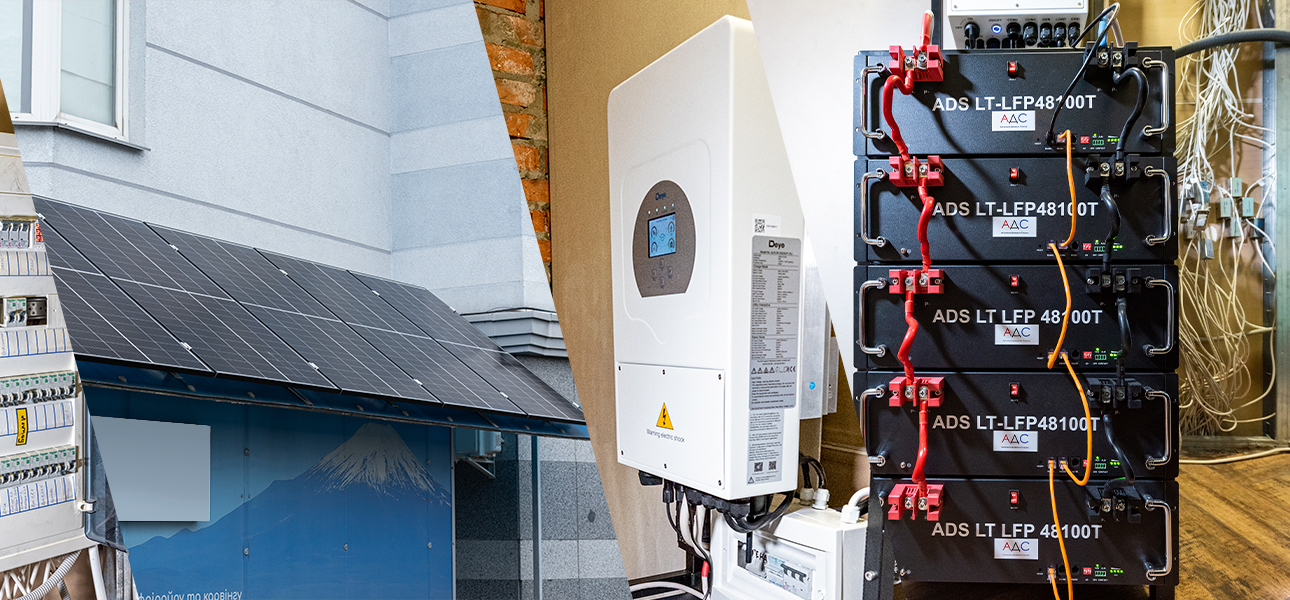
One of VENCON’s projects involved ensuring an uninterrupted power supply to a 130 m² office in Kyiv, where heating was provided by a heat pump.
To implement the project, the engineers used a 5.5 kW hybrid inverter, lithium iron phosphate batteries and five solar panels.
The system has been designed to allow for the use of multiple electricity sources. This approach enables the equipment to be adapted to different consumption scenarios and the duration of power cuts.
A similar design principle applies to flats, but taking into account the lower load, the available space and the specific characteristics of the electrical network in a block of flats.
What to check before buying equipment
When selecting an emergency power supply system, the following must be taken into account:
- the inverter’s rated and peak power;
- usable battery capacity;
- charging speed once the power supply has been restored;
- component compatibility;
- the potential for further scaling;
- warranty terms and availability of after-sales service.
Particular attention should be paid to the speed at which the charge is restored. If the electricity supply is only available for a few hours, the system must be able to store enough energy to last until the next power cut.