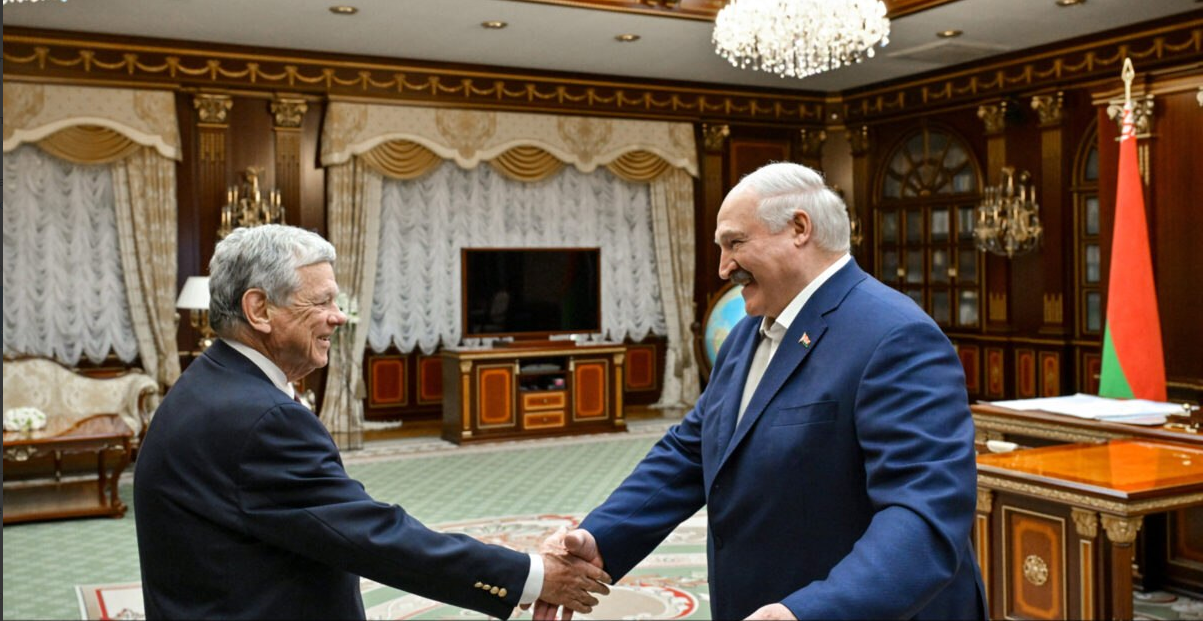
John Cole, US President Donald Trump’s special envoy for Belarus, has built up an informal rapport with Alexander Lukashenko through dinners, crude jokes and private conversations, according to The New York Times. The US administration and the Belarusian opposition attribute the release of more than 500 political prisoners to this channel of communication, whilst Washington has gradually eased some of the sanctions against Minsk.
Briefly about the main points
- Cole has met Lukashenko at least four times.
- During the feast, the messenger drank two glasses of vodka, whilst discreetly pouring the rest away.
- In March 2026, Minsk released 250 prisoners.
- Sanctions were eased for certain banks and companies in the potash sector.
- Human rights activists are calling for an end to politically motivated persecution.
An informal style has become part of the negotiations
79-year-old John Cole told the NYT that he had deliberately avoided a dry, diplomatic style. At the first meeting Lukashenko After about 20 minutes, he began to sharply criticise European leaders, whilst the American envoy responded with a crude joke. According to Cole, the Belarusian leader’s attitude towards him changed dramatically after that.
During one of the drinking sessions, Cole drank two glasses of vodka and, according to him, discreetly poured the rest onto the floor to stay sober. After the toasts, Lukashenko agreed to release another American who was not on the previously agreed list, explaining that this was due to his personal goodwill.
At another meeting, Lukashenko remarked on his interlocutor’s weight loss. Cole spoke about a medicine that had helped him lose more than 20 kilograms. Shortly afterwards, Belarus released a group of political prisoners, among whom was Sergei Tikhanovsky.
The release of prisoners was accompanied by an easing of sanctions
Cole and Lukashenko met at least four times. In March 2026, as part of one of the most significant agreements, the Belarusian authorities released 250 prisoners.
In response, the US has gradually eased restrictions on certain Belarusian banks, potash companies and other entities. Cole states that his aim is the release of all political prisoners; at the same time, the parties are discussing a broader normalisation of bilateral relations.
Lukashenko has become an unofficial channel for communicating with Moscow
According to the NYT, Cole’s personal contacts with Lukashenko extended beyond the Belarusian issue: the Minsk leader became one of the unofficial channels through which Washington could send messages to Moscow.
Russian Nobel laureate Dmytro Muratov asked Cole to help organise exchange of civilian prisoners between Russia and Ukraine. The special envoy replied that he first wanted to complete his work on Belarusian political prisoners.
Human rights activists warn against trading in prisoners
Critics of the negotiation strategy emphasise that the release of individuals does not mean an end to repression. Reuters reported in June that human rights activists were still counting hundreds of people imprisoned for political reasons.
Former political prisoner and journalist Katerina Andreeva believed easing of sanctions premature whilst political persecution continues in the country. Human Rights Watch has called on Washington to press for not only the release of those detained, but also an end to this practice.
Critics fear that exchanging sanctions relief for the release of individuals could create an incentive for authoritarian regimes to use prisoners as bargaining chips in political negotiations. Supporters of this approach, on the other hand, point to those who have already been released.