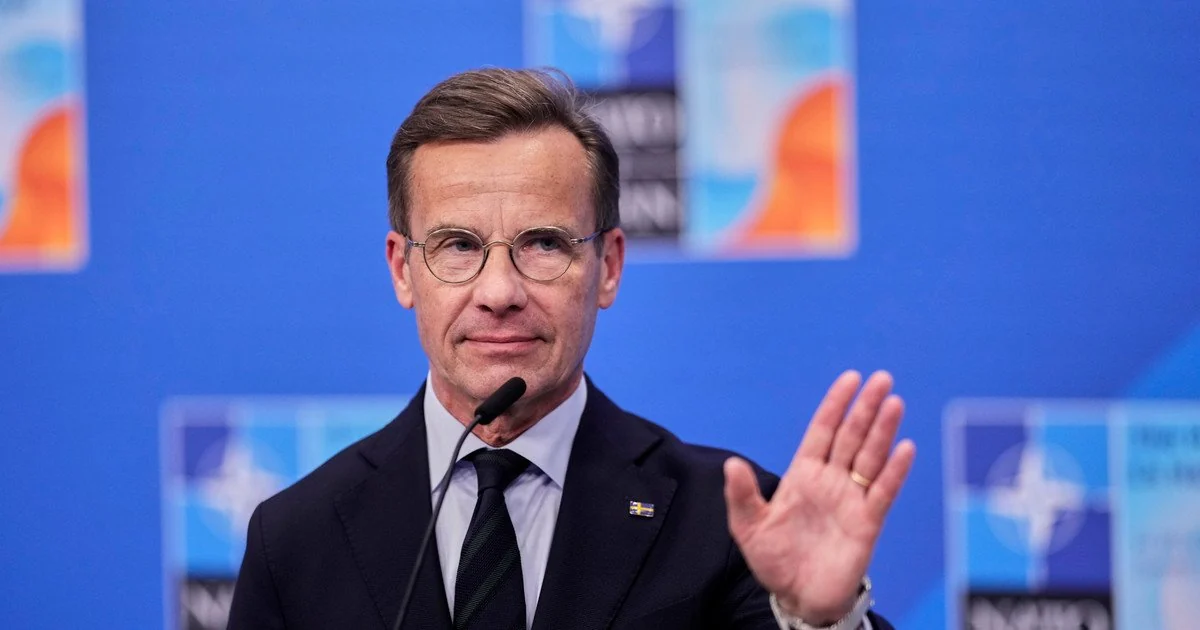
Swedish Prime Minister Ulf Kristersson has spoken out against the possibility of individual European Union member states refusing to contribute to the joint funding of Ukraine. Ahead of the informal summit of EU leaders in Dublin on 13 November, he backed the position of German Chancellor Friedrich Merz and called on European countries to remain united on the issue of aid to Kyiv. The Swedish Prime Minister also advocated the use of frozen Russian assets and warned against separate negotiations with Moscow, which could weaken Europe’s united stance.
- Sweden has spoken out against the refusal of certain EU countries to provide funding to Ukraine.
- Kristersson backed the position of German Chancellor Friedrich Merz.
- Stockholm is proposing to use frozen Russian assets to support Ukraine.
- The Swedish Prime Minister has warned Europe against holding separate talks with Moscow.
Sweden calls for the EU to share responsibility for supporting Ukraine
Speaking to journalists in Dublin, Ulf Kristersson stated that individual states must not be allowed to opt out of joint decisions on financial support for Ukraine.
«To allow individual countries simply to withdraw their support for Ukraine — that is unacceptable to us,» emphasised the Swedish Prime Minister.
He noted that he fully shares this view Friedrich Merz, which advocates for the continuation of financial aid Ukraine, within the framework of the EU’s future long-term budget.
According to Kristersson, Sweden is prepared to consider various funding mechanisms that will help Ukraine get through the winter and meet the needs of the civilian population.
It has been proposed that frozen Russian assets be channelled towards aid for Ukraine
Separately, the Swedish Prime Minister confirmed his support for the use of Russian assets frozen in European financial institutions.
At the same time, he acknowledged that implementing such a decision involves complex legal and technical issues. In particular, EU Member States need to agree on a mechanism for the use of funds in accordance with current legislation.
Christersson emphasised that Russia’s frozen assets should be used for the benefit of Ukraine, but did not announce any specific new decision regarding their transfer during his speech.
Christersson warned Europe against entering into separate agreements with Russia
The Swedish Prime Minister also criticised the idea of individual European states conducting independent negotiations with Moscow. In his view, differing positions and uncoordinated diplomatic initiatives could play into Russia’s hands.
He supported the participation of European representatives in negotiations to end the war, provided that this is what Ukraine wants.
At the same time, Kristersson urged people not to overestimate the results of diplomatic contacts. He stressed that Russia’s true intentions should be judged by its actions, and not merely by statements made during closed-door talks.
On 13 November, an informal meeting of EU leaders is taking place in Dublin, focusing on Europe’s competitiveness, the development of artificial intelligence and the situation surrounding the war in Ukraine. Among the issues under discussion is the future of European funding for Kyiv.