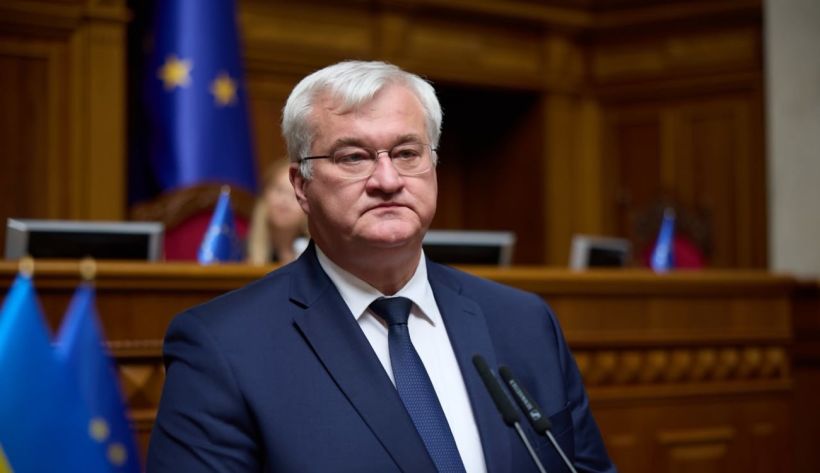
Ukraine is ready for a complete cessation of hostilities across the entire front line and expects a similar decision from Russia. Foreign Minister Andriy Sibiga stated that the successful humanitarian operation in the occupied town of Oleshky in the Kherson region had demonstrated that it is possible to agree on a ceasefire even during wartime. According to the Foreign Minister, this experience could form the basis for broader peace agreements and help to move the negotiation process forward.
- Ukraine is ready for a ceasefire across the entire front.
- Sibiga called on Russia to take a similar step.
- A local ceasefire made it possible to evacuate the residents of Oleshky.
- Kyiv regards the operation as a model for peace talks.
Sybiga stated that Ukraine was prepared to cease hostilities
On 31 October, the Minister for Foreign Affairs Andriy Sibiga commented on the conclusion humanitarian operation in Oleshky, during which civilians were successfully evacuated from the temporarily occupied territory.
The head of Ukrainian diplomacy emphasised that the local ceasefire had demonstrated that agreements between the parties were possible provided there was the political will.
«If hostilities can be stopped in one place, they can be stopped everywhere – and for good. Ukraine is ready. We expect the same from Russia,» said Sibiga.
He emphasised that Ukraine had fulfilled its commitments and ensured that the humanitarian mission took place.
According to the minister, the outcome of the operation could serve as a confidence-building measure and pave the way for the next steps in the peace process. At the same time, Sibiga’s statement does not mean that the parties have already agreed on a general ceasefire. It refers to Kyiv’s readiness for such a decision and a call on Moscow to take the corresponding step.
How the ceasefire made it possible to evacuate the residents of Oleshky
The humanitarian operation in Oleshky was one of the rare instances of a coordinated ceasefire between Ukraine and Russia.
At 03:00 on 27 October, a special ceasefire was introduced in a designated area of the Kherson region, necessary to clear roads of mines, deliver humanitarian aid and evacuate local residents.
The Ukrainian Ombudsman was involved in preparing the operation Dmytro Lubinets and the Russian Commissioner for Human Rights Yana Lantratova. The US side played a mediating role, with the involvement of the US First Lady, Melania Trump.
Under the terms of the agreement, the residents of Oleshky were free to choose whether to remain in the town, leave for territory controlled by Ukraine, or go to Russia. Those who decided to return to Ukraine were transported via occupied Crimea to Anapa, from where they were flown by military aircraft to Gomel in Belarus. People completed the final leg of the journey by bus.
31 October The evacuees crossed the Ukrainian border in the Chernihiv region.
The oldest person among those rescued was 94 years old, and the youngest was just over a year old. The residents’ pets were also successfully evacuated along with them.
Sybiga emphasised that the people who have remained in Oleshky must continue to have unhindered access to humanitarian aid.
Could a local ceasefire form the basis for a broader agreement?
The experience in Oleshky is of significant diplomatic importance, as the parties were able to agree on a specific ceasefire mechanism, define the area to which it applies and organise humanitarian measures.
However, a local humanitarian agreement and a complete cessation of hostilities across the entire front line are decisions of different scales. A general ceasefire would require agreement on the terms, monitoring mechanisms, procedures for responding to breaches and guarantees that the agreements will be implemented.
During the operation in Oleshky, both sides reported that they were observing the agreed ceasefire. At the same time, fighting continued in other areas, and Russian troops continued to launch attacks on Ukrainian territory. The successful evacuation therefore demonstrates that limited cooperation is possible, but does not in itself guarantee that a general ceasefire will be achieved.
Ukrainian diplomats view the results of the mission as an argument in favour of further negotiations and the expansion of humanitarian agreements.