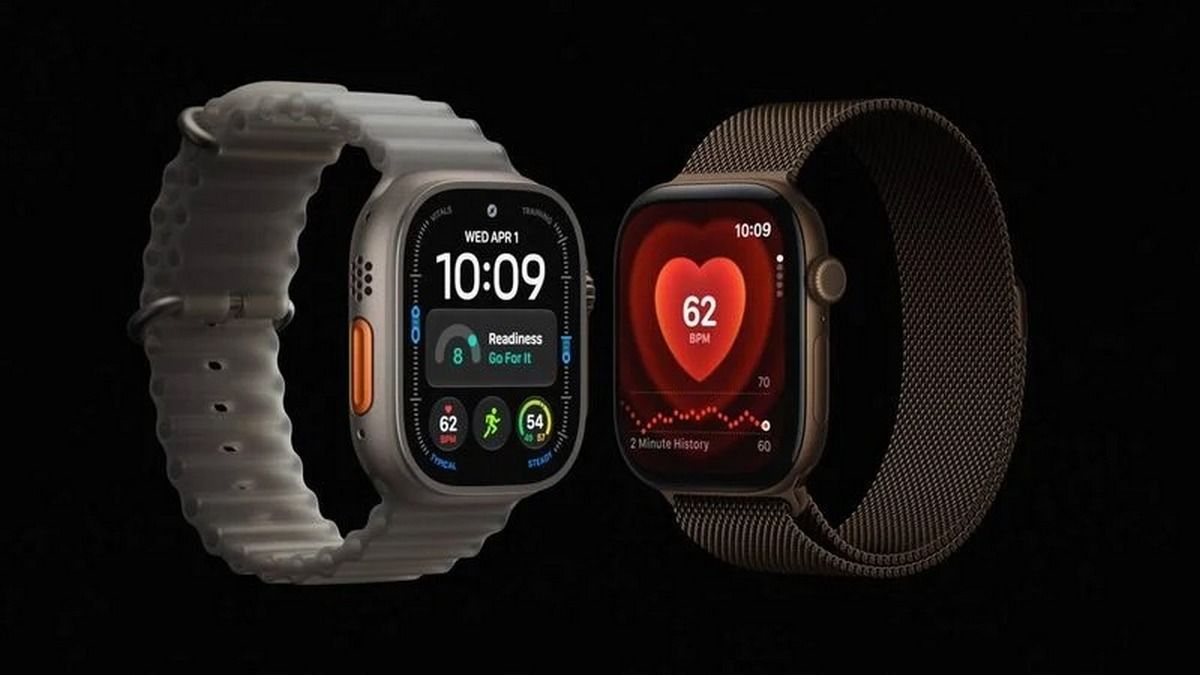
The new Apple Watch Series 12 and Ultra 4 will feature Audio Intelligence, which will enable the watch to analyse ambient sound, replay the last 15 seconds of a conversation and generate AI-powered summaries of conversations. Apple emphasises that audio recordings are not stored, and that processing is protected by a dedicated hardware module. However, the very fact that a wearable device can constantly «listen» to its surroundings has already sparked a debate about the privacy of people who may not even be aware that their conversations are being analysed.
- The Apple Watch Series 12 and Ultra 4 will feature the new Audio Intelligence system.
- Live Rewind can display the text of the last 15 seconds of the conversation.
- Siri Recap creates short AI-generated summaries of conversations and meetings.
- The function can only be disabled or enabled at specific times.
- Apple states that raw audio is neither recorded nor stored.
The Apple Watch will be able to rewind 15 seconds
One of the most unusual new features was the function Live Rewind.
If the user hasn’t heard the phrase or wants to recall what was just said, simply press the Digital Crown twice. The Apple Watch will display a text transcript of the previous 15 seconds of the conversation. You can save it in the new Siri app or ask Siri a question about what you’ve heard.
For example, Apple suggests using this feature if someone hasn’t heard the instructions clearly in a noisy restaurant, has forgotten the title of a recommended book, or wants to remember an important point made by the person they’re talking to.
From a practical point of view, it is like a digital short-term memory.
But there is another side to it: a watch must to constantly process ambient sound, so that when you press it, you can replay the text from the previous 15 seconds.
Siri Recap will be able to summarise your conversations
An even more interesting feature is — Siri Recap.
When it is activated, the Apple Watch uses what is known as ‘ambient listening’ — background listening — and generates not a verbatim transcript of conversations, but A brief AI summary.
Following the conversation, Apple Intelligence automatically creates:
- heading;
- brief description;
- Key points.
Apple gives examples such as a work meeting, a consultation with a coach or a conversation between parents and a teacher. The result is saved in the Siri app.
You can leave Siri Recap running all the time, set a schedule — for example, only during working hours — or switch it off completely.
It was precisely the possibility of steady-state operation that became the main point of contention.
Does this mean that the Apple Watch is constantly recording people?
No — at least not in the traditional sense of audio recording.
Apple says that Audio Intelligence does not create or store audio files. The raw audio from the microphone is processed in a specially isolated section of the new S11 processor — the Secure Exclave — and is then immediately deleted.
According to the company:
- the operating system does not have access to the raw audio;
- third-party programmes cannot access it;
- the user themselves cannot open the original record;
- Apple does not have access to it either;
- Siri Recap does not identify which participant said a particular phrase.
Live Rewind text snippets and Siri Recap summaries are synchronised via iCloud with end-to-end encryption and, according to Apple, are not even accessible to the company itself.
Therefore, the headline «Apple Watch secretly records everything around it» would be inaccurate.
But. The watch really does need to analyse sound continuously, provided that the relevant mode is enabled.
The main problem is that the person next to you might not know anything
This is where the more complicated question arises.
TechCrunch points out that the owner Apple Watch He himself agrees to the role, but his interlocutors — not necessary.
For example, two people might be having a private conversation. One of them is wearing a watch with Siri Recap, whilst the other might not even realise that the system is generating AI notes from their conversation.
And although the audio file is not saved, the result is still a text containing the key facts.
This raises questions not only of ethics but also of the law. In the US, the rules on recording conversations vary from state to state: in some, the consent of just one participant is sufficient, whilst in others, all parties must give their consent.
With Apple’s new model, the situation becomes even more complicated — formally speaking, a classic recording may not exist at all.
Apple has added a special warning
In the event that Live Rewind Apple has provided a clear signal.
When the user presses the Digital Crown twice, the watch:
- emits an audible signal even in silent mode;
- displays a full-screen animation;
- displays a microphone icon.
This should let the people nearby know that the conversation has just been resumed.
However, Siri Recap works differently, as its purpose lies precisely in continuous background analysis.
TechCrunch believes that Apple is, in fact, trying to strike a balance between a useful AI assistant and technology that could be perceived as overly intrusive surveillance.
Apple describes it first and foremost as an accessibility tool
Audio Intelligence was not created solely for taking notes.
Function Sound Recognition uses the same microphone and on-device AI to recognise:
- a fire siren or other siren;
- alarm system;
- doorbell;
- a baby’s cry.
This is primarily an accessibility feature for people with hearing impairments. It can work even when the user’s iPhone is not nearby.
The technology of continuous sound analysis therefore has obvious practical applications.
A dispute arises when that same mechanism begins to analyse human conversations.
Not all Apple Watches will have these features
Live Rewind and Siri Recap will not be available on older watch models.
Apple states that they will require:
Apple Watch Series 12 or Apple Watch Ultra 4, as well as iPhones featuring Apple Intelligence — iPhone 16 or later, with the exception of the iPhone 16e.
Both functions will be set to the status beta by the end of 2026.
Initially, they will work in English and will not be available in the European Union. Apple also warns that daily usage limits may apply to certain AI features.
Apple risks facing the same problem as other AI gadgets
The market is already moving towards devices that are constantly by a person’s side and record their day.
AI-powered wearables and devices such as the Amazon Bee use a similar concept. Meta has also faced criticism over its smart glasses, which feature cameras and AI functions.
TechCrunch believes that Apple’s decision may gradually to normalise the concept of technology that is always listening, even if, technically speaking, it does not store the complete record.
This is particularly interesting for Apple, as the company has been building its marketing strategy around privacy for years.
It is now trying to convince users that it can continuously analyse ambient sound without turning the watch into a surveillance device.
Should we be wary of the new Apple Watch?
From a technical point of view, Apple has done a great deal to minimise risks: there are no persistent audio files, the raw audio is isolated from the system, notes are encrypted, and features can be disabled.
Therefore The Apple Watch does not turn into a hidden voice recorder that sends your conversations to Apple round the clock.
But the issue of privacy is not going away.
Previously, to record a conversation, you had to take out your phone or switch on a voice recorder. Now, all you need to do is wear your watch on your wrist — and the AI can capture the key points of the conversation almost without you noticing.