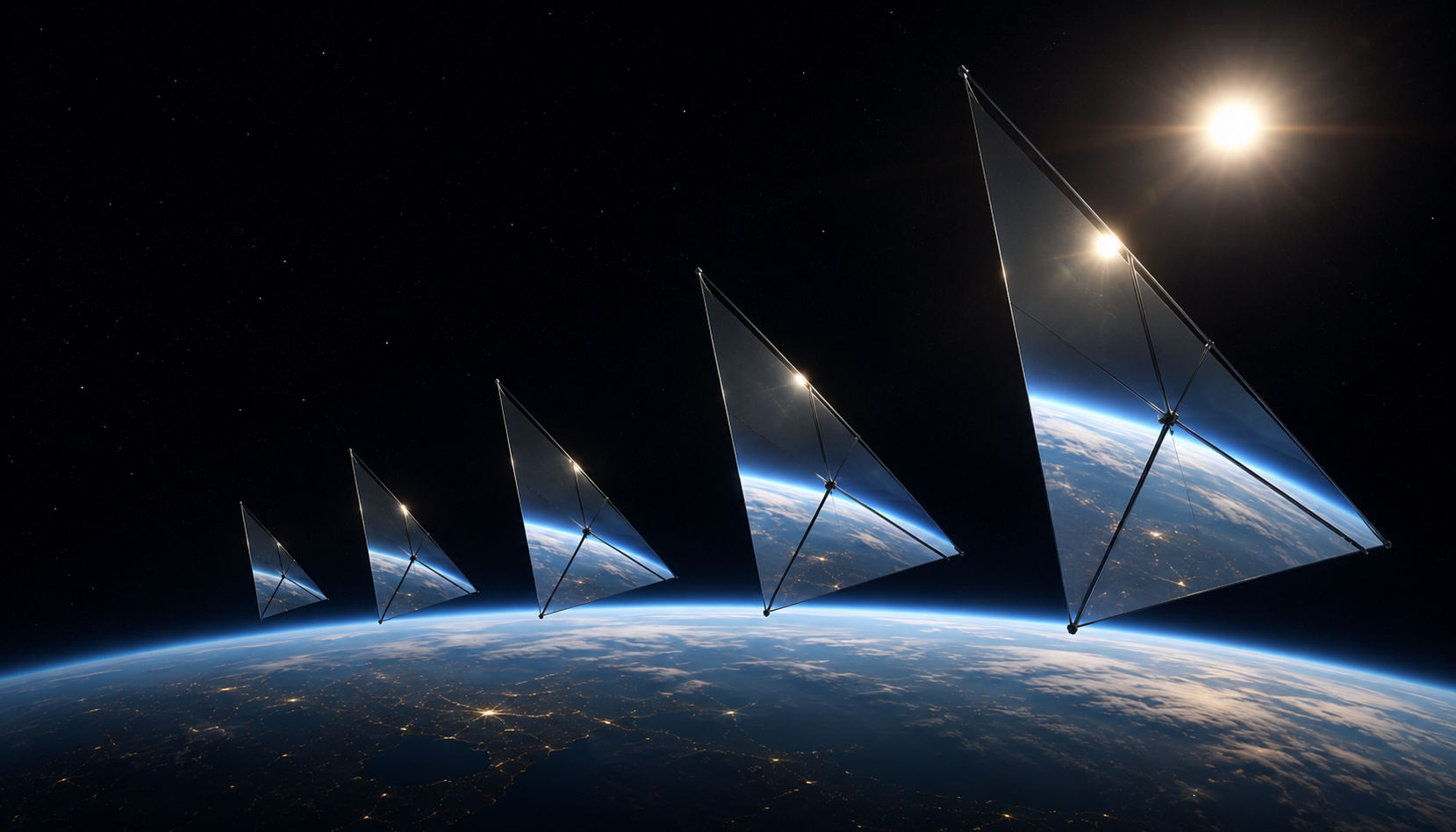
The American company Reflect Orbital plans to launch tens of thousands of satellites fitted with large mirrors that will reflect sunlight back to Earth after sunset. A ground-based demonstration of the future technology has already been carried out in California, illuminating part of the desert in the middle of the night. The project envisages the creation of a constellation of over 50,000 satellites by 2035, but astronomers and environmentalists warn that such a system could alter the appearance of the night sky and harm the natural environment.
- The American start-up Reflect Orbital is developing satellites fitted with mirrors to illuminate the Earth at night.
- In California, the company demonstrated the future effect using ground-based spotlights.
- The first orbiter will have a mirror with a diameter of around 18 metres.
- By 2035, the company plans to establish a constellation of more than 50,000 satellites.
- Astronomers are concerned about light pollution, which could hinder observations of space.
An unusual light appeared in California in the middle of the night
Residents of the area near the town of Lone Pine in California witnessed an unusual sight: a bright light appeared over the desert during the night, illuminating a large part of the area.
The demonstration was organised by Reflect Orbital. The company has installed powerful floodlights near Mount Whitney in the Sierra Nevada mountain range to demonstrate how satellite-based lighting will work in the future.
The light turned out to be so bright that some local residents described it as blinding. At the same time, company representatives compared the lighting to the brightness of a full moon.
It was merely a ground-based simulation. Real orbital mirrors had not yet been used, but the experiment demonstrated what night-time lighting might look like without conventional streetlights near the area being illuminated.
How will mirrors that reflect sunlight work?
The idea behind Reflect Orbital is to use satellites fitted with large deployable mirrors capable of directing sunlight onto specific areas of the Earth’s surface.
Even when night has already fallen in a particular location, a satellite in orbit may, under the right conditions, remain illuminated by the Sun. By tilting the mirror at the correct angle, it will reflect some of the sunlight downwards.
First demonstration The Earendil-1 satellite will have a mirror with a diameter of approximately 18 metres. It is planned to be used at an altitude of around 625 kilometres. The light spot on the Earth’s surface will have a diameter of approximately five kilometres.
In July 2026, the US Federal Communications Commission authorised the company to operate its first demonstration satellite.
However, a single satellite will not be able to illuminate the city throughout the night. Due to its rapid orbital movement, it will remain over a specific area for only a few minutes. To provide illumination for a longer period, a large number of satellites will be required, which will take turns directing light towards the Earth.
According to Reflect Orbital’s plans, the constellation is set to exceed 1,000 satellites by 2028, 5,000 by 2030 and 50,000 by 2035.
The company plans to use the technology to provide lighting for rescue operations, industrial sites, agricultural areas and large-scale events. Another area of focus is ensuring that solar power stations continue to operate after sunset.
At the same time, the economic viability of this method of energy generation has not yet been proven. A significant increase in electricity generation would require much more intense illumination than a single demonstration satellite is capable of providing.
Astronomers warn of a threat to the night sky
Reflect Orbital’s plans have raised concerns amongst scientists and environmental organisations.
DarkSky International, an international organisation dedicated to protecting the night sky from light pollution, has spoken out against the project in its current form.
Experts warn that a large number of orbital mirrors could significantly increase the brightness of the night sky. This would make it more difficult for ground-based telescopes, which use extremely sensitive instruments to observe distant galaxies, to carry out their work, stars and others space objects.
There are additional risks associated with wildlife. Artificial lighting at night can disrupt bird migration, the navigation of nocturnal insects, animal behaviour and the natural cycles of plants.
A particular cause for concern is the possibility of sudden, bright flashes, which could pose a danger to pilots and drivers.
In August, DarkSky International, together with other environmental organisations, called on the US regulator to review the authorisation for Reflect Orbital’s first satellite.
The company assures us that it plans to direct the light only towards approved areas, avoiding observatories and nature reserves, and to provide for the option of dimming or switching off the lighting.
On 14 October, Reflect Orbital announced the acquisition of two launch slots from the space company Skyroot Aerospace for the deployment of future spacecraft. The timeline for the full-scale implementation of the project will depend on the results of testing and subsequent regulatory approvals.