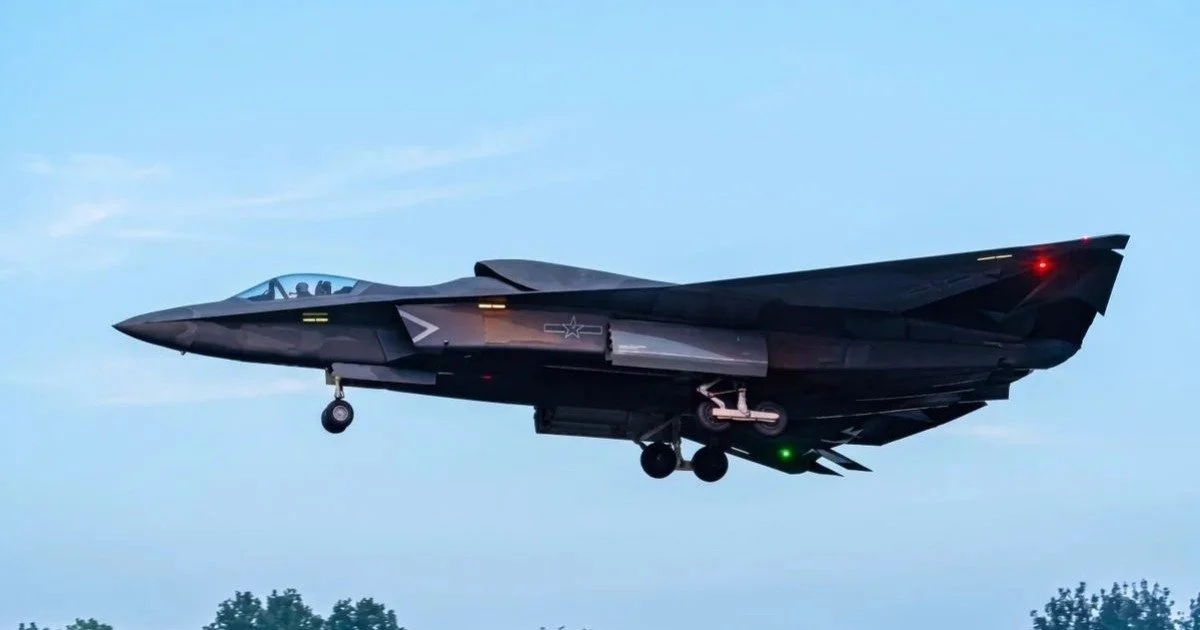
China has once again spotted the promising tailless J-36 aircraft during a test flight, whilst AVIC has unveiled a laser weapon guidance and tracking system for combat aircraft. The specifications in the promotional material suggest a power output of 100 kW, though there has been no public confirmation that this system has been fitted to the J-36 or that it has undergone in-flight testing.
Briefly about the main points
- The J-36 has been spotted again during a test flight in China.
- According to publicly available information, up to five prototypes may take part in the programme.
- AVIC has unveiled a laser guidance and tracking system for combat aircraft.
- The marking «*00 kW» may indicate that the complex has a capacity of 100 kW or more.
- The installation of a laser on the J-36 and the flight tests have not been confirmed.
Work is continuing on refining the design of the J-36
J-36 — an unofficial designation for a large Chinese fighter aircraft, the development of which is believed to be linked to the Chengdu Aircraft Corporation. The aircraft was first spotted over Chengdu in December 2024. The aircraft features a tailless configuration, three engines, a large delta-shaped wing and internal weapon bays.
According to publicly available information, up to five prototypes could have taken part in the programme. Differences were observed across the various vehicles in terms of air intakes, chassis, engine nozzles and the nose section. The exact status of each prototype has not been officially disclosed, but such changes suggest that various technical solutions are being tested.
Given its dimensions and configuration, experts regard the J-36 as a platform for long-range strikes, gaining air superiority and other complex missions. Jane’s notes that the programme may require an extended testing period before a possible move to mass production.
AVIC has demonstrated laser guidance for a combat aircraft
New information about a potential aviation incident laser weapons were showcased at the China International Defence Electronics Exhibition, which took place in Beijing on 15–17 September. The Beijing Precision Engineering Institute for Aircraft Industry, part of AVIC, presented a system whose name can be translated as «laser weapon tracking and guidance system for combat aircraft».
In the promotional material, the system was shown alongside an image of an aircraft resembling the J-36. The power output was labelled as «*00 kW»; if the hidden symbol is a number, this refers to 100 kW or more. According to Defense Express, the system weighs around 360 kg, whilst other publications cite a figure of less than 380 kg.
These estimates do not clarify whether the mass figure takes into account the entire system, including the power source and cooling system. The range, endurance and other parameters required to assess the system’s combat capabilities have not been disclosed.
A large platform could simplify the integration of energy weapons
If successfully integrated, the laser could provide an additional means of protecting the aircraft against drones and missiles. Its potential role is to destroy or disable the target’s optical and infrared sensors and, under favourable conditions, to damage individual components of the target.
A fully-fledged airborne weapon requires sufficient power generation, heat dissipation, precise beam guidance and stable target tracking during manoeuvres. The J-36’s substantial dimensions theoretically provide more space for generators, cooling systems and electronics, whilst its three engines can provide a significant power reserve.
A demonstration of the system does not mean that the combat system is ready for service. The laser’s true capabilities can only be assessed once there is evidence of its integration onto an aircraft, flight tests have been carried out, and the system’s actual performance has been established.