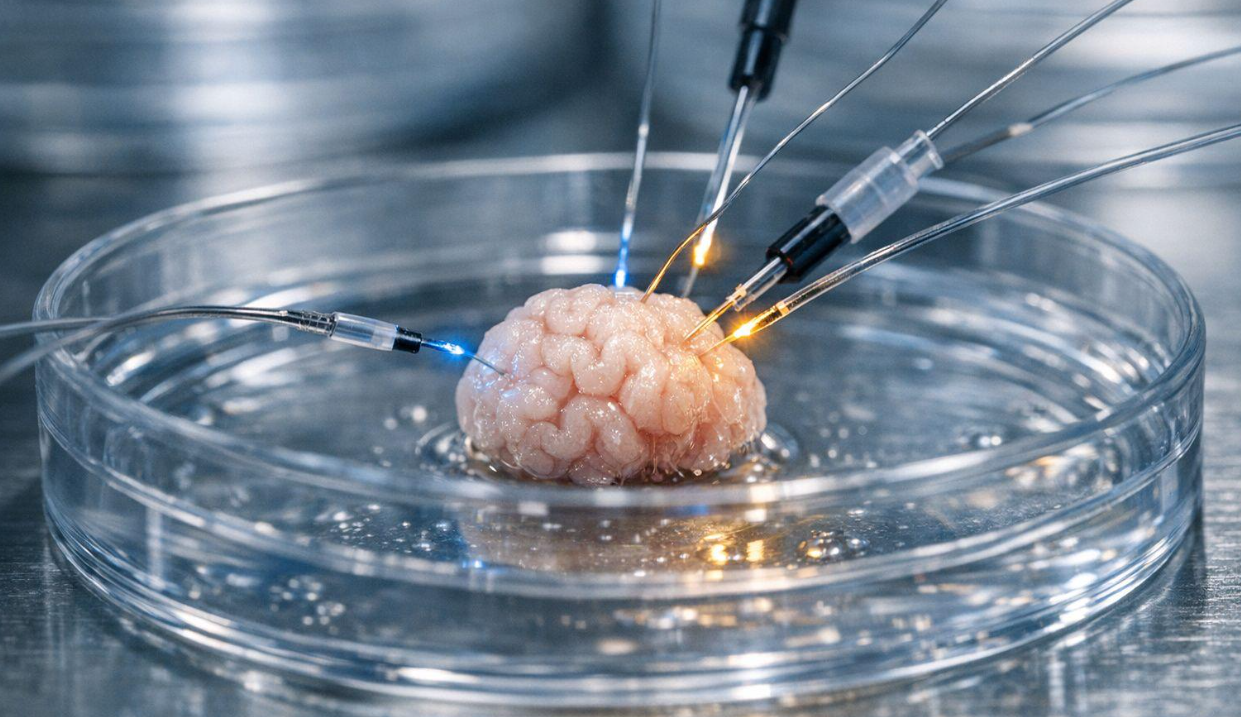
British scientists carried out an unusual experiment in which they connected miniature structures of the human brain, grown in a laboratory, to a computer system and used them to process information. The living neurons received electrical signals corresponding to Braille characters, and a special algorithm identified the symbols based on the cells« activity. When the researchers combined the signals from three such »mini-brains’, the recognition accuracy reached 83%. The findings of the University of Bristol researchers were published on 16 October 2026 in the scientific journal Frontiers in Artificial Intelligence. This discovery could be a step towards creating computers that combine electronics with living neurons.
A system using living neurons has been developed in the UK
Researchers at the University of Bristol have demonstrated the ability to transmit information from electronic sensors to living neural structures grown in the laboratory. The experiment utilised so-called brain organoids — three-dimensional clusters of cells that replicate certain features of the human brain. Each such organoid is less than one millimetre in diameter and contains around 10,000 neurons, along with supporting cells.
Despite the name «mini-brains», these structures are not fully-fledged brains. They do not have the complex structure of the human brain and do not exhibit conscious thought. However, the neurons within the organoids are capable of exchanging electrical impulses and responding to external stimulation.
It was precisely this property that the scientists used to test whether it was possible to transmit information through a living neural network and then recognise it using a computer.
How «mini-brains» helped people read Braille
Braille — a writing system in which letters are represented by combinations of raised dots. It is used by people with visual impairments. Scientists chose this system for their experiment because each symbol has a distinct tactile pattern that can be detected by a sensor.
Researchers have devised a sequence for processing information:
-
A robotic tactile sensor read the raised letter combinations of the 26 letters of the English alphabet.
-
The computer converted the data it received into electrical signals.
-
The pulses were transmitted via electrodes to living brain organoids.
-
The neurons responded to stimulation by generating characteristic electrical signals.
-
The machine learning algorithm analysed this activity and determined which letter it corresponded to.
Thus, the information passed through a living neural structure, and the computer reconstructed it on the basis of the recorded cellular responses.
It is important to note that the organoids themselves did not consciously read the symbols. They responded to electrical stimuli, whilst the recognition was carried out by a computer programme.
Brain organoids have improved recognition accuracy to 83%
One of the most interesting findings of the experiment was the difference between the functioning of a single organelle and that of three organelles functioning simultaneously.
Accuracy of Braille character recognition

Results of a laboratory experiment conducted at the University of Bristol, 2026.
When the researchers used a single organoid, the computer correctly classified approximately 61% characters.
After combining the results from the three organoids, the accuracy increased to 83%.
Researchers are not yet able to definitively explain the reason for this improvement. One hypothesis is that different neural structures respond differently to the same signals. Their responses may complement one another, enabling the algorithm to recognise information more accurately. At the same time, individual differences between organelles complicate the creation of stable and predictable biological computing systems.
Living neurons helped distinguish signals from noise
In a follow-up experiment, the researchers deliberately introduced artificial noise into the signals. The aim was to test how reliably the system recognises symbols when the information is distorted.
The researchers compared two methods of data processing: direct recognition by a computer and the classification of signals after they have passed through living neural structures.
The result was unexpected. The system with three organoids coped better with certain types of artificial interference than the algorithm that processed the distorted electrical signals directly.
This suggests that the response of a living neural network can retain useful information even in the presence of noise. However, this result has so far only been confirmed for a specific laboratory task. It does not mean that biological computers already outperform traditional electronic systems.
Why do scientists want to build computers using living cells?
The main aim of such research is to develop biohybrid computing systems.
Modern computers use silicon processors, whilst the human brain processes information using a complex network of neurons. One of the advantages of the biological brain is its energy efficiency. According to scientists’ estimates, the human brain consumes approximately 20 watts of power. At the same time, large artificial intelligence computing systems require significantly more energy. This is precisely why researchers are exploring the possibility of using living neurons as additional computing elements.
In the long term, such technologies may find applications in robotics, sensor signal recognition systems and experimental computing platforms. However, in the current study, the researchers did not measure the biohybrid system’s energy efficiency. Furthermore, living cells require a specialised environment, nutrients and equipment to sustain their vital functions.
Can living «mini-brains» learn to think?
The authors of the study emphasise that the experiment did not prove that organelles are capable of independent learning. The neural structures received signals and responded to them; however, the researchers were unable to determine whether their behaviour changed as a result of accumulated experience.
The next stage will involve testing the organelles’ responses to more complex tactile stimuli. In particular, the researchers plan to use different textures, the edges of objects and other tactile characteristics.
In the long term, they aim to create a closed-loop system with feedback, in which the neural network will receive information about the outcome of its own response. This will make it possible to test whether such biological systems are capable of modifying their responses based on previous experience.
At present, the research merely demonstrates the possibility of transmitting and storing information in living neural networks. Despite these limitations, the experiment has marked an important step forward in the study of the interaction between biological cells and electronic devices.