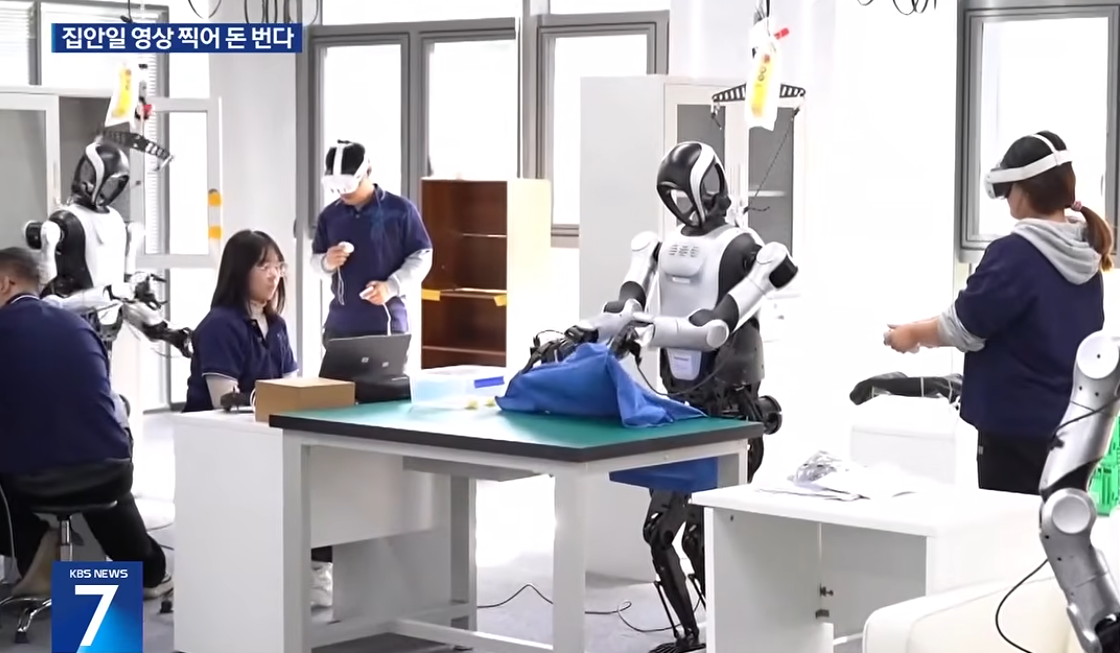
In South Korea, a new way of earning extra money is gaining momentum: residents are filming themselves carrying out everyday household tasks, so that they can then send these recordings to companies to train artificial intelligence robots. Whilst text-based chatbots have been trained using vast amounts of data from the internet, humanoid domestic robots are sorely lacking in real-life examples of how human hands hold a cup or fold clothes. That is precisely why developers are willing to pay ordinary people for first-person video recordings.
Briefly about the main points
- In South Korea, people earn money by filming themselves washing up, tidying up, ironing and doing other household chores on their smartphones.
- The company uses the uploaded recordings to train AI robots to perform precise hand and finger movements.
- Some services pay around 1,000 won for every 10 minutes of accepted footage, but rejected footage is not paid for.
- The humanoid training industry is growing rapidly following the opening of the KIMM specialised data centre in Korea and investments in AI running into the billions.
Why do robots need videos of ordinary cleaning?
To train humanoid robots, companies collect what is known as ‘first-person’ data — video footage shot from the perspective of the person themselves, who attaches their phone to their head or chest so that their hands remain in the frame at all times. As experts explain, expensive motion-capture suits were previously used for this purpose, but recording everyday videos on a smartphone has proved to be a significantly cheaper and more widespread method.
Once the videos have been uploaded to specialised apps, algorithms analyse the movement trajectories of the joints and fingertips and convert them into precise coordinates. Thanks to this, robots are learning to perform routine tasks that they were previously unable to handle — from chopping vegetables to folding laundry or tidying up the fridge.
How much do they pay for this, and what are the pitfalls?
According to Korean media reports, some platforms offer up to 1,000 won (around 34 hryvnias) for every 10 minutes of high-quality video, whilst active participants have reported earnings of around 50,000 won. In international markets, similar services can pay between $3 and $20–50 per hour, depending on the country and the complexity of the shoot.
At the same time, analysts at AI Business highlight a number of limitations to this form of income:
- Companies only pay for videos that have passed quality control — if hands are visible outside the frame or the lighting has changed, the work is not accepted;
- Participants are effectively giving third-party companies access to the interiors of their own homes and, as a rule, transfer the rights to use the recordings permanently;
- Payments are one-off, with no royalties payable for the subsequent commercial use of the trained models.
Demand for such datasets in South Korea is only growing. In November, the Korea Institute of Machinery and Materials (KIMM) launched the country’s first data factory, featuring 12 robots designed to handle domestic and industrial tasks. At the same time South Korea and Amazon are building a data centre to the tune of $5.2 billion, accelerating the development of the national AI infrastructure.