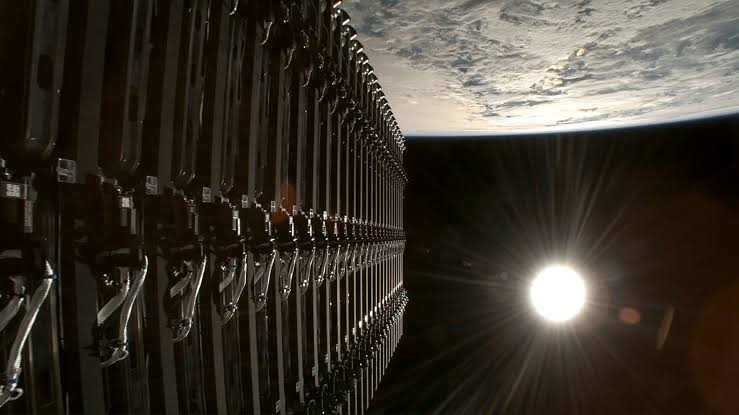
The US Federal Communications Commission (FCC) has approved SpaceX’s application to deploy a constellation of one million satellites in low Earth orbit to operate space-based artificial intelligence data centres. According to the regulator’s decision, published on 25 November, the Starmind project’s satellites will be positioned at altitudes ranging from 500 to 1,002 kilometres, and the company is due to complete the network by November 2040. The decision paves the way for moving energy-intensive computing into space, but has drawn sharp criticism from physicists, astronomers and rival operators due to the risks of space debris and the technical limitations of heat dissipation in a vacuum.
- The US Federal Communications Commission has authorised SpaceX to launch up to 1 million satellites into orbit for AI space data centres.
- A constellation known as Starmind will operate at altitudes of between 500 and 1,002 kilometres, with full deployment scheduled by 2040.
- SpaceX plans to power its orbital servers using solar energy and reduce the strain on Earth’s electricity grids and water resources.
- Scientists and competitors warn of the challenges of heat dissipation in space, the threat of space debris and the obstacles to astronomy.
Details of the FCC’s decision and the roll-out schedule
As stated in the official the FCC’s decision (Order DA-26-1273), the licence allows SpaceX to establish the first US orbital constellation of computing modules designed to process large data sets directly in space, with the results subsequently transmitted to Earth. The limit of 1 million units is a regulatory cap, not a guaranteed number of launches; however, the licence obliges the company to adhere to strict deployment milestones:
to launch and commission the first Starmind satellite no later than 25 November 2033 (although the company itself plans to begin deployment as early as 2028);
to place at least 100,000 spacecraft into orbit by November 2035;
to expand the constellation to 500,000 satellites by November 2038;
to complete the roll-out of the full network by November 2040.
The regulator has also postponed consideration of SpaceX’s request regarding alternative methods for disposing of spacecraft at altitudes above 600 km, insisting on compliance with current federal regulations on the prevention of space debris.
Why are data centres being moved into space?
Rapid development of artificial intelligence requires gigawatt-scale amounts of electricity and huge quantities of water to cool the servers, which is increasingly meeting with resistance from local communities in the US. SpaceX claims that, that Starmind satellites in sun-synchronous orbits will be able to receive almost continuous solar energy.
According to the technical documentation, each such unit will provide up to 250 kW of peak computing power, will be equipped with solar panels and deployable liquid radiators covering an area of over 100 square metres to dissipate heat into outer space, whilst data exchange between the modules will take place via laser optical channels. The company attributes the feasibility of large-scale launches to the reduced cost of payload delivery thanks to the reusable Starship rocket, which recently completed another test phase Starship rocket tests upon returning to the launch complex.
«Starmind and competing systems will use solar energy to strengthen America’s leadership in the field of superintelligence,» commented FCC Chairman Brendan Carr on the approval of the application.
Why are academics and competitors criticising the project?
According to the European Space Agency, As of mid-November 2026, there were around 19,770 satellites in Earth orbit, of which approximately 15,800 remained active (more than 11,000 of these were Starlink satellites). The deployment of a further one million objects will increase traffic density in orbit tenfold.
The scientific community and market participants point to a number of critical risks:
The physics of cooling in a vacuum: In space, there is no convection of air or water, so the only way to dissipate hundreds of kilowatts of heat from powerful AI chips is through thermal radiation from large heat sinks.
The snowballing increase in space debris: Any failure of the control system on such a large number of spacecraft increases the risk of collisions in low Earth orbits.
Light pollution in the night sky: The American Astronomical Society (AAS) has stated that it is «disappointed and dismayed» by the FCC’s decision, as Starmind’s large, bright satellites will remain visible in the sky for a long time and will interfere with the work of ground-based observatories.
Realistic deadlines: Rival operators, notably Amazon (the Kuiper/Leo project) and Viasat, have called for the application to be rejected, pointing out that, at the current rate of launches, it could take centuries to build such a constellation.
At the same time, space computing is emerging as a new frontier in the technology race: Jeff Bezos’s company, Blue Origin, has already submitted its own application for 51,600 orbital data centres as part of Project Sunrise, whilst Google has begun orbital testing of its AI chips as part of the Project Suncatcher initiative.