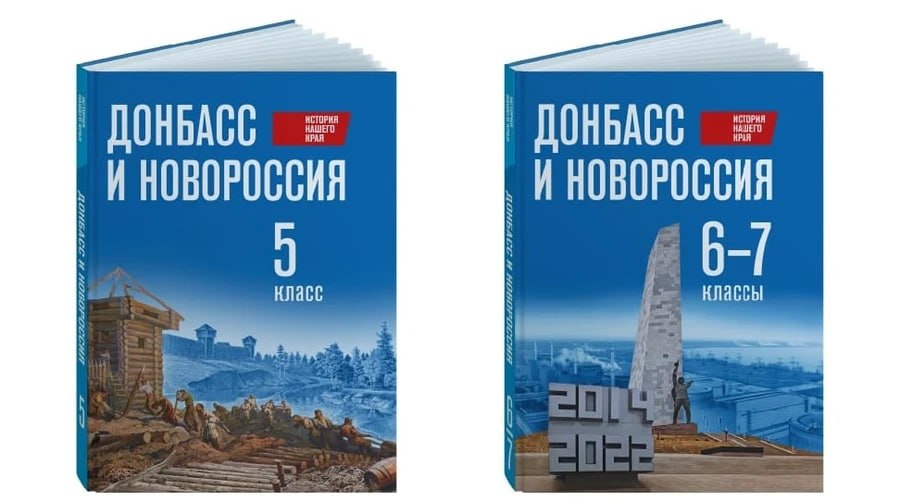
The Russian Ministry of Education has included the textbook *The History of Our Region: Donbas and Novorossiya* for pupils in Years 5–7 on the federal list. From 1 September 2026, the course is to be made compulsory in schools in the temporarily occupied territories of Ukraine. The textbooks present the history of Ukrainian regions through the lens of Russian imperial narratives and deny the circumstances of their occupation.
Briefly about the main points
- Russia has approved a separate course on «Donbas and Novorossiya» for schoolchildren.
- There is a separate edition for Year 5 and a combined edition for Years 6 and 7.
- ZMINA reported on the launch of the course, specifically in the occupied city of Melitopol.
- The manuals describe the occupied regions as territories that have allegedly «returned» to Russia.
- The UN has documented the replacement of the Ukrainian curriculum with a Russian one in the occupied territories.
The publications have been included in the federal list
The Russian ministry has updated the list of educational materials authorised for use in schools. The list includes two publications from the new curriculum: a separate book for Year 5 and a combined textbook for Years 6 and 7.
Inclusion on the federal list formally allows these books to be used in accredited Russian schools. Russian media, citing the Ministry of Education, reported that the books are due to be delivered to schools at the start of the new academic year.
The occupation is being portrayed as a «return» of territories to Russia
The Russian Ministry of Education has stated that the course covers the history of the Donetsk, Luhansk, Zaporizhzhia and Kherson regions from ancient times to the present day. Russia has occupied parts of these Ukrainian regions; its attempts at annexation are not recognised by Ukraine or the international community.
The textbooks treat these territories within the framework of the concept of so-called «Novorossiya», which Russian propaganda uses to justify its territorial claims against Ukraine. In the final chapters, the authors describe the period of Ukraine’s independence and the alleged «return» of the regions to Russia, glossing over the facts of armed aggression, occupation and illegal annexation.
There are plans to introduce the course in Melitopol and other occupied towns and villages
The ZMINA Human Rights Centre has reported that the new subject is to be taught, in particular, in schools in occupied Melitopol. Russian sources have also reported that textbooks are being supplied to other occupied towns and villages.
The Russian Federation’s Minister of Education, Sergei Kravtsov, described the information contained in the books as «objective» and declared the course compulsory in schools in the occupied territories. During the presentation, Vladimir Medinsky, an aide to the Russian President, stated that the materials had been edited by Dmitry Medvedev, Deputy Chairman of the Russian Security Council, and denied that the publications were of a propagandistic nature.
The new subject complements the replacement of Ukrainian education with Russian education
Human rights organisations describe compulsory education based on Russian curricula as part of a policy the destruction of Ukrainian identity. According to their reports, Ukrainian books, symbols and educational programmes are being removed from schools, whilst Russian textbooks, propaganda lessons and military training are being introduced.
The UN Human Rights Monitoring Mission has noted that the Russian curriculum replaced the Ukrainian one in all schools in the occupied territories as early as the 2022/23 academic year. According to the UN, narratives justifying the war and glorifying the Russian military have been incorporated into the curriculum and extracurricular activities. A separate course could further strengthen the integration of the occupied territories into the Russian educational and ideological sphere.