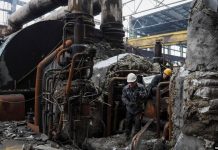
Years of Russian attacks have damaged Ukraine’s energy infrastructure to such an extent that it will no longer be possible to restore it to its pre-war condition through repairs alone. The situation is particularly dire in Kyiv and the Kyiv region, where high-voltage substations – which transmit electricity from power stations to consumers – have suffered significant damage. This was stated by Yuriy Korolchuk, an energy expert and co-founder of the Energy Strategies Foundation.
Russian strikes have forced Ukraine to change its electricity supply system three times
According to Korolchuk, since the start of the full-scale invasion, the energy sector has been forced to repeatedly restructure the electricity transmission and distribution system to compensate for the loss of damaged equipment.
The expert claims that new electricity supply plans were drawn up in 2022, 2024 and 2026. However, even the most recent of these had to be amended due to further Russian attacks.
«Three schemes were drawn up — in 2022, 2024 and 2026. The scheme that was being developed this year has already had to be amended,» said Korolchuk.
In his view, the power system is gradually losing its ability to transmit electricity in the volumes that were possible before the large-scale damage. Emergency repairs and the temporary rerouting of electricity flows help to keep the system running, but do not always restore the equipment to its original specifications.
Why have substations become the biggest problem in the Kyiv region?
Korolchuk had previously pointed out that one of the most vulnerable elements of the capital region’s power system remains high-voltage substations «Ukrenergo».
It is these that ensure the transmission of large volumes of electricity between regions and its subsequent delivery to distribution networks. Therefore, even where there is sufficient generation capacity, damage to substations can limit the ability to deliver electricity to consumers.
The situation is exacerbated by repeated shelling of facilities that have already undergone emergency repairs. Some of the damaged equipment requires not just routine repairs, but major refurbishment or replacement.
According to an expert’s assessment, the capital’s energy infrastructure sustained particularly severe damage during the 2025–2026 heating season. Restoration work is being hampered by a shortage of specialised equipment, a lack of funding and the constant threat of further attacks.
Damage to Kyiv’s energy infrastructure is also affecting the western regions
Korolchuk emphasises that Ukraine’s power system operates as a single grid. Consequently, the destruction of individual electricity transmission nodes causes problems far beyond the regions that were directly hit.
«One cannot assume that attacks – even if they are, for the sake of argument, limited to Kharkiv, Kyiv, the Kyiv region, Dnipro and Odesa – do not affect western Ukraine. They do have an impact, because the country has a single power grid,» the expert explained.
Damage to large substations limits the ability to redistribute electricity between regions. As a result, grid capacity shortages may arise even in areas where power stations and local infrastructure have not suffered direct damage.
What is happening with the electricity supply on 3 November?
The expert’s statement came against the backdrop of yet another large-scale Russian attack on Ukraine’s energy sector.
According to a report from NEC «Ukrenergo», as of the morning of 3 November, further power cuts resulting from bombardments were recorded in the Vinnytsia, Odesa, Zhytomyr, Kharkiv and Poltava regions.
In some regions, hourly power cuts are still being implemented, and in difficult circumstances, emergency restrictions are being imposed. Schedules may change over the course of the day depending on the state of the power grid.
At the same time, Korolchuk’s assessment does not imply that restoring a stable electricity supply is impossible. The main issue is the loss of the previous technical specifications of certain parts of the grid and the need for large-scale modernisation rather than temporary repair solutions.
According to the State Energy Regulatory Authority, between April and September 2026, specialists carried out 101 inspections of repair and emergency restoration work at Ukrenergo’s substations. The agency emphasised that preparing energy facilities for winter does not always mean that it is possible to fully repair all damage.