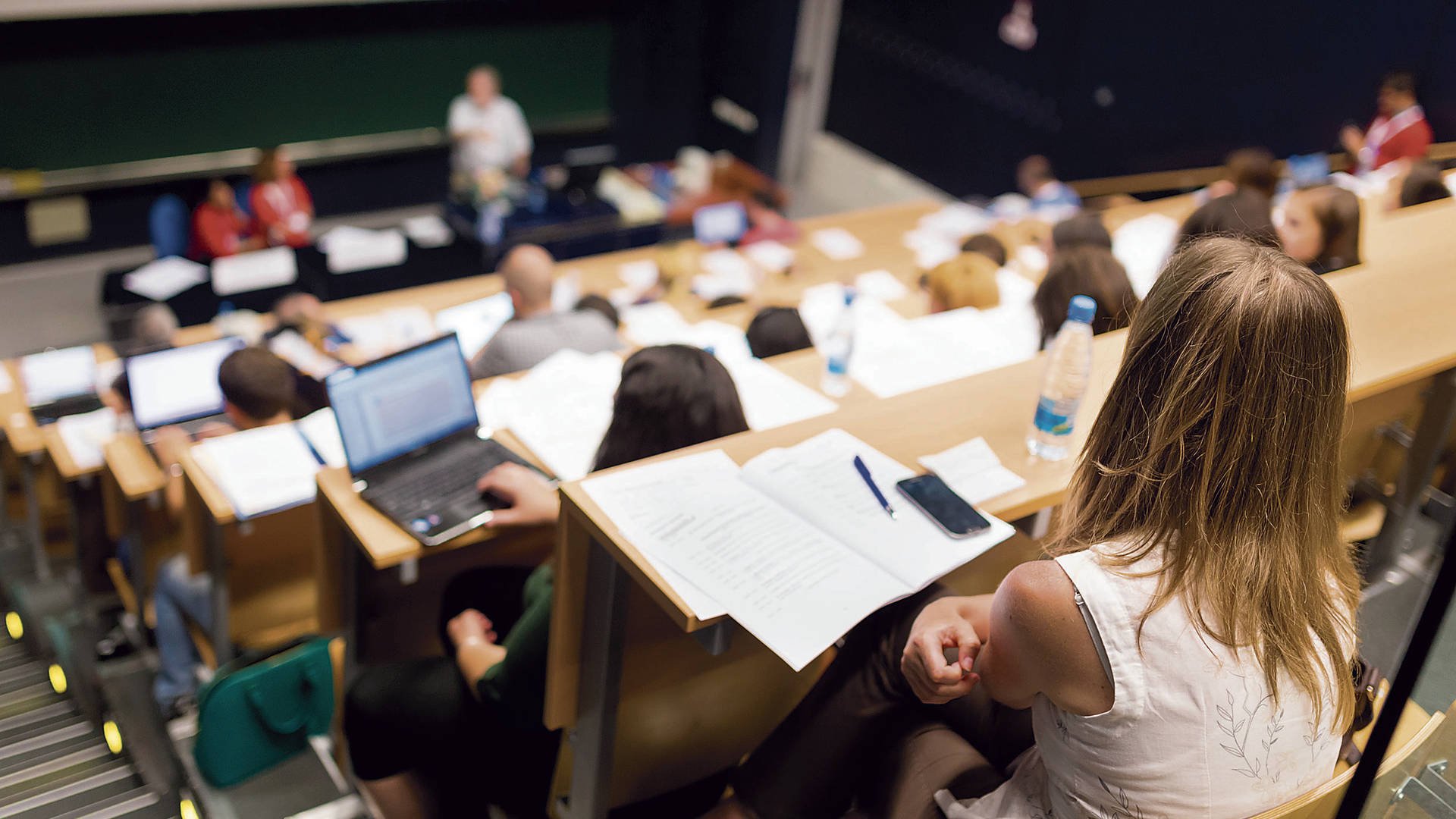
The Ministry of Education and Science has recommended that higher education institutions consider condensing the academic calendar for the 2026–2027 academic year. Universities may use Saturdays for classes in the autumn and spring, and, if necessary, extend the academic year into the summer of 2027. This option does not apply to final-year students.
Briefly about the main points
- The Ministry of Education and Science has issued recommendations, but has not introduced compulsory Saturday schooling.
- Universities are being asked to tighten up their timetables in the autumn and spring.
- Studies may continue during the summer only for non-final-year courses.
- Classes, practical sessions and assessments may be conducted remotely.
- For face-to-face teaching, the capacity of the shelters should be taken into account.
The calendar can be adapted to the conditions of the autumn and winter months
In a letter dated 20 August, the Ministry of Education and Science suggests that heads of educational institutions consider this approach to organising the educational process on their own initiative. The Ministry links these recommendations to preparations for the autumn-winter period, minimising learning losses and ensuring the safety of learners.
Where necessary, lectures, practical training, assessments and individual assignments may be conducted remotely. It is recommended that classrooms be used for those types of classes or educational components that cannot be organised effectively and to a high standard online.
The Ministry of Education and Science also recommends digitising teaching content as much as possible so that students have asynchronous access to recorded lectures, laboratory sessions and self-assessment tools.
Universities are being advised to develop energy-independent solutions and change the way buildings are used
In the event of a critical shortage of energy resources, institutions are advised to prioritise their material and technical resources. Teaching, the operation of support services and student accommodation – particularly for orphans and those from temporarily occupied territories – may be concentrated in the most secure and energy-efficient buildings. It is recommended that unused spaces be temporarily mothballed.
Separately, the Ministry of Education and Science proposes moving away from the use of individual generators towards system-based solutions energy independence: hybrid solar power stations, industrial energy storage systems and uninterruptible power supply systems for server and communications equipment.
Establishments are also advised to ensure they have backup power supplies, fuel reserves, and that their heating, lighting, drainage and water supply systems operate reliably.
The in-person format should depend on the capacity of the shelters and the readiness of the warning systems
If a higher education institution delivers teaching in a classroom-based or blended format, it must take into account the design capacity of its civil defence shelters. For the purpose of holding individual classes, the shelters must meet the minimum requirements for the organisation of the educational process.
The Ministry recommends upgrading protective structures into dual-purpose shelters where certain classes can be held on a continuous basis. This requires adequate ventilation, self-contained lighting, communications and heating.
In teaching blocks and halls of residence, local warning systems for «Air Raid» alerts and other relevant signals must be kept in good working order. Separately, universities are advised to regularly back up critical data and to use secure cloud services for electronic resources.
The Ministry of Education and Science proposes involving local communities and stepping up psychological support
Higher education institutions are advised to maintain contact with local authorities, communities, businesses, cultural and sports organisations, enterprises and other educational institutions. Such arrangements may enable the use of suitable premises for teaching on the basis of cooperation agreements or tenancy agreements.
The Ministry of Education and Science also proposes integrating psychological support for students and staff, aimed at preventing occupational and academic burnout amidst prolonged stress and uncertainty. The letter identifies the safety of students and staff as a shared priority.