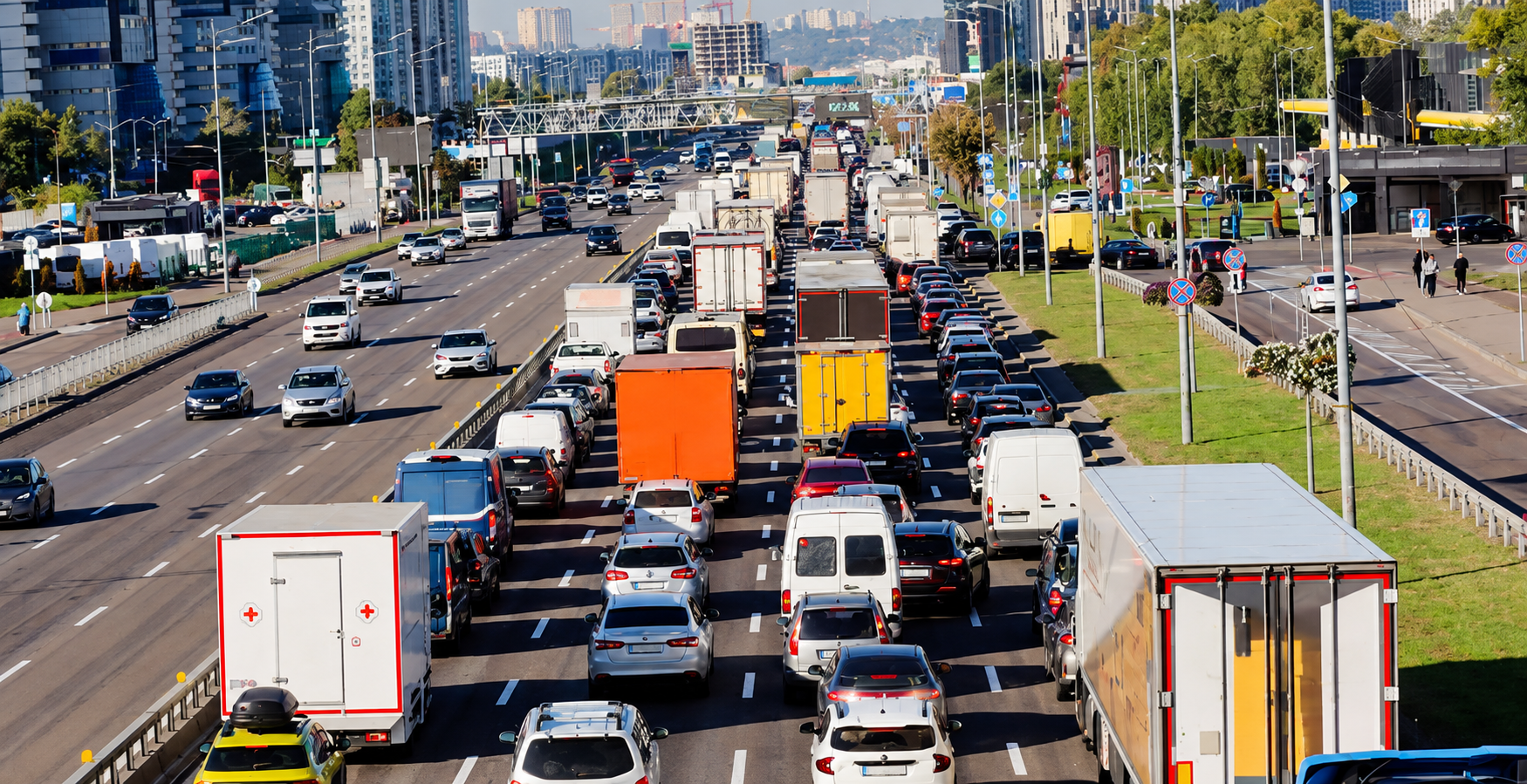
On the morning of 2 October, a major traffic gridlock occurred in Kyiv after traffic was restricted on several bridges across the Dnipro. The South Bridge was completely closed in both directions following renewed Russian strikes; traffic on the Paton Bridge was also significantly restricted; and on the Metro Bridge, only partial access towards the right bank was permitted. Traffic flows of cars and public transport were diverted to alternative routes, resulting in massive traffic jams on the left bank and on the approach roads to the crossings. At the same time, demand for taxis soared: individual journeys between the banks via Uklon and Bolt cost over 1,000–1,800 UAH.
- The South Bridge in Kyiv was completely closed in both directions on the morning of 2 October.
- Traffic has also been restricted at the Paton Bridge and the Metro Bridge.
- Due to the diversion of traffic, the city was brought to a standstill by massive traffic jams.
- The South Bridge was attacked several times by Russian UAVs the day before.
- Some bus routes have been diverted via the Darnytsia Bridge.
Kyiv was brought to a standstill by massive traffic jams
The most difficult situation arose on the routes between the left and right banks of the Dnipro. The Southern Bridge was completely closed to traffic; on the Metro Bridge, passage from the left to the right bank was significantly restricted; and on the Paton Bridge, additional road closures were in place. Major traffic jams formed on the Dnipro embankment, in Osokorky, Pechersk and on the approach roads to the accessible bridge crossings. Dozens of people gathered at public transport stops.
Due to the closure, traffic began to concentrate on the Darnytsia Bridge and other accessible bridges. Buses No. 22 and No. 91, which usually use the South Bridge, were rerouted via the Darnytsia Bridge. Buses Nos. 51, 55, 115 and 118-D were also diverted there, which further increased the load on the crossing. Some trolleybuses were operating on shortened routes.
Local media reported that traffic was moving so slowly that some passengers got off the vehicles and continued on foot. The situation was exacerbated by the fact that the restrictions coincided with the morning rush hour, when tens of thousands of people traditionally travel from residential areas on the left bank to the centre and business districts of Kyiv.
The South Bridge came under a series of attacks
The most severe restrictions were caused by Russian attacks on the South Bridge. On 1 October, two drones struck near its support structure. Following an initial inspection, no critical damage to the structure was found at the time, and public transport services were able to resume during the day.
During one of the explosions, a train on the Syretsko-Pecherska metro line was travelling across the bridge. As a result of the blast wave, dust and debris from the explosion entered the carriages via the ventilation system. The passengers and the driver were unharmed, and the train was subsequently sent to the depot for inspection.
However, on the evening of 1 October, a Russian UAV for the third time that day struck the South Bridge. Vitali Klitschko reported that the vehicle had struck the road surface. According to preliminary information, parts of a bridge pier, a crash barrier, the road surface and a concrete metro barrier were damaged. Metro and surface transport services were then suspended once again.
On the night of 2 October, the following was recorded Another hit on the South Bridge, after which it was decided to completely restrict traffic across the crossing in order to inspect the structures and deal with the aftermath of the attack.
Taxi fares have shot up instantly
The transport chaos had an immediate impact on taxi fares. Due to the huge demand, long journey times and a limited number of routes, fares for cross-strait journeys rose sharply.
According to Ukrmedia, on 2 October, the trip A ride from the «Poznyaki» metro station to Khreshchatyk cost around 998 UAH, whilst the Comfort fare is approximately 1,123 UAH. From «Osokorky» to Obolon, the service showed a price starting from 1,191 UAH to 1,856 UAH depending on the class of vehicle.
The situation was similar with Bolt. A journey from «Poznyaki» to Khreshchatyk cost approximately 924–1,324 UAH, and from «Osokorky» to Obolon — 1,174–1,699 UAH. Even a journey from Khreshchatyk to «Chervonyi Khutir» could cost between 504 and 724 UAH.
This sharp increase is due to the mechanism of dynamic pricing. The services automatically raise their fares when the number of bookings rises and the number of available drivers falls at the same time. Bolt It officially explains that during periods of high demand, the cost of a journey may increase, and that the final price is also affected by traffic congestion and the length of the route.
Everyone is travelling via the available crossings
Restrictions on several bridges at once effectively created a «bottleneck» for traffic between the two banks. A significant number of buses and private cars were forced to use the Darnytsia Bridge, whilst other drivers sought alternative routes via the Pivnichnyi and Podilskyi crossings.
However, the alternative route did not mean a quicker journey. A large number of cars diverted onto the same available main roads, so traffic jams began to spread far beyond the bridges themselves — onto avenues, embankments and roundabouts.
Meanwhile, the city commuter train and the Kyiv City Express continued to run between the two banks according to their usual timetables, so for some Kyiv residents, the rail service became one of the few ways to avoid traffic jams.
The restrictions remain temporary
The Kyiv authorities emphasise that the transport restrictions are due to the need to inspect the condition of the bridges following the Russian strikes. Following the attacks, experts must assess the bridge piers, the road surface, protective structures and elements of the underground infrastructure.
Therefore, traffic conditions may change throughout the day depending on the results of the survey. Drivers and passengers are advised to check the latest public transport routes before setting off and to allow considerably more time for their journey.