
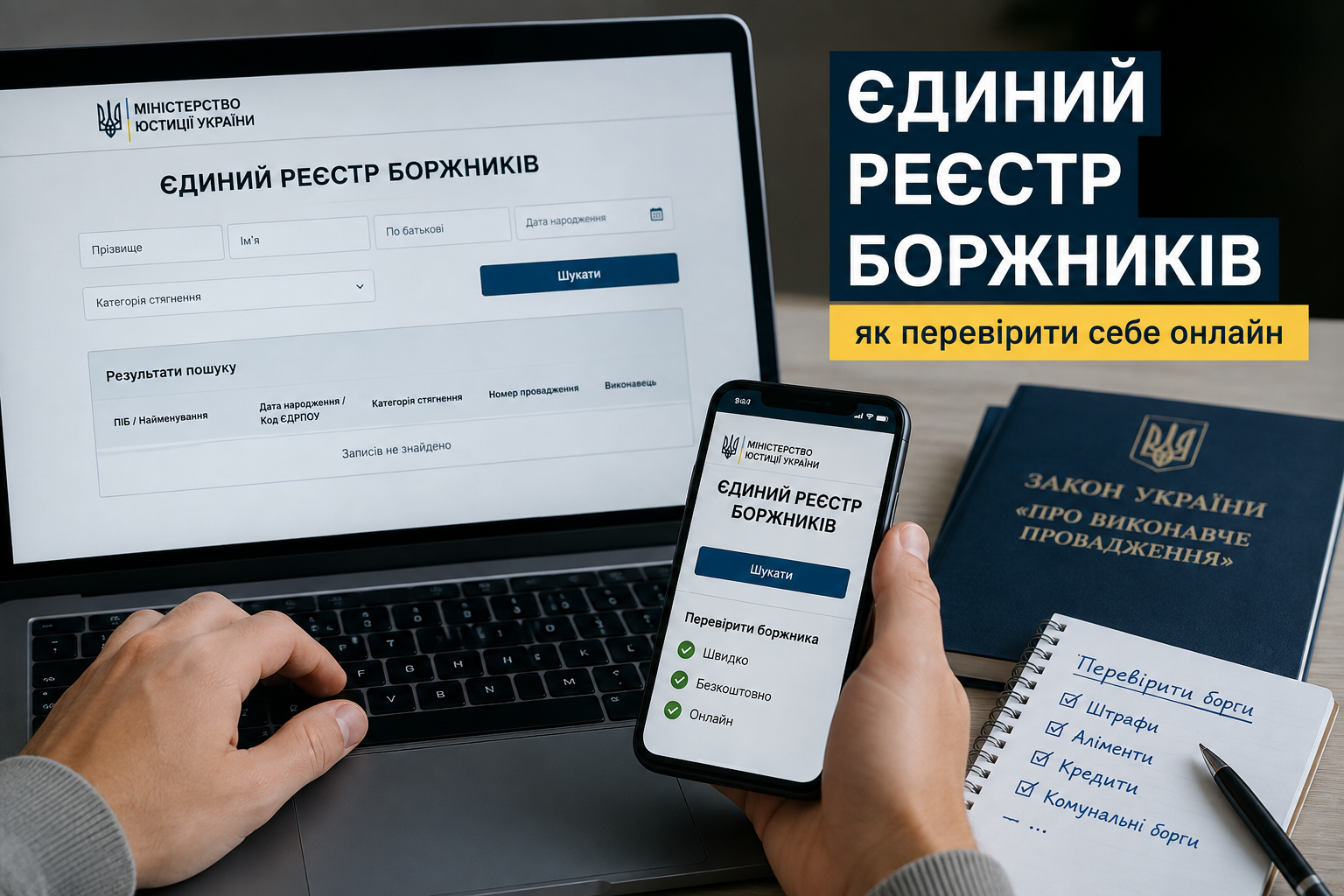
The Unified Register of Debtors is one of the most popular government databases for checking debts in Ukraine. In just a few minutes, you can find out whether enforcement proceedings have been initiated against a person or company, who is handling the case, and the reason for the debt recovery. However, the register is often misunderstood: the absence of a surname in it does not necessarily mean that a person has no loans, tax or utility debts. We explain how the Unified Register of Debtors actually works, who is included in it, and what to do if you find yourself listed in the register.
Briefly about the main points
- The Unified Register of Debtors is a public database.
- Data is entered into it once enforcement proceedings have been initiated.
- The register does not show all of a person’s potential debts.
- You can check yourself or your company online for free.
- The register shows the case number, the enforcement officer and the category of enforcement.
- Once the debt has been paid off, the record does not always disappear straight away.
What is the Unified Register of Debtors?
The Unified Register of Debtors, or URD, is a state-run electronic database containing information on debtors, which forms part of the Automated Enforcement Proceedings System.
Its purpose is set out directly in the Law of Ukraine «On enforcement proceedings»: the register was established to publish real-time information on outstanding financial obligations and to prevent debtors from disposing of their assets. The data in the Unified Register of Debtors is publicly available.
To put it simply, this is not a list of all Ukrainians who owe something to someone. Usually, a person ends up on this list when their debt has already reached the stage of enforcement and the enforcement officer initiated the relevant proceedings.
For example, grounds may include:
- an outstanding fine;
- debt arising from a court judgement;
- child maintenance arrears;
- enforcement of credit obligations following the receipt of an enforcement order;
- other property-related claims that have been referred for enforcement.
As a general rule, details of the debtor are entered into the Unified Register of Debtors at the same time as enforcement proceedings are initiated. The law provides for exceptions for certain categories.
How to check if you’re on the Debtors’ Register
Check free and does not require you to contact a government department.
The official service can be found on the Ministry of Justice’s website:
The Ministry of Justice’s Unified Register of Debtors
To search for an individual, you can use:
- surname;
- name;
- patronymic;
- date of birth;
- RNOKPP — tax number;
- category of penalty.
The Ministry of Justice explicitly states that these parameters are available for searching.
If a person has a common surname, it is best not to rely solely on their full name. A date of birth or tax identification number can help avoid a situation where the search results show another person with the same first name and surname.
You can check more than just yourself. As the information in the Unified Register of Debtors is publicly available, you can also search for other individuals and companies.
What information will the Register of Debtors show?
If the system identifies enforcement proceedings, the user sees more than just the debtor’s name.
For an individual, the register contains:
- Full name;
- date of birth;
- the authority or official who issued the enforcement order;
- a state enforcement agency or the details of a private enforcement agent;
- the contractor’s contact details;
- enforcement proceedings number;
- category of penalty.
For example, a category might specify «child support», «fine» or another type of penalty.
This is particularly useful if a person has first learnt of the issue from the register itself: the case reference number and the enforcement officer’s contact details enable them to ascertain the document on which the enforcement action is based.
A single person may, in this case, have several separate enforcement proceedings, and they will appear separately in the search results.
The debtors’ register does not show all your debts
This is the service’s most important feature.
If the search shows:
«No records found»
This should not automatically be interpreted as:
«I don’t have any debts at all.».
The EBRD is concerned with the enforcement of judgements, rather than with all of a citizen’s financial obligations.
For example, a person may have an overdue credit card payment, but the bank has not yet received an enforcement order. Or there may be an outstanding electricity bill for which the supplier has not yet sought enforcement.
In such cases, there may be no entry in the Unified Register of Debtors.
The following are therefore checked separately:
| Type of debt | Where to check |
|---|---|
| Enforcement proceedings | Unified Register of Debtors / ASVP |
| Loan liabilities | Credit Reference Agency |
| Tax debt | State Tax Service Online Portal |
| Traffic fines | Ministry of Internal Affairs Services / «Diya» |
| Utility bills | Suppliers’ personal accounts |
| Debt arising from a court judgement currently being enforced | EBRD / ASVP |
It is therefore best to view the Unified Register of Debtors as one of the key stages of a financial audit, rather than as a universal basis for all debts.
When a person is entered into the Unified Register of Debtors
Under the rules in force as of August 2026, in most property cases an entry is made at the same time as the order to commence enforcement proceedings.
But there are exceptions.
In particular, information concerning state bodies and local authorities is not entered into the Unified Register of Debts. There are also special rules governing periodic payments and non-property-related decisions.
For recurring payments, such as maintenance payments, the duration of the arrears is of significant importance: the information is recorded if the debt exceeds the sum of the relevant payments for three months.
A separate procedure applies to cases concerning access to a child and the removal of obstacles to such access. In this case, the entry is made after the enforcement officer has issued a penalty order for failure to comply with the relevant decision.
How does the Debtors’ Register differ from the ASVP?
These two services are often confused.
Unified Register of Debtors first and foremost, it answers the question:
Is this person a debtor in enforcement proceedings?
А Automated Enforcement Proceedings System — AEPS is used specifically to obtain information about enforcement proceedings.
Official service:
Automated enforcement proceedings system
The Ministry of Justice states that information on whether enforcement proceedings are in progress can be checked online via both services.
The parties to enforcement proceedings also have access to more detailed information via access ID, as specified in the relevant enforcement proceedings documents. You can use the system to view information on the progress of the proceedings and the documents involved.
So, if you find your name listed in the Unified Register of Debtors, the next step is to check the enforcement proceedings themselves.
What to do if you find your name on the Debtors’ Register
The mere fact that a surname appears in the register does not explain all the circumstances of the case.
First of all, it’s worth taking a look at:
- enforcement proceedings number;
- category of penalty;
- who is a public or private enforcement agent;
- the contractor’s contact details.
After that, you need to find out:
- On the basis of which document were the proceedings initiated?.
- What is the current amount due?.
- Were any seizures carried out?.
- How can the solution be implemented?.
- What steps are required to conclude the proceedings?.
You should not pay off a «debt» using bank details received in a random text message, Telegram message or on a third-party website simply because your surname appears in the register.
It is best to check the grounds and current details directly via the official systems or with the contractor.
Does an entry in the Register automatically result in the seizure of the cards?
Not exactly.
The Unified Register of Debtors and the freezing of bank accounts are two different things.
An entry in the register indicates that the relevant status exists within the enforcement system. The attachment of funds or other property constitutes a separate enforcement measure and is carried out in accordance with the procedure laid down by law.
Consequently, there may be situations where a person is already listed in the Unified Register of Debtors, but a specific account has not yet been frozen, or, conversely, where the enforcement officer has already taken further action as part of the proceedings.
That is precisely why it is not possible to ascertain the full status of a case from the entry in the public register alone.
Can you sell a flat or a car if you are on the Debtors’ Register?
One of the main aims of the EBRD is to prevent the debtor from transferring assets against which a judgement may be enforced.
Under the rules in force in August 2026, if a person listed in the Unified Register of Property Owners (URPO) approaches a notary, registrar or other authorised body to carry out an action relating to their property, that entity must notify the relevant state or private enforcement agent no later than the next working day.
What’s more, if property agreement If the debtor’s actions have rendered it impossible to satisfy the creditor’s claims out of that property, the law provides for the possibility of declaring such a transaction void.
But the rules will change this autumn.
From 23 October 2026, the rules for debtors will become stricter
In April 2026, Law No. 4833-IX on the digitalisation and modernisation of enforcement proceedings was passed.
At the time of writing, he has come into force only in part. The majority of the changes will come into force 23 October 2026.
Among the key changes is a significant strengthening of the role of the Unified Register of Debtors in property transactions.
Once the relevant provisions come into force, state bodies, local authorities, notaries and other entities specified by law will, as a general rule, be required, in the event of the disposal or pledging of property by a person listed in the Unified Register of Debtors, to, to refuse to carry out the relevant action and inform the contractor.
Ahead of the introduction of the new rules, the Ministry of Justice has already prepared a mechanism for electronic interaction between the State Register of Real Rights to Immovable Property and the Unified Register of Business Entities. The relevant procedure was adopted in July 2026, but its key provisions are due to come into effect alongside the new version of the law.
In fact, the process of checking a debtor’s status is increasingly shifting from manual information exchange to automated interaction between government systems.
How to remove yourself from the Unified Register of Debtors
An entry in the register is not deleted simply because a person has clicked the ‘pay’ button or reached an agreement with the debt collector.
A legal basis is required for the removal of information from the Unified Register of Enterprises.
Under current law, such information is, in particular, deleted at the same time as a decision is issued on termination of enforcement proceedings, as well as, in some cases, the return of the enforcement order to the claimant. For recurring payments, the entry may be removed once the enforcement officer has established that there is no outstanding debt.
In other words, the typical algorithm is as follows:
1. Find out the case number.
2. Contact the contractor.
3. Specify the total amount and the procedure for implementation.
4. Comply with the requirements of the enforcement order.
5. Ensure that the contractor has adopted the necessary resolution.
6. Check the Unified Register of Debtors again.
Sometimes a dispute arises precisely at the final stage: the principal debt has already been paid off, but the old entry remains on the records.
For certain old or returned enforcement documents, the law provides for a special procedure for the removal of an entry, in particular upon application by the debtor.
Therefore, if the debt was settled some time ago but the person is still listed in the Unified Register of Debtors, it is advisable to contact the enforcement agent specified in the register.
Why might a person be unaware of enforcement proceedings?
These things do happen.
There may be various reasons for this: the person’s address has changed; the notification was sent to their old address; the person did not check their online accounts; or they only found out about the decision after proceedings had already been initiated.
That is precisely why it makes sense to check the register yourself from time to time, even for those who are confident they have no debt problems.
This is particularly useful before:
- the purchase or sale of property;
- the sale of a car;
- the processing of large financial transactions;
- by applying to a notary;
- other transactions involving property.
The check takes a few minutes and can identify a problem in advance that would otherwise only come to light when the transaction is being finalised.
Are maintenance debtors included in the Register?
Yes.
Maintenance payments are one of the specific categories of enforcement that can be found in the Unified Register of Enforcement Proceedings. Under the current rules governing periodic payments, the key threshold is arrears of more than three months.
The existence of maintenance arrears may also have consequences beyond the enforcement proceedings themselves.
For example, in 2026, the Ministry of Justice reminded the public that having more than three months’ arrears in child maintenance payments could affect the eligibility of parents with multiple children for certain types of deferral from mobilisation. Data from state registers is used for automatic verification.
This shows that the ERB is gradually becoming not just a separate section of the Ministry of Justice’s website, but a source of data for other government information systems.
Is it possible to check a company before entering into a deal?
Yes, and that’s one of the practical ways of using the register.
For a legal entity, the following details are entered in the Unified State Register:
- its name;
- EDRPOU code;
- enforcement proceedings number;
- a body or a contractor;
- category of penalty.
For example, before making a large advance payment to a contractor or entering into a contract with a little-known company, you can check whether it is involved in any enforcement proceedings.
However, the mere fact that a company is listed does not automatically mean that it is fraudulent or insolvent. There may be various reasons for this — ranging from a single fine to a substantial sum following a court ruling.
It is therefore better to use the EBRD’s findings as an indication for further verification, rather than as a definitive assessment of the counterparty.
Is the Unified Register of Debtors free of charge?
Yes.
Checking the publicly accessible section of the Unified Register of Legal Entities on the Ministry of Justice’s official website is free of charge.
For a standard search, there is no need to purchase a report from a third-party service.
If a website offers to charge you simply to find a person in the «debtors» register’, you should first check whether it is a private aggregator that merely resells or reorganises publicly available government data.
The official search function is available directly:
Frequently asked questions about the Debtors’ Register
Does the fact that it is not listed in the register mean that there are no loans?
No. The loan may exist, but it may not yet be at the enforcement stage.
Will the EBRD disclose the exact amount of the debt?
The public register primarily displays details of the enforcement proceedings, their category and the enforcement officer. The current amount and details must be checked within the enforcement proceedings themselves.
Is it possible to test another person?
Yes. The data in the Unified Register of Businesses is publicly available in accordance with the law.
Will the entry disappear immediately after payment?
Not necessarily. The party responsible must carry out the actions required by law, and there must be a legal basis for removing the information from the register.
Can one person have more than one entry?
Yes. If several enforcement proceedings have been initiated, there may be several entries in the results.
Is it possible to check one’s tax arrears via the register?
Only if the relevant liability has already reached the stage of proceedings that resulted in an entry being made in the Unified Register of Debts. To check your budget settlements directly, you need to use the State Tax Service’s online services.
It is worth checking the register of debtors, but that alone is not enough
The Unified Register of Debtors is a simple and useful tool that allows you to find out, in just a few minutes, whether enforcement proceedings have been initiated against an individual or a company.
But the main mistake is to view it as a single database of all Ukraine’s debts.
The absence of an entry does not guarantee that there are no outstanding loans, fines, tax or utility bills. At the same time, the presence of an entry is in itself a reason not to put off dealing with the matter: find out the case reference number, contact the enforcement officer and establish the exact grounds for the recovery.
This will become particularly relevant in 2026, when the state strengthens the automatic exchange of data between the Unified Register of Business Entities and other registers. And once the main provisions of Law No. 4833-IX come into force 23 October 2026 The debtor’s status will be even more significant in transactions involving property.