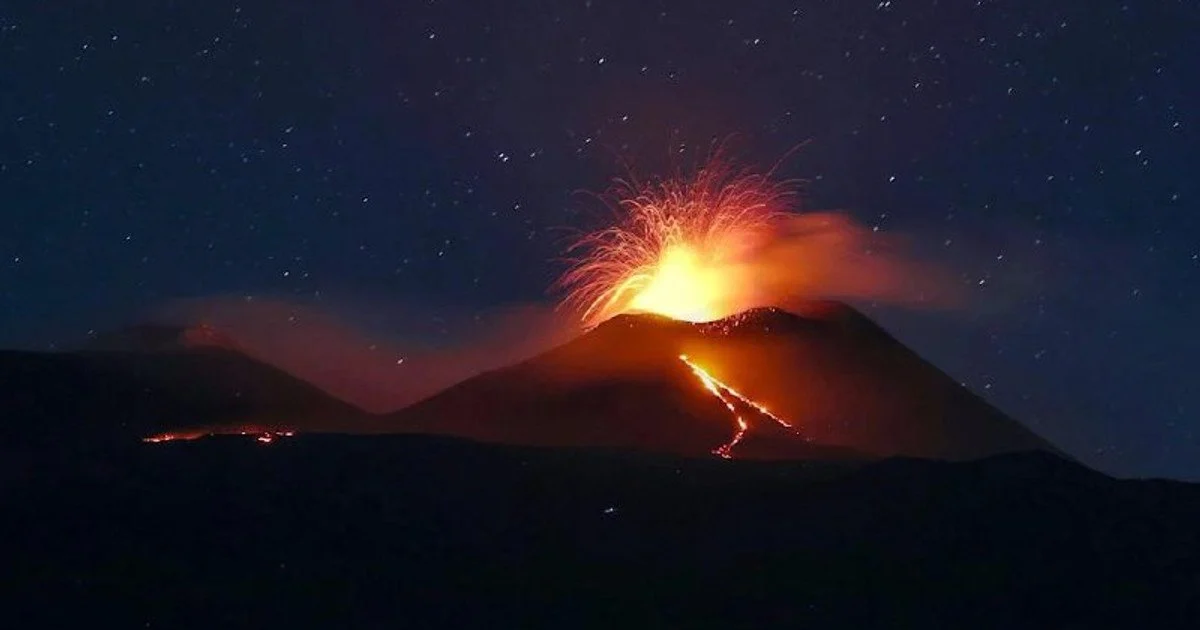
A new eruption of Mount Etna is underway in Sicily, accompanied by intense explosions, lava flows and ash emissions. Due to the ash cloud, Catania Airport temporarily suspended flight arrivals on 10 August until 17:00 local time. In the evening, the Italian National Institute of Geophysics and Volcanology reported that the volcano’s activity was continuing.
Briefly about the main points
- Catania temporarily suspended flights due to the closure of part of its airspace.
- The restriction did not mean that the airport was completely closed for the whole day.
- The INGV has recorded explosive activity in the Voragine crater and significant ash emissions.
- The furthest edge of the lava flow had descended to an altitude of approximately 1,370 metres.
- Passengers are advised to check their flights with the airline before travelling.
The restrictions applied to arrivals, not to the airport’s overall operations
SAC, the company that operates Catania-Fontanarossa International Airport, has announced the closure of part of the airspace due to volcanic activity. The temporary measure affected all flights due to arrive in Catania and did not mean that the airport was completely closed for the whole day.
A red-level VONA aviation advisory remained in place for Etna. Volcanic ash poses a danger to flights, as particles can enter jet engines and damage equipment.
Even after the restrictions have been eased, some flights may still be delayed, diverted or cancelled whilst airlines work to restore their disrupted timetables.
Lava was spewing from several vents, and ash was falling on the southern slope
According to the INGV’s evening bulletin, lava flows were emerging from vents at altitudes of around 2,750 and 2,360 metres. As of 17:00 UTC, the furthest-reaching active front had descended to approximately 1,370 metres.
Throughout the day, intense explosive activity continued in the Voragine crater, causing significant ash emissions. Some of the ash fell on the southern slope of the volcano.
Volcanologists had previously reported the formation of large lava fields and high levels of volcanic tremor.
Passengers are advised to check the current status of their specific flight
The airport operator advises passengers to check their flight status directly with the airline before setting off. Information on arrivals and departures is also updated on Catania Airport’s official tracking system.
Further restrictions will depend on the intensity of the emissions and the direction of the wind, which determines the movement of the ash cloud. The INGV continues to monitor Mount Etna, whilst the airport is adjusting its operations in line with the volcano’s location.