Germany has launched a large-scale assessment of its healthcare system’s readiness for a potential military scenario in Europe. The Bundeswehr is working on the basis of a planned scenario in which between 300 and 1,000 wounded and sick servicemen could be admitted to German hospitals every day, approximately a third of whom would require intensive care. Military and civilian medical facilities are already practising evacuation procedures, handling large-scale influxes of casualties, defending against drones, and operating in conditions of power cuts and medicine shortages.
- The Bundeswehr is preparing for a scenario in which up to 1,000 wounded soldiers could be transported to Germany each day.
- The country’s five military hospitals will not be able to cope with such a large influx on their own, so civilian hospitals will be called upon to help.
- In Ulm, plans are being considered to restore a Cold War-era bunker designed to accommodate 2,000 people.
- Hospitals are assessing their protection against drones, their stocks of medicines and the feasibility of setting up underground shelters.
- One of the main problems remains the shortage of doctors with experience in treating combat injuries.
Germany is preparing for a massive influx of wounded people
How to. reports Bloomberg, the German military and government bodies are assessing the healthcare system’s capacity to function in the event of a major armed conflict on the territory NATO. Germany plays a special role due to its location at the heart of Europe: the country could serve both as a major logistics hub for the deployment of troops to the east and as a centre for the reception of the wounded.
The Bundeswehr’s official scenarios envisage the arrival of between 300 and 1,000 patients a day, around a third of whom may require intensive care. Germany has five military hospitals — in Ulm, Berlin, Hamburg, Koblenz and Westerstede — but their capacity would be insufficient in the event of a large-scale conflict.
Consequently, a significant proportion of military personnel will be treated in civilian hospitals, which will, at the same time, have to continue treating their usual patients.
A nuclear bunker may be restored in Ulm
One of the symbols of the new training programme is the military hospital in Ulm. Beneath its buildings lies a large medical bunker dating from the Cold War.
The underground complex was completed in 1979. It was designed to enable doctors to continue working even after a nuclear strike, and is intended to accommodate approximately 2,000 people who can stay independently for up to 90 days. The complex has effectively been out of use for decades, but the military is now considering the possibility of bringing it back into service.
This would require spending millions of euros on modernising ventilation systems, power supplies and other infrastructure. However, the Bundeswehr officially states that the bunker complexes at its hospitals are not currently in use.
«Is our healthcare system ready? The only answer is no,» said Benedikt Frimert, head of the Ulm Military Hospital.
Hospitals are considering measures to protect against drones
German healthcare facilities are looking at more than just bed capacity. Possible measures include anti-drone barriers, bulletproof glass, additional stocks of medicines and the conversion of underground premises into secure treatment areas.
The Bundeswehr’s contingency plans also take into account cyber-attacks, power cuts and disruptions to the supply of medicines and medical supplies. In the event of a major crisis, hospitals may need to postpone elective operations and discharge some patients early to free up beds.
A separate issue is the healthcare system’s reliance on global supply chains. Hospitals fear shortages of antibiotics, painkillers, blood products and consumables if supplies are disrupted.
Doctors are being trained to treat combat injuries
According to estimates cited by Bloomberg, only a few hundred doctors in Germany have practical experience of treating typical combat injuries. The Bundeswehr, in collaboration with the German Society for Traumatology, is therefore expanding training programmes for civilian surgeons.
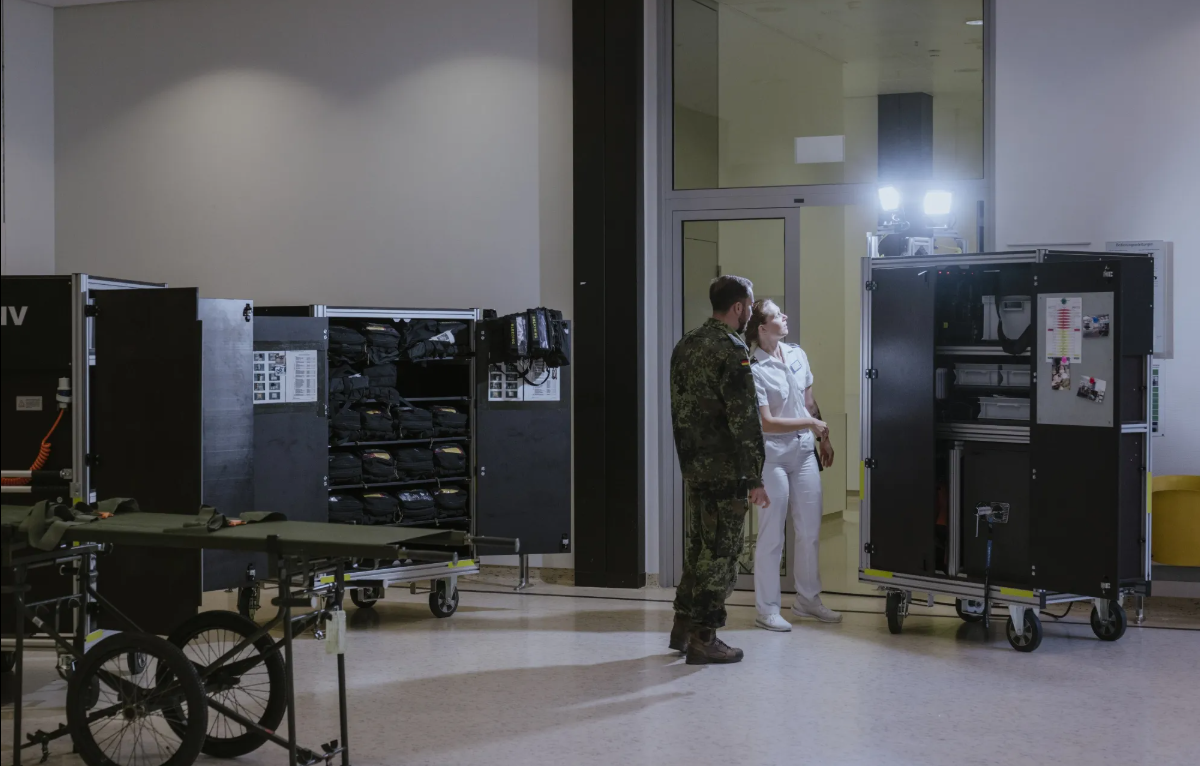
In March 2026, the military carried out Medic Quadriga 2026 — the Bundeswehr’s largest and most complex medical exercises since the start of Russia’s full-scale war against Ukraine. Over 1,000 military personnel and around 250 representatives from civilian organisations took part. The entire route taken by a casualty was practised — from evacuation from Lithuania to handover to civilian hospitals in Germany.
Ukraine’s experience has become one of the benchmarks
German medical professionals are also studying the experiences of Ukrainian hospitals since the start of Russia’s full-scale invasion.
Ukrainian anaesthetist Kateryna Belka She explained that healthcare facilities had to move patients to the lower floors, protect windows from falling debris, set up treatment rooms underground and establish alternative sources of electricity using generators and solar panels.
Germany is now trying to put such mechanisms in place in advance. Bundeswehr emphasises that, in the event of a major crisis, military medical services will not be able to provide the necessary level of care on their own; the system must therefore be based on close cooperation between military and civilian hospitals.