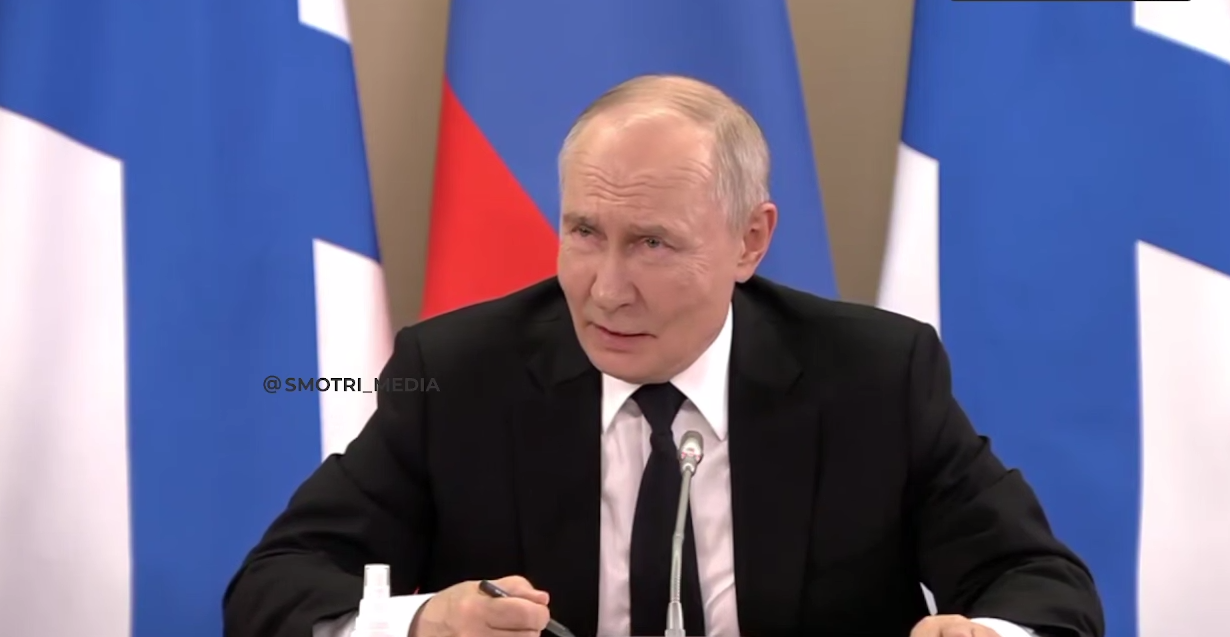
Russian dictator Vladimir Putin claimed that Moscow had allegedly «not started the war», but was responding to the actions of the Ukrainian authorities. In his speech, he repeated propaganda claims about «Nazism» in Ukraine, cast doubt on its borders and declared that the so-called «special military operation» would end in «Russia’s victory». His words contradict the chronology of Russian aggression and the position of international institutions.
Briefly about the main points
- Putin blamed Ukraine for starting the war.
- He repeated the propaganda claim about «Nazism» in Ukraine.
- Putin has threatened Ukraine with the possible loss of its western regions.
- The UN condemned the Russian invasion and demanded the withdrawal of troops.
- The EU describes Russia as an aggressor and rejects the changing of borders by force.
The Kremlin’s version contradicts the timeline of the aggression
Putin said that Russia had allegedly been «forced» to launch the so-called «special military operation» because of Kyiv’s actions. He described the change of government in Ukraine in 2014 as an «unconstitutional coup» and accused Western states of allegedly turning a blind eye to these events.
Russia’s aggression against Ukraine began in 2014 with the occupation of Crimea and the intervention in the Donbas. On 24 February 2022, Russian troops, acting on Putin’s orders, launched a full-scale invasion from the territory of Russia, Belarus and occupied Crimea.
In Resolution 68/262 of 27 March 2014, the UN General Assembly reaffirmed the sovereignty and territorial integrity of Ukraine within its internationally recognised borders and called for the change in the status of Crimea not to be recognised. In March 2022, the General Assembly also demanded that Russia cease its unlawful use of force and unconditionally withdraw its troops.
Threats to the western regions of Ukraine
Separately, Putin once again put forward the unfounded claim that Ukrainian identity is shaped «on the basis of Nazism and neo-Nazism». He stated that the western territories of Ukraine, which he described as «gifted by Stalin», could be «returned» to Poland, Hungary and Romania.
None of these states has made any official territorial claims against Ukraine. Poland, Hungary and Romania recognise its borders. Russian propaganda regularly uses the idea of a possible partition of Ukraine; such rhetoric may fuel mistrust between Ukraine and its neighbouring countries.
At the same time, Russia occupied Crimea and parts of the Donetsk, Luhansk, Zaporizhzhia and Kherson regions, thereby violating Ukraine’s territorial integrity.
Reference to the UN Charter and international assessment
Putin described the UN Charter as the foundation of modern international law, whilst at the same time casting doubt on the system of international relations following the collapse of the USSR. The UN Charter prohibits the threat or use of force against the territorial integrity or political independence of another state.
On 16 March 2022, the International Court of Justice ordered provisional measures and instructed Russia to immediately suspend the military operations it had launched on 24 February. The Court noted that it had no evidence before it to substantiate Russia’s allegations that Ukraine had committed genocide as a justification for the invasion. This was not a final ruling by the Court on all aspects of Russia’s liability.
In its conclusions of 18 June 2026, the European Council explicitly described Russia as an aggressor and its war as a war of aggression. The EU emphasised that borders cannot be changed by force, and that a peaceful settlement must be based on the UN Charter, Ukraine’s sovereignty and territorial integrity.
Rhetoric showing no sign of compromise
At the end of his speech, Putin stated that the war would end with «the enemy being defeated and victory going to Russia». Coupled with the denial of responsibility for the invasion and territorial threats, this statement gives no public indication that the Kremlin is prepared for a settlement based on Ukraine’s sovereignty and the inviolability of its borders.
In June, the EU called on Moscow to agree to a full, unconditional and immediate ceasefire and move on to substantive negotiations. At the same time, the European Council’s conclusions noted that Russia had stepped up its missile and drone strikes on Ukrainian cities and energy infrastructure.