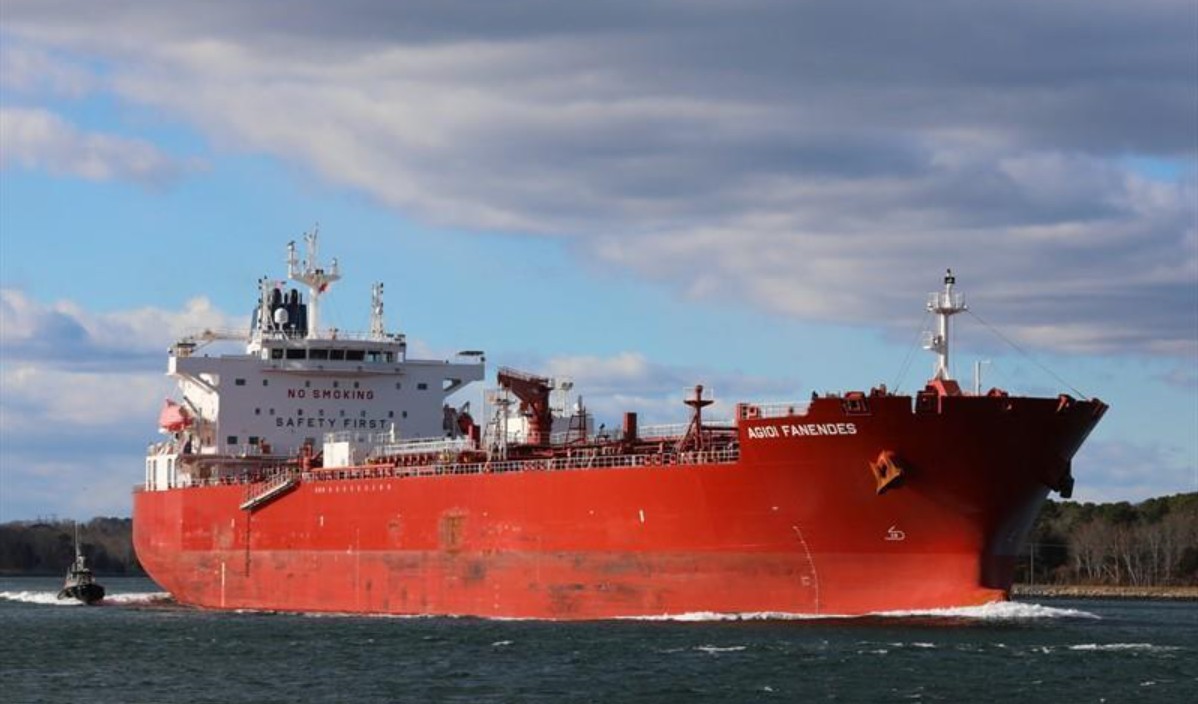
Of the three tankers that were carrying around 140,000 tonnes of Russian diesel fuel to the US, only one is still heading in the likely direction of the American coast. The other two vessels have changed their declared destinations, and American companies are in no hurry to buy Russian fuel, even at significant discounts. This comes after agreements between Donald Trump and Vladimir Putin on large-scale diesel supplies, which were intended to help lower fuel prices in the US.
- Two of the three tankers carrying Russian diesel have changed their declared routes.
- Agioi Fanendes remains in the Atlantic, but no longer lists New York.
- American companies are concerned about the legal consequences of purchasing Russian fuel.
- The Governor of New Jersey has called on ports to refuse to accept Russian tankers.
- Diesel remains expensive in the US despite Trump’s agreement with Putin.
Two tankers have changed course; the third is awaiting instructions
According to Windward data dated 3 November, the vessels Agioi Fanendes, Talisman and Leruo, which were previously heading towards the US, no longer have identical declared routes.
Tanker Agioi Fanendes under the Maltese flag, loaded approximately 40,000 tonnes of Russian diesel at the port of Primorsk on 22 October. The ship had originally stated New York as its destination, and was due to arrive on 7 November.
Subsequently, the crew changed the entry in the automatic identification system to For Orders — «awaiting further instructions». Despite this, the vessel is continuing its journey across the Atlantic Ocean towards the north-east coast of the United States.
The other two tankers altered their routes more significantly.
Talisman It sailed through the Strait of Gibraltar under the Russian flag and changed its declared destination to an unspecified location. It had previously been expected to arrive in the US on 9 November.
Leruo, which flies the Sierra Leone flag, now points towards the American coast instead of Brazil for Order — Brazil, with the port to be confirmed at a later date. Prior to the change of route, the vessel was due to arrive in the US on 11 November.
Windward notes that Talisman and Leruo are subject to international sanctions. Agioi Fanendes, which is owned by Greek shareholders, is not subject to such restrictions.
At the same time, a change to the stated destination does not constitute definitive confirmation that the shipment has been cancelled: tanker routes may be adjusted in accordance with the charterers’ instructions.
Greenpeace initially identified seven tankers carrying Russian fuel
In late October, Greenpeace Ukraine reported that seven tankers may have been transporting a total of around 288,000 tonnes of Russian diesel to the US. The estimate was subsequently revised to six vessels and 268,000 tonnes of fuel.
According to the publication «Agency», as of the evening of 3 November, four tankers remained on Greenpeace’s interactive map. In addition to the Agioi Fanendes, the Talisman and the Leruo, the organisation was tracking the Primorye, which was showing the Bahamas as its destination.
Consequently, of the seven vessels reported at the end of October, none have so far been confirmed as heading directly for a US port. The Agioi Fanendes remains the closest to the route to the US.
According to Windward’s assessment, no consignment of Russian diesel has yet been delivered to the US following the granting of a special licence by the US Treasury Department.
American buyers are turning their backs on Russian diesel
The supply problems were not caused solely by changes to the routes.
At the end of October, *The Washington Sun* reported that officials from the Trump administration had privately are calling on American companies to agree to the purchase of a Russian diesel engine.
However, potential buyers are wary of the legal and reputational consequences of working with Russian suppliers. According to the publication, difficulties in finding buyers persist even when significant price discounts are offered.
Particular risks stem from the fact that the US Congress passed a law back in 2022 banning the import of Russian energy resources.
On 9 October 2026, the Office of Foreign Assets Control (OFAC) of the US Department of the Treasury issued General Licence No. 135, which temporarily permits certain transactions involving Russian diesel, including its import.
However, the question of how this authorisation relates to the 2022 legislative ban has sparked controversy amongst American politicians and lawyers.
The Governor of New Jersey has threatened ports with fines running into millions
2 November, the Governor of New Jersey Miki Sherrill sent an official letter to port operators demanding that they refuse to accept tankers carrying Russian fuel.
She stated that the Trump administration’s authorisation contravenes federal legislation and does not lift the ban on imports of Russian petroleum products, which was introduced following the Russian Federation’s full-scale invasion of Ukraine.
According to her, companies involved in unloading such fuel could face civil and criminal consequences, including fines running into millions of dollars.
The governor emphasised that the state authorities would use all available legal means to prevent Russian diesel from being shipped through local ports.
At the same time, the legality of imports under the new OFAC licence remains a matter of legal dispute. No final court ruling on this matter has been issued.
Trump’s agreement with Putin provided for up to 4.8 million tonnes of diesel
On 9 October, Donald Trump announced that an agreement with Vladimir Putin regarding the increase in supplies of Russian diesel to the US and global markets.
According to the announced plans, Russia was due to supply over 300,000 tonnes of fuel in the near future, a further 500,000 tonnes in November and one million tonnes thereafter.
In addition, the supply of a further three million tonnes was under consideration, depending on the condition of Russian oil refineries. The total potential volume amounted to approximately 4.8 million tonnes, but part of this figure was provisional.
Trump had hoped that increasing the supply of diesel would help to bring down prices on the US market.
However, there was no significant fall in fuel prices following the announcement of the agreement. Whilst the average price of diesel on 9 October was around $6.28 per gallon, according to the US Energy Information Administration, it stood at $6.292 on 2 November.
Meanwhile, the Russian Deputy Prime Minister Alexander Novak reported plans to export approximately 2.15 million tonnes of diesel to various global markets in November.
However, these volumes do not imply guaranteed deliveries to the US. The actual shipping routes, the availability of buyers and disputes surrounding sanctions legislation mean that the implementation of the US-Russian agreements remains uncertain.