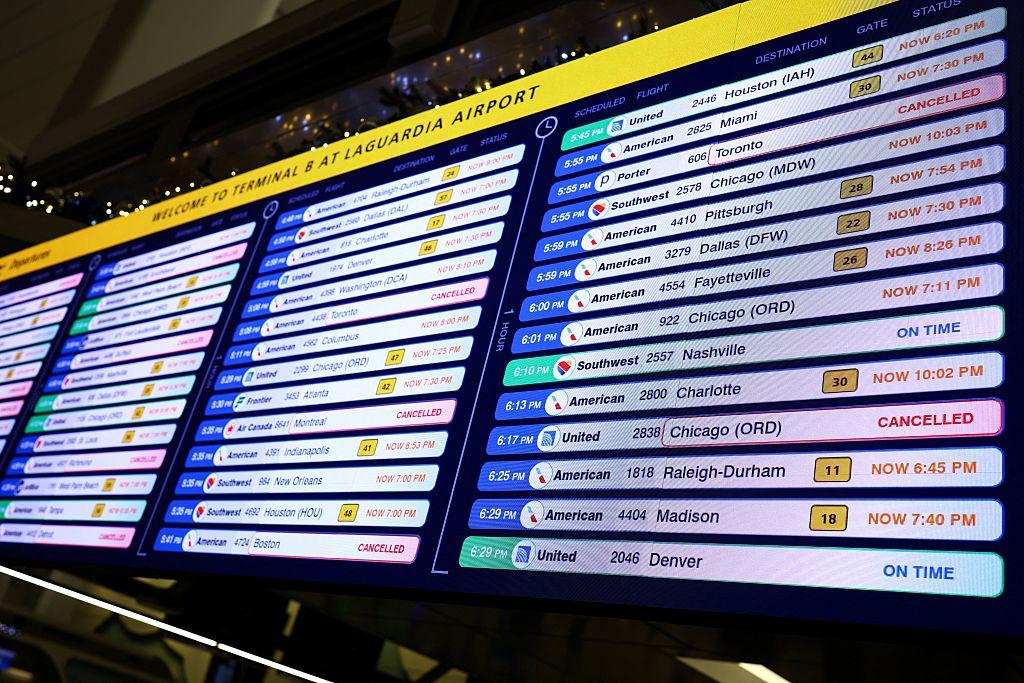
In the US, attention has focused on the new $875 million SMART artificial intelligence system following a major failure on 13 November 2026, which led to the temporary suspension of flights across the country. The US Federal Aviation Administration (FAA) had rolled out the system nationwide just three days before the incident. Even before the incident, Democrats in Congress had been calling for an independent review of the technology due to concerns about its reliability and impact on aviation safety. Meanwhile, the FAA, the Department of Transport and the developer, Air Space Intelligence, maintain that SMART did not cause the failure.
What has happened to air travel in the US?
On Friday, 13 November, the Federal Office US civil aviation introduced a nationwide suspension of flights following serious malfunctions in the communications system between air traffic control centres.
The disruption lasted for over four hours and caused significant delays and flight cancellations.
According to Reuters, on the day of the incident, approximately 1.5 million passengers were due to fly on US airline flights. There were around 11,000 flights scheduled, but this does not mean that all of them were cancelled.
US Secretary of Transport Sean Duffy explained that The fault occurred in the FAA’s outdated communications infrastructure. Overloading of routers and other network equipment disrupted the transmission of data required for flight control.
The incident has once again drawn attention to the technical condition of the US air traffic control system, which has been undergoing modernisation for many years.
How the new $875 million SMART system works
SMART is an acronym for Strategic Management of Airspace, Routes and Trajectories. It is a system for the strategic management of airspace, routes and flight trajectories.
It was developed by the American technology company Air Space Intelligence (ASI). The contract for the development of SMART and the associated system is worth approximately $875 million over 12 years. In other words, this refers to the total cost of the long-term programme, rather than a one-off payment for the software.
SMART brings together around 200 data streams, including information on weather conditions, aircraft routes, traffic volumes, airport capacity and the availability of air traffic control staff.
Algorithms analyse this information and predict potential congestion in airspace. Based on the results, the system suggests alternative routes and ways to minimise delays.
At the same time, SMART does not fly the aircraft on its own. Its recommendations are reviewed by experts, and the final decisions are made by people.
The first trials of the technology began in September in the Washington area. By 10 November, the FAA had extended its use to the airspace of all 22 air traffic control centres in the US.
According to the agency, during initial testing, SMART helped to reroute 180 flights. On average, this saved around ten minutes of flight time and nearly 80 gallons of aviation fuel on each flight.
Why is Congress calling for security checks on artificial intelligence?
Concerns about SMART had arisen even before the widespread disruption to air travel.
On 9 October, a group of US lawmakers called on the FAA to suspend the use of the system at three airports in the Washington area until further clarification had been provided regarding testing, staff training and control mechanisms.
On 13 October, Democrats in the House of Representatives asked the US Government Accountability Office (GAO) to carry out an audit of the software.
Lawmakers are concerned about the lack of involvement of air traffic controllers in the development of the technology and the limited amount of training provided to staff prior to its implementation.
They paid particular attention to the risk of so-called AI hallucinations — situations in which the system generates false information that may appear credible.
In aviation, such errors are potentially dangerous if the algorithm’s recommendations are used without being properly verified.
Former FAA official Mike O’Donnell He emphasised in comments to the AP that technology should remain a supporting tool rather than replacing air traffic controllers. According to him, mechanisms are needed to verify the accuracy of every critical decision.
At the same time, the call for an audit does not mean that the system has already been deemed unsafe or that the investigation has established any breaches. Lawmakers are insisting specifically on an independent assessment.
Could SMART have caused the suspension of flights?
The FAA, the US Department of Transport and the software developer deny that SMART was involved in the incident on 13 November.
Air Space Intelligence stated that the fault was not caused by the SMART system, nor by any of the company’s other products or their integration with the FAA’s infrastructure.
Minister for Internal Security Mark Wayne Mallin He also stated that the authorities had found no evidence of a link between the new AI system and the communications failure.
According to the FAA, SMART analyses information and provides recommendations, but does not directly control the communication systems that have malfunctioned.
Therefore, the proximity of the launch dates of SMART and the major accident does not in itself prove a cause-and-effect relationship.
Why US aviation infrastructure remains vulnerable
The glitch highlighted problems that had existed long before the introduction of artificial intelligence.
According to the findings of a GAO audit in 2024, 105 of the FAA’s 138 mission-critical systems were deemed unsustainable or potentially unsustainable for continued operation.
Some parts of the infrastructure continue to use equipment that was manufactured decades ago. For some systems, it is becoming increasingly difficult to source spare parts and carry out maintenance.
In 2025, the US Congress allocated $12.5 billion for the modernisation of air traffic control infrastructure. The administration has also requested additional funding, but lawmakers and auditors are raising questions about the planning of expenditure and the timetable for the upgrade.
A separate problem remains the shortage of qualified dispatchers, which has built up over many years.
Artificial intelligence can help predict airspace congestion, but it cannot, on its own, replace the modernisation of communications, radar and other critical systems.
As of 16 November 2026, the FAA continues to use SMART, whilst US lawmakers are calling for an independent assessment of its safety. Official explanations attribute the nationwide flight suspension to problems with the communications network, rather than to the AI algorithms. The final results of the investigations and measures to prevent similar incidents remain unresolved issues.