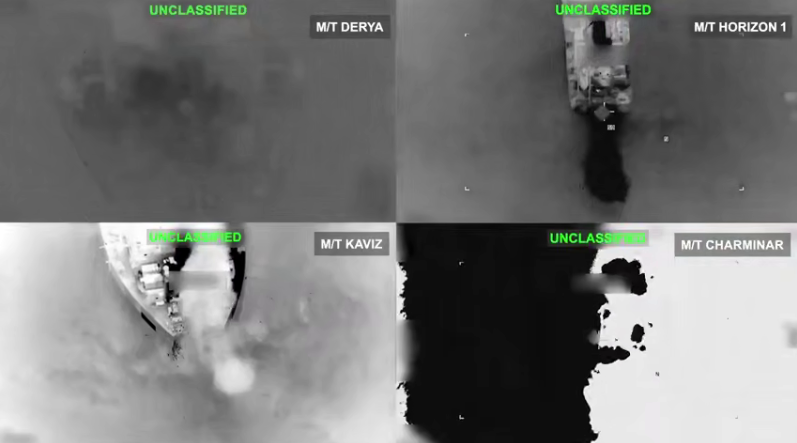
On 8 September, the US destroyed five Iranian oil tankers following two attempts by the Islamic Revolutionary Guard Corps to attack a US Navy vessel with ballistic missiles, according to US Central Command. The American vessel evaded the strikes, and no service personnel were injured. In response, Tehran launched a missile strike on a base near Al-Azraq in Jordan.
Briefly about the main points
- CENTCOM has announced the destruction of five tankers linked to the IRGC’s financial network.
- An American ship evaded two missile attacks by the IRGC without suffering any military casualties.
- Jordanian air defences shot down 18 of the 20 missiles fired by Iran.
- The QIR threatened tankers in Bahrain and Kuwait and announced attacks near the strait.
- Brent crude has approached $100 due to risks to oil exports.
Washington has linked the tankers to the financing of the IRGC
CENTCOM stated that the vessels attacked were part of a «shadow network» that provides funding IRGC and associated forces in the region. The command has also released footage of the strikes.
US Secretary of State Marco Rubio stated that, should there be any further attempts to attack US warships, Washington would resort to further destruction of Iranian tankers.
5 September CENTCOM reported that three Iranian tankers had been put out of action following attacks by the IRGC on two US Navy vessels. According to the US military, the crew of one of the ships were ordered to abandon ship before the attack.
Jordan has reported that it has intercepted most of the missiles
The QIR stated that it had attacked a base used by US forces near Al-Azraq with ballistic missiles, and claimed to have caused significant damage.
The Jordanian Armed Forces reported that they had detected 20 missiles launched from Iranian territory. The air defence system intercepted 18 of them, whilst the remaining two fell in uninhabited areas. No deaths or injuries were reported in the country.
An American official told Reuters that the attack had been ineffective and that all US personnel were accounted for.
The KVI reported new attacks and threats to shipping
At the same time, the IRGC warned of possible attacks on oil tankers in the ports of Bahrain and Kuwait, according to Iranian state media.
On 9 September, the corps also reported an attack on ten vessels in the Strait of Hormuz, naming two US ships and eight oil tankers among them. There is no independent confirmation of the extent of the damage caused.
Strait of Hormuz is one of the key routes for global oil exports, so any threats to shipping in this area quickly have an impact on the energy market.
Transportation risks have driven up oil prices
Brent crude prices have approached $100 a barrel amid fears of further disruptions to oil shipments through the Strait of Hormuz.
Tensions escalated following attacks by Yemeni Houthis on Saudi Arabia on 8 September. They attacked several cities, including Saudi Aramco facilities. The Saudi authorities reported 73 casualties and fires at oil infrastructure sites.
The series of attacks has heightened fears of a wider energy crisis in the Persian Gulf.
After a month of relative calm, the conflict entered a critical phase
The latest attacks mark one of the most serious escalations following around a month of relative calm in the six-month-long conflict. Washington is seeking to maintain shipping through the Strait of Hormuz and restrict Iranian oil exports.
Tehran is attacking US forces and US allies in the region and is attempting to obstruct the passage of oil tankers. The areas most at risk remain US bases in the Persian Gulf, oil ports and shipping routes.