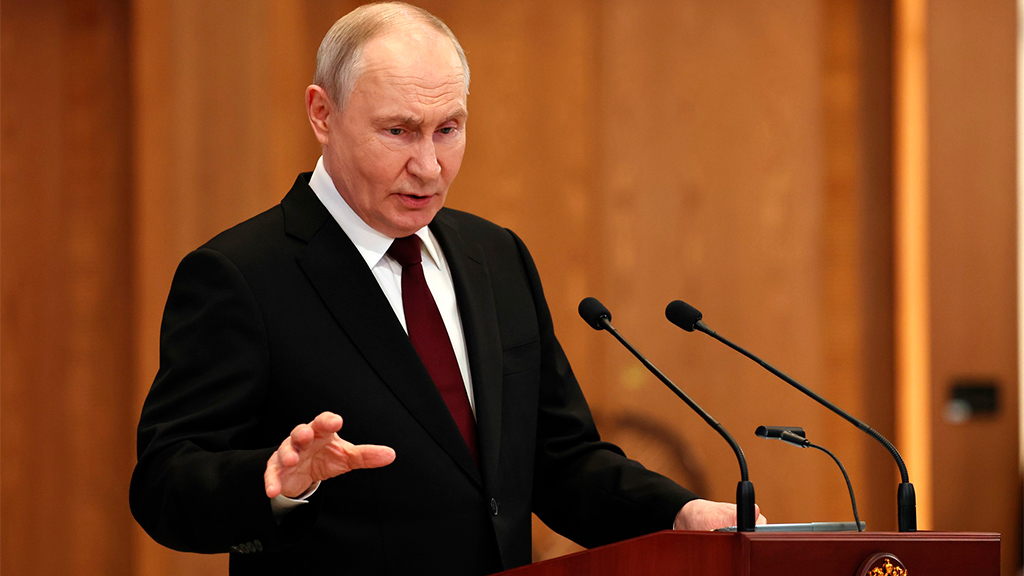
The Russian dictator's latest statements indicate the Kremlin's attempt to fix the current front lines and bargain for the legitimisation of the occupied territories through direct agreements with the West. Putin's announcement of talks based on his meeting in Anchorage with Donald Trump was accompanied by traditional military threats, including references to the Oreshnik ballistic missile system and Russia's superiority in aviation and air defence. How Moscow is trying to put pressure on Kyiv and Washington and what is behind these media messages - in a detailed article.
The scale of the occupation: what figures does the Kremlin give?
During his speech, for the first time in a long time, the Russian leader detailed the extent of the occupied Ukrainian territories in the East and South, trying to turn this factor into a key negotiating point.
According to Vladimir Putin, According to the Russian side, the occupation forces currently control over 851,000 square kilometres of Donetsk region (the so-called «DPR»), 1001,000 square kilometres of Luhansk region (the «LPR») and about 801,000 square kilometres of Zaporizhzhya region. The Russian side emphasises that its control over these administrative regions is unshakable and a key condition to start any substantive dialogue with the Ukrainian government. In fact, Moscow is seeking to force Kyiv to agree to capitulation compromises disguised as a peace agreement.
Anchorage formula: conditions for compromise with Trump
The main political sensation of the speech was the mention of the previous security consultations that took place in Alaska between the leaders of the United States and Russia. Putin has openly declared his readiness to return to the diplomatic track with Ukraine, but only on the basis of the agreements and framework previously discussed in detail with Donald Trump in Anchorage. The Russian leader made it clear that he sees the future security architecture as a direct agreement between Moscow and Washington, where Ukraine's interests should be subordinated to geopolitical compromises between the great powers.
Territories and EU integration: Moscow's position
It is noteworthy that the Kremlin leader tried to separate security and economic issues. By stating that control over Donbas and Conclusion of a peace agreement «are not mutually exclusive concepts», he suddenly expressed support for the idea of Ukraine's associate membership in the European Union. This is an attempt to demonstrate to the West a false «flexibility»: Russia is categorically opposed to Kyiv's integration into NATO, but is ready to turn a blind eye to Ukraine's European economic prospects in exchange for giving up the occupied territories.
Military blackmail: «Oreshnik» and the confrontation of air defence systems
Putin's diplomatic proposals have traditionally been backed by direct military threats aimed at intimidating Ukrainian society and European partners.
-
Tests and threats with the Oreshnik complex: Russian dictator officially confirms the recent use of the latest ballistic missile system «Oreshnik» on targets on the territory of Ukraine. According to him, the strike was aimed at «assessing the effectiveness of the warheads» in real conditions. Moreover, Putin explicitly stated that he does not rule out the full-scale use of these weapons in the future, in particular against urban areas and large metropolises of Ukraine.
-
Imbalance in strike weapons: The speech emphasised that Ukraine allegedly does not have and will not have analogues to Russian strike systems, including modern hypersonic and long-range cruise missiles, which gives Russia a strategic advantage.
-
The war of air defence systems: The Kremlin leader paid special attention to air defence. He noted that the Russian Federation has a full-fledged, deeply echeloned air defence system, while Ukraine, despite Western supplies of Patriot and IRIS-T systems, allegedly has only some of its elements, which are not capable of protecting the country's entire critical infrastructure.
The significance of the statements for the further development of the war
Vladimir Putin's latest statements clearly demonstrate Russia's current strategy: to combine missile terror with diplomatic pressure through the new White House administration. Hints of Oreshnik's use in civilian areas are intended to spread panic within Ukraine and force Western allies to limit military aid to Kyiv to prevent an alleged «global escalation».
At the same time, the appeal to the Anchorage agreement with Trump suggests that Moscow is in a hurry to secure territorial gains in Donbas and Zaporizhzhia, realising that the prolonged war of attrition is exhausting Russia's own domestic economic resources. Whether the West will accept the Kremlin's terms or whether Ukraine will be able to turn the tide on the battlefield with conventional weapons will be shown in the coming months.