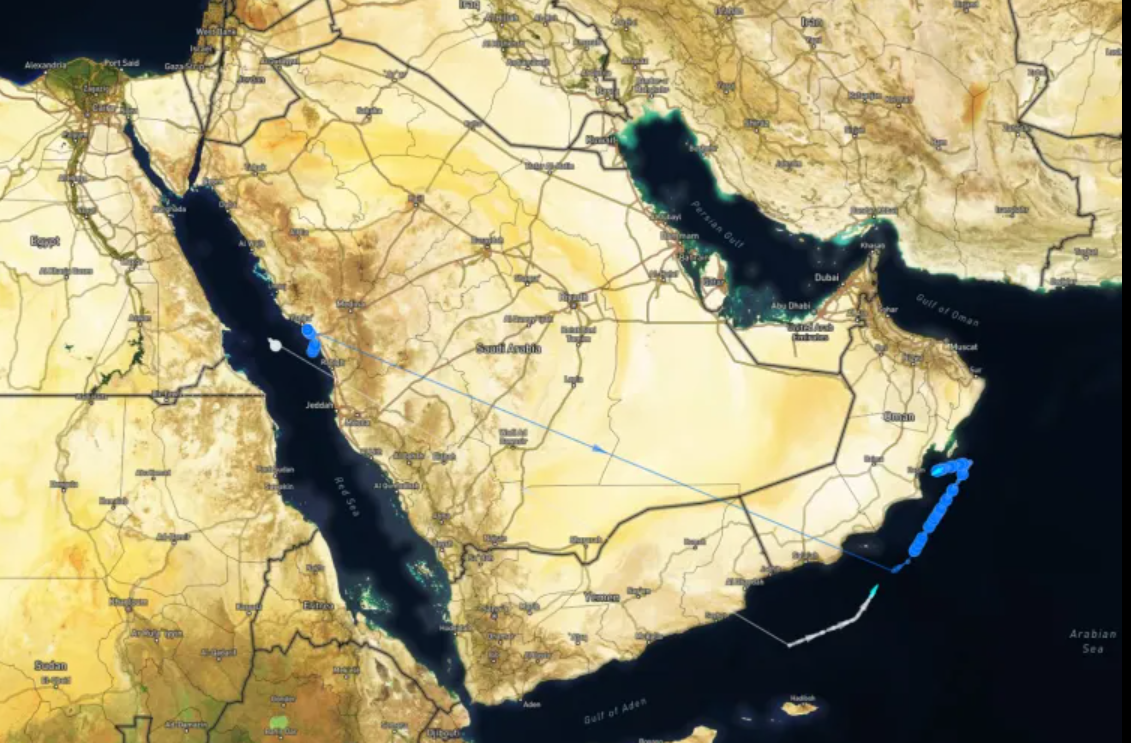
The Saudi port of Yanbu on the Red Sea has experienced what is likely to be its busiest day since the Yemeni Houthis first threatened to block the kingdom’s ports. Bloomberg, which analysed Sentinel-2 satellite imagery, spotted five very large crude carriers (VLCCs) near the oil terminals. Meanwhile, vessels carrying Saudi oil are passing through the Bab el-Mandeb and Strait of Hormuz with their AIS systems switched off.
Briefly about the main points
- Five VLCC tankers were moored at the Yanbu oil terminals.
- Each VLCC-class vessel can carry around 2 million barrels.
- Lesvos and Desh Vaibhav passed through Bab el-Mandeb with their AIS switched off.
- More than 8.4 million barrels were shipped out of the Persian Gulf in a single day.
- Alternative routes do not eliminate the risks in the Red Sea.
Yanbu has become an alternative route bypassing the Strait of Hormuz
Yanbu’s importance has grown following the disruption to navigation through the Strait of Hormuz caused by the war with Iran. Saudi Arabia is able to transport oil from the east of the country via a pipeline to the Red Sea coast, where it is then loaded onto tankers for global buyers.
The presence of five VLCCs at the terminals may indicate that this route is being used extensively to support exports. At the same time, periodic satellite images do not provide a continuous picture of port activity and do not, in themselves, establish the volume of shipments.
According to the International Energy Agency, the Saudi Abqaiq–Yanbu system has a design capacity of 5 million barrels per day. In March 2025, Saudi Aramco announced an increase to 7 million barrels per day, although the IEA noted that sustained flows at that level had not yet been verified. The agency also estimated that, following the outbreak of the war, exports via Yanbu had risen from around 2 million to over 5 million barrels per day by early June.
Some tankers are disappearing from public monitoring
Analytics firms Vortexa and Kpler have established that the Suezmax Lesvos, owned by a Greek company, and the Indian VLCC Desh Vaibhav loaded oil in Yanbu and passed through the Bab el-Mandeb Strait with their transponders switched off. Both vessels subsequently reappeared on tracking systems off the coast of Oman.
A switched-off AIS makes it more difficult to track a vessel’s route for commercial purposes, but does not render the vessel invisible to satellite or military surveillance systems. The International Maritime Organisation states that vessels fitted with AIS should generally keep the system switched on, although the captain may decide otherwise in the event of an imminent threat of attack.
Not all shipping companies opt for this route. Some tankers, particularly those carrying Russian oil, cross Bab el-Mandeb is open; others are sailing around Africa. From Friday to Sunday, according to Kpler, 75 vessels carrying raw materials passed through the strait in both directions, whilst Russian oil accounted for the majority of traffic leaving the Red Sea.
Exports are continuing, but logistics costs are rising
Despite a sharp drop in visible traffic, shipments from the Persian Gulf have not stopped. On Friday, more than 8.4 million barrels of oil were shipped out of the region — one of the highest daily figures since the war began in late February. Most of the cargo was transported by tankers with their transponders switched off. Kpler recorded 34 passages of crude oil tankers through Strait of Hormuz in both directions from Friday to Sunday; these figures may be subject to revision once vessels without AIS have been identified.
Risks on maritime routes remain high. A liquefied natural gas tanker from Qatar was struck by an unidentified projectile whilst passing through the Strait of Hormuz. Another vessel reported an explosion off the coast of Oman, whilst yet another oil tanker reported a dangerous incident whilst entering the Persian Gulf.
Yanbu provides Riyadh with a means of partially bypassing the Strait of Hormuz, but shifts part of the risk to the Bab el-Mandeb Strait. The MEA emphasises that alternative routes cannot fully replace the Strait of Hormuz: before the war, around 20 million barrels of oil and petroleum products passed through it every day. Circumnavigating Africa lengthens voyages, and tensions surrounding the two straits may continue to put pressure on insurance, freight rates and energy prices.