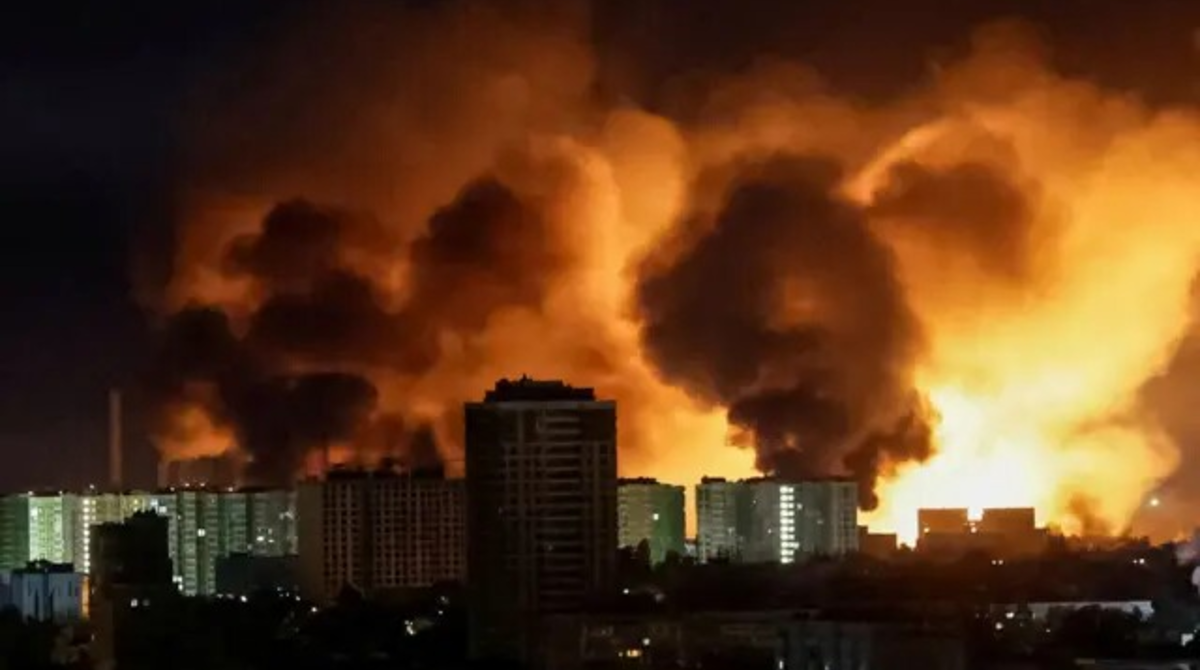
Ukraine is preparing for probably the most intense winter campaign of Russian strikes against the energy sector since the start of the full-scale war, writes *The Economist*. The publication names Kyiv as one of the most vulnerable cities: the capital relies on large thermal power stations and energy hubs, which cannot be fully protected against a concentrated strike by ballistic missiles. In the event of serious damage, the problems could affect not only electricity and heating, but also water supply and sewerage systems.
- Russia may step up its attacks on the energy sector this winter.
- *The Economist* describes Kyiv as being particularly vulnerable.
- Electricity, heating, water and sewerage services are at risk.
- It is impossible to fully protect large combined heat and power plants.
- Ukraine is already strengthening the energy resilience of its cities.
Why is Kyiv considered to be particularly vulnerable?
The Economist reports that Russia has increased its production of ballistic missiles to approximately 100 a month, whilst Ukraine has a limited stock of interceptors for the Patriot system. At the same time, Russia has begun to make more active use of new high-speed jet-powered drones, against which Ukraine does not yet have a sufficient number of low-cost interceptors.
Head of DTEK Maksym Timchenko He told the publication that the number of attacks in recent months had set new records. According to him, major energy facilities remain vulnerable even after construction work has been completed physical protection, as a concentrated ballistic strike is capable of causing critical damage to a power station.
The situation regarding Kyiv’s large combined heat and power stations is particularly challenging. Unlike distributed generation, such a facility cannot simply be relocated or completely sheltered within protective structures.
What might happen following large-scale strikes
The main risk lies not only in the generation of electricity, but also in the ability to transmit it to the city.
The Economist points out that some of the substations around the capital lack adequate redundancy. The power lines connecting Kyiv to the nuclear power stations — Ukraine’s main source of electricity — also remain vulnerable.
A power supply is also essential for pumping stations to operate. In the event of a prolonged power cut, problems may arise in turn with water supply, district heating and sewerage.
The problem had already become apparent last winter. An article in *The Economist* about Troieshchyna described how, following the storms and severe frosts, the essential services came under critical strain. The Head of the Desnianska District State Administration Maksym Bakhmatov At the time, he described a possible sequence of problems as water, heating, electricity and, finally, the sewerage system.
«They will torment Kyiv»
A senior Ukrainian government official, whom *The Economist* does not name, has stated that he sees no reason to expect this winter to be any milder than the last.
In his view, once the frosts set in, the capital will be «torment» with blows. Maksym Timchenko was more cautious in his comments, but also acknowledged that no one can guarantee that last year’s problems will not recur.
The Russian Federation’s new tactics pose a particular risk. Ukrainian air defence forces have learnt to deal effectively with conventional «Shaheds», but jet drones can move about three times as fast. According to a source at The Economist within the air defence command, only around 30% of such aircraft were shot down during the latest attacks.
Kyiv is already building up stocks of food and water
At the same time, the city authorities are preparing for the possibility of prolonged power cuts.
The Kyiv City State Administration has officially announced that Kyiv builds up and constantly maintains reserves of food and drinking water for the autumn–winter season of 2026–2027. The supplies are to be used at emergency centres, to assist those affected and to support the emergency services.
The city is also installing backup power supplies at critical infrastructure sites. Back in July, Mayor Vitali Klitschko stated that the capital was preparing for a difficult winter and was enhancing the self-sufficiency of key facilities.
Across Ukraine as a whole, preparations are underway for backup power supplies for heating and water systems. Regions have been instructed to check their emergency reserves, generators and operational procedures in the event of large-scale damage to infrastructure before the start of the heating season.