The Ukrainian company Fire Point expects the Ministry of Defence to finalise the certification of the FP-7 tactical strike missile within two to four weeks. According to CEO Iryna Terekh, the missile has undergone around 15 test launches. Once the procedure is complete, the missile will be officially procured and supplied to the Defence Forces, and the company plans to deploy it in combat for the first time in early autumn.
Briefly about the main points
- The FP-7 underwent approximately 15 test launches prior to its codification.
- Fire Point expects to complete the Ministry of Defence procedure within two to four weeks.
- Codification paves the way for contracts and the transfer of missiles to the armed forces.
- The developer is targeting early autumn for the first deployment of FP-7.
- The developer plans to deploy the FP-9, which has a claimed range of 855 km, for the first time in late autumn.
The FP-7 is being developed for strikes against ground targets
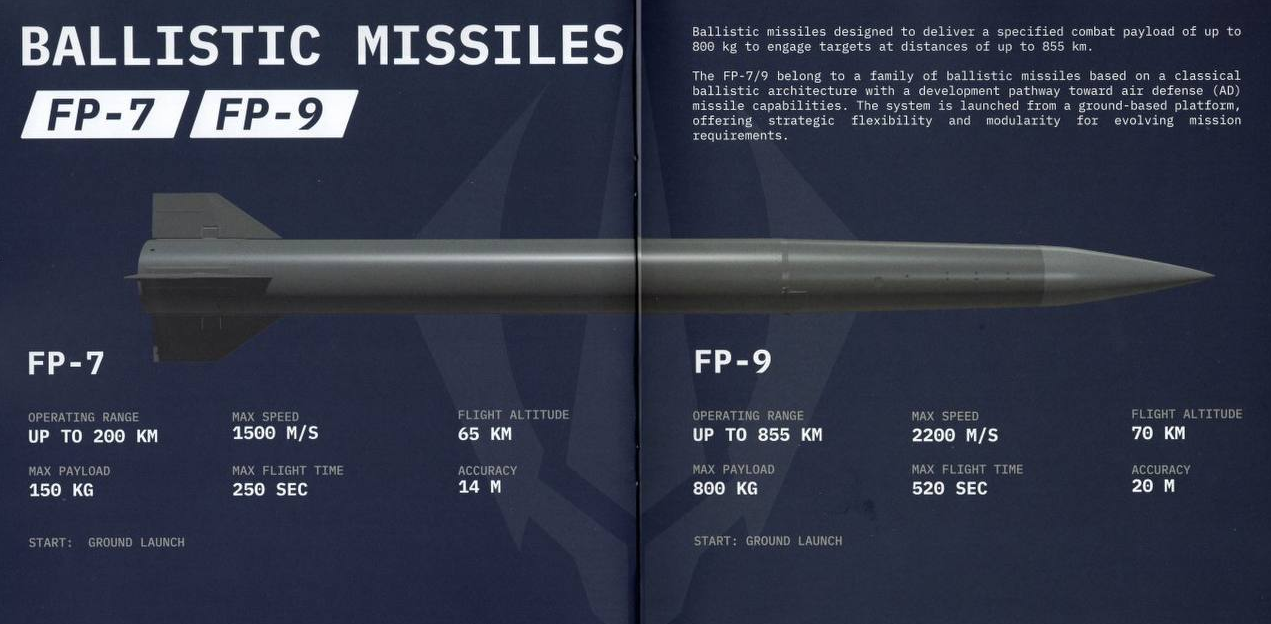
The FP-7 is a ground-based tactical ballistic missile. According to specifications released by Fire Point, it is capable of delivering a payload of up to 150 kg over a range of up to 200 km. The company also claims a maximum speed of up to 1,500 metres per second, a flight altitude of up to 65 km, an airborne duration of up to 250 seconds and an accuracy of approximately 14 metres. There is no independent confirmation of these parameters in open sources.
Iryna Terekh she explained that in the original design FP-7 They drew on Soviet technology used in the missiles of the S-300 and S-400 systems. However, according to her, the modern Ukrainian system bears only about 20% resemblance to them.
Fire Point is aiming for the FP-7 strike missile to see its first combat deployment in early autumn. The actual timetable will depend on the completion of the procedure, the results of the tests and the readiness of mass production.
How does the codification affect the supply of the missile?
According to the Ministry of Defence, codification is the final stage in the development, production and testing of a new type of weapon before it is authorised for service or adopted into service.
During the procedure, the product’s declared specifications, configuration, technical documentation and details of the manufacturer are verified. Successful completion enables the defence ministry to procure a prototype, enter into contracts, organise deliveries and distribute it to its units.
At the same time, codification in itself does not mean that widespread use will automatically begin. It creates the legal and organisational basis for the transition from testing to potential supply.
The FP-9 has a longer range and is still being prepared for testing
At the same time, Fire Point is working on FP-9 — a larger ballistic missile designed to strike targets deep behind enemy lines. The manufacturer states that it has a range of up to 855 km and a maximum payload of up to 800 kg. Other declared specifications include a speed of up to 2,200 metres per second, a flight altitude of up to 70 km, a flight time of up to 520 seconds and an accuracy of around 20 metres.
On its official website, the company also states that the complex’s architecture is designed to integrate with existing command, communications and reconnaissance systems. In June, Fire Point’s co-founder and chief designer, Denis Shtilerman, said that flight tests were due to begin in the summer, whilst combat trials were planned for the autumn.
According to the latest figures from Reuters, the developer is tentatively planning the first launch of the FP-9 for late autumn. This timeline may change depending on the engine tests, confirmation of the rocket’s performance and the readiness of production facilities.
The FP-7.X is a separate interceptor project for Freyja
The FP-7 strike variant should not be confused with the FP-7.X — a faster variant that Fire Point is developing as an interceptor for the prospective European missile defence system, Freyja. It has completed at least five test flights.
The company is integrating the FP-7.X with radars, guidance systems and a command centre, all of which are being developed by European partners. According to Fire Point, 13 defence companies are involved in the project. The first successful interception of a ballistic target as part of the Freyja programme is planned to take place by mid-2027.
Fire Point It aims to reduce the cost of a single interceptor to less than 1 million euros, although the system is still at the stage of development and component integration. The company has not disclosed production volumes or rates, the cost of the FP-7 and FP-9 series models, or the results of any of their tests.