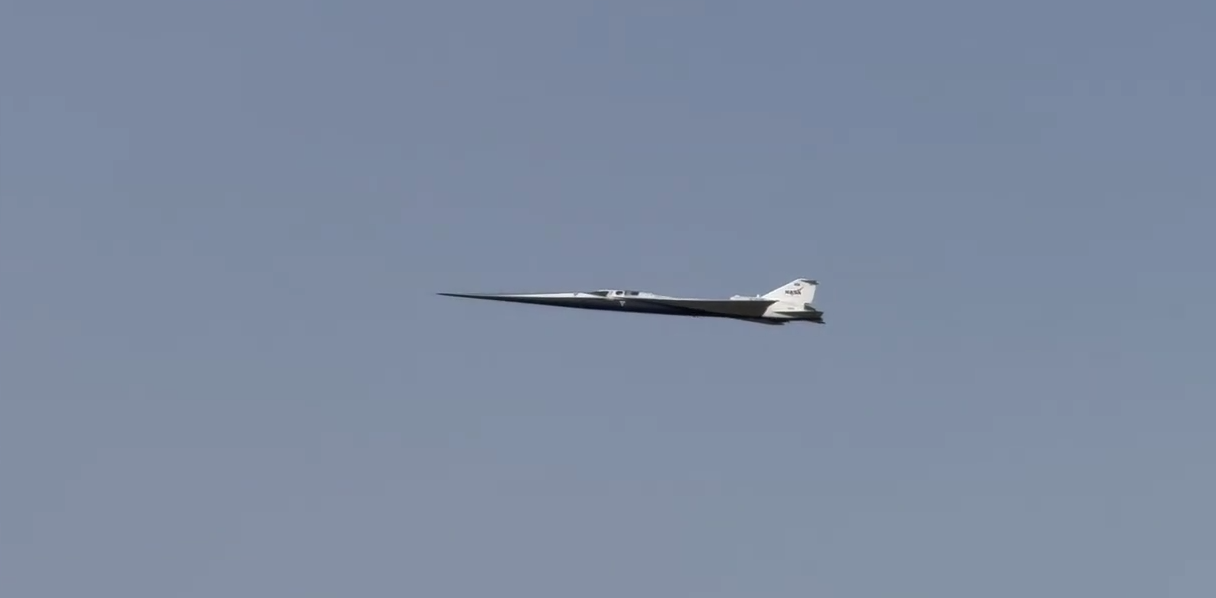
NASA’s experimental supersonic aircraft, the X-59 – designed to fly without the usual loud sonic boom – is making its way across the United States to Florida. The aircraft, with its exceptionally long and narrow nose, has already caught the attention of aviation enthusiasts during its journey from California. The aircraft is capable of speeds in excess of 1,800 km/h, and its unusual design is intended to make supersonic flights significantly quieter. This development by NASA and Lockheed Martin could change the future of passenger aviation.
- NASA’s X-59 experimental aircraft is heading for Florida.
- The aircraft has already reached a speed of 1.53 Mach.
- Its design is intended to significantly reduce the noise level of the sonic boom.
- Instead of a windscreen, the pilot uses a camera system.
- NASA is preparing for the next phase of acoustic testing on the aircraft.
The X-59 set off for Florida after a year of testing
On 28 October, the experimental aircraft took off from Edwards Air Force Base in California, where it had been undergoing flight tests for a year. The route passes through several US states, including Texas, where the unusual aircraft was spotted by aviation spotters.
The final stop on the journey is the Kennedy Space Centre in Florida. There, X-59 will be showcased at the MAX POWER aviation exhibition, which is due to take place on 7–8 November.
According to the information NASA, since its maiden flight on 28 October 2025, the aircraft has carried out a further 40 test flights. During this time, it has reached a speed of Mach 1.53 and an altitude of over 17 kilometres.
Its first supersonic flight took place on 5 June 2026. On that occasion, the X-59 exceeded the speed of sound, reaching 1.1 Mach.
How an aeroplane breaks the sound barrier almost silently
Supersonic aircraft typically generate powerful shock waves, which are perceived on the ground as a loud explosion. It is precisely because of this effect that commercial supersonic flights over land have long been restricted.
The X-59 has been designed so that shock waves do not merge into a single powerful sonic boom. Its elongated nose, narrow fuselage and special aerodynamic shape are intended to transform the familiar roar into a much quieter sound, similar to the muffled thud of a car door closing.
Due to its unusual design the pilot does not have a traditional windscreen. Instead, the eXternal Vision System, comprising a network of cameras and displays, is used to provide a view of the area in front of the aircraft.
The next stage of NASA’s Quest programme involves measuring noise levels during supersonic flights. Researchers subsequently plan to conduct flights over populated areas of the US and study people’s reactions to aircraft noise.
The findings may provide a basis for reviewing the restrictions on commercial supersonic flights over land.