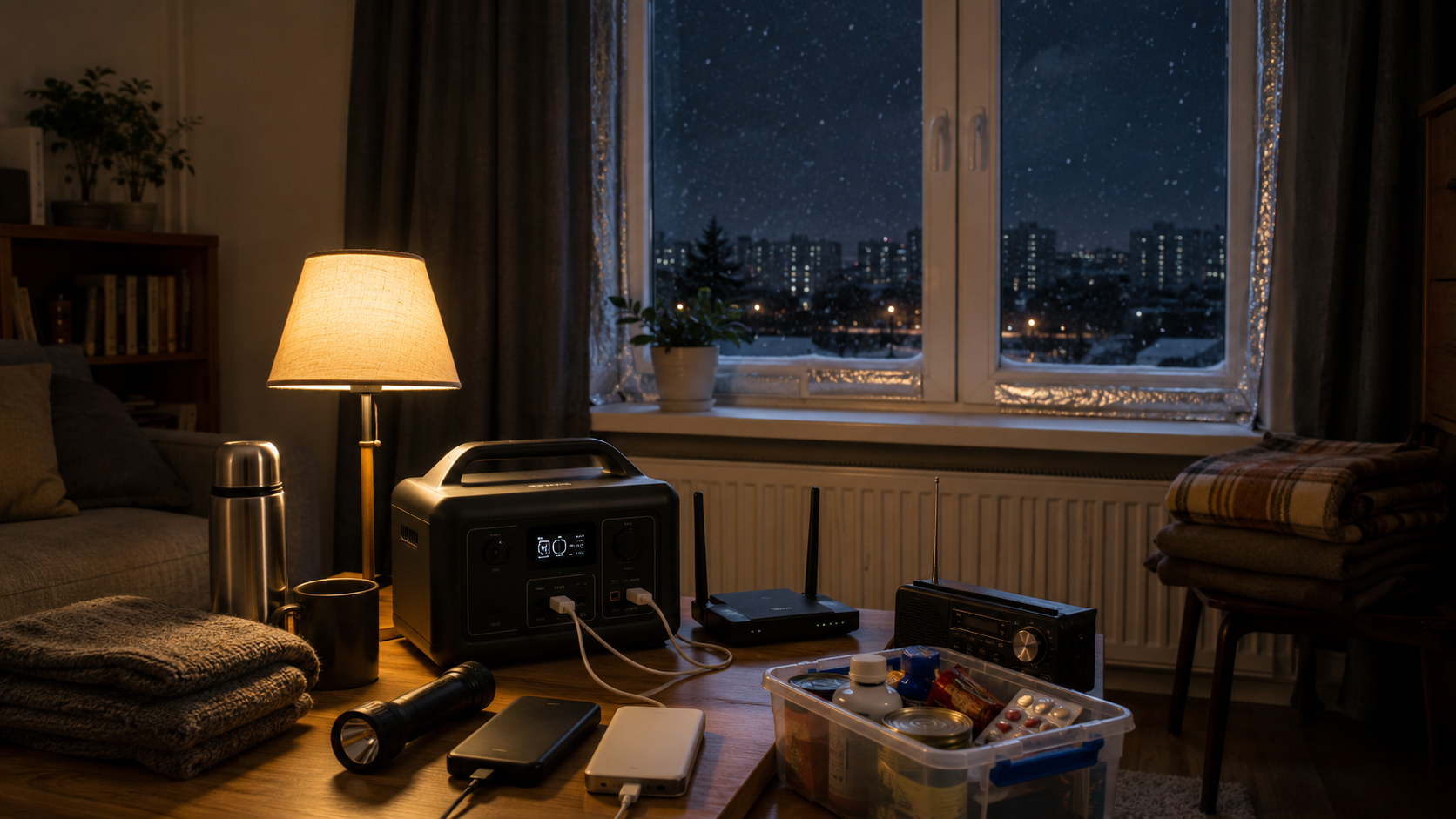
Russian attacks on Ukraine’s energy infrastructure pose a risk of prolonged power, heating and water cuts. It is therefore advisable to prepare your home for winter in good time — before the start of the heating season and the rise in demand for backup equipment. Preparations do not necessarily have to start with an expensive generator or a high-capacity charging station. First and foremost, you need to minimise heat loss, identify essential electrical appliances and build up a safe reserve in case of several hours or days without centralised services.
- It is worth starting your preparations for winter by insulating windows, doors and the areas where heat is lost most.
- You should choose a charging station based on the power rating of your devices and how long you want them to run for.
- Electric heaters use a lot of energy and quickly drain the battery of portable power stations.
- The use of generators, barbecues and homemade stoves is prohibited in flats.
- Homeowners should ensure they have a backup power supply for their boiler and pumps, as well as an alternative heat source.
How to prepare your home for winter: start by tackling heat loss
The cheapest energy is the energy you don’t have to use. Even a powerful heating system won’t help if heat escapes quickly through gaps in windows, doors, the roof or uninsulated walls.
Before the cold weather sets in, check:
- seals on windows and balcony doors;
- gaps around window frames, window sills and door frames;
- the condition of the front door and the vestibule;
- the loft, roof and floor structures of a detached house;
- pipes in unheated rooms;
- the proper functioning of the radiators, boiler and circulation pumps;
- ventilation ducts and flues.
To seal windows and doors, you can use sealing tape, sealant and special draught excluders. The US Department of Energy cites sealing gaps as one of the simplest ways to reduce energy loss through windows and doors. However, you must not block standard ventilation, particularly in rooms with gas appliances, experts point out.
During the day, it’s a good idea to open the curtains on the sunny side, and close them in the evening. Thick curtains help to retain heat, but they shouldn’t cover the radiators. You should also avoid placing furniture right up against the radiators.
In a flat, it is a good idea to choose one room in advance where the family will stay during a prolonged heating outage. A smaller space is easier to keep warm. You can keep the doors to other rooms closed and lay a rug or other heat-insulating covering on the floor.
How to work out the required charging station
A portable power bank does not generate electricity; it simply stores it in a battery. You should therefore decide, before buying one, which devices you need to keep running during a power cut.
The basic scenario usually requires:
- Wi-Fi router;
- several LED bulbs;
- smartphones;
- laptop;
- radio;
- circulation pump;
- gas boiler control system;
- fridge.
First, add up the power of all the appliances in watts, and then multiply this by the number of hours you want them to run.
Approximate formula:
required capacity in Wh = total load in watts × operating hours
You should add at least 20–30% to the result to account for losses during energy conversion, consumption errors and the gradual reduction in battery capacity.
For example, a router consumes around 15 W, two LED bulbs around 20 W, and a laptop an average of 65 W. The total load will be around 100 W. Eight hours of operation will require approximately 800 Wh, so a power station with a capacity of at least 1 kWh would be a practical choice.
A 1.5–2 kWh station or more may be required to power a boiler, a circulation pump, lighting and a router. The exact calculation depends on the specifications of the specific equipment.
What specifications should you look out for?
When choosing a charging station, the following factors are important:
- battery capacity in W·h or kW·h;
- continuous output power;
- peak power for starting compressors and pumps;
- pure sine wave for boilers, pumps and other sensitive equipment;
- battery type — LiFePO₄ batteries generally have a longer cycle life;
- charging speed from the mains;
- the ability to charge via solar panels;
- UPS or EPS mode;
- availability of after-sales service and warranty in Ukraine.
Do not connect the unit to your home fuse box using a homemade cable with two plugs. This method poses a risk of electric shock and of voltage being fed back into the external mains supply. The connection of the backup power supply to the building’s wiring must be carried out by a qualified electrician using a dedicated switch or an automatic transfer switch.
What would be suitable for a flat
For a flat, the safest backup power source is a charging station or a system comprising an inverter and a battery, installed by a specialist.
A basic kit might consist of a 500–1,000 Wh power station, several power banks, LED lights and a battery-powered radio. This will be enough for communication, lighting and powering a laptop.
If the flat has its own gas boiler, it is advisable to install a separate UPS with a pure sine wave. Its power output must be sufficient to meet the power requirements of the control system and the circulation pump.
It is not cost-effective to use a charging station to provide a continuous power supply to an electric heater. A standard heater consumes approximately 1.5–2.5 kW. A 2 kWh charging station would last for about an hour or less under such a load, taking losses into account.
Therefore, for a flat, it is more important to retain the heat that is already present, to ensure lighting, communications and the boiler is working, than to try to heat the room using a storage heater.
The following should under no circumstances be used in the flat:
- a petrol or diesel generator;
- a brazier or charcoal barbecue;
- a camping stove for heating a room;
- a gas hob as a heater;
- a homemade stove without a dedicated flue;
- faulty or makeshift electric heaters.
The generator must not be installed on a balcony, loggia, in a stairwell, basement or garage. Carbon monoxide is colourless and odourless and can enter neighbouring flats through windows and ventilation systems.
Back-up heating for a detached house
Owners of private homes have more options when it comes to setting up an independent heating system, but every solution requires professional design and safe installation.
A modern wood-burning stove
A factory-made metal stove, a convection oven or a fireplace insert with a sealed combustion chamber can operate without electricity. This makes it one of the most self-sufficient sources of backup heating.
However, a correctly sized flue, a non-combustible base, wall protection and an adequate air supply are required. The flue must be inspected and cleaned before each heating season.
Pellet stove
A pellet stove automatically feeds fuel and maintains the set temperature. It is more convenient than a traditional wood-burning stove, but it relies on electricity: power is required to run the automatic controls, the fan and the screw conveyor.
The pellet system should therefore be supplemented with an uninterruptible power supply or a charging station.
Solid-fuel boiler
A boiler of this type can heat the whole house via a water-based heating system. It works best in conjunction with a heat storage unit, which stores excess heat and gradually releases it into the system.
The boiler must be fitted with the manufacturer’s overheating protection. The circulation pump and control system require a backup power supply. The design and installation must be carried out by a qualified specialist.
A heat pump or an air conditioner
An inverter air conditioner in heating mode is, in effect, a heat pump. It is capable of producing more heat per unit of electricity consumed than a conventional electric heater.
Efficiency depends on the outside temperature, the model’s specifications and the insulation of the house. In the event of a total power cut, the heat pump will not operate either unless there is a powerful backup system in place.
Solar panels with a battery
A hybrid inverter, battery and solar panels can keep critical appliances running. However, in winter, electricity generation is unreliable due to shorter daylight hours, cloud cover and snow.
The Solar System It should be regarded as part of a system, together with batteries, the mains supply or a generator, rather than as a guaranteed sole source of energy.
What equipment should I choose?
| Decision | The most suitable option is | Advantages. | Restrictions |
|---|---|---|---|
| Charging station | Flat and house | Quiet, no exhaust fumes, easy to use | Limited energy reserves |
| Uninterruptible power supply for a boiler | Flat and house | Supplies power to the automatic system and the pump | Does not power high-output heaters |
| Inverter with battery | Mainly a house | You can increase the capacity | Requires professional installation |
| Generator | Detached house | Operates for a long time when there is fuel available | Noise, exhaust fumes, complicated installation |
| Solar panels | Detached house | Renewable energy source | Unstable production in winter |
| Wood-burning stove | Detached house | Can operate without electricity | A flue and a supply of fuel are required |
| Pellet stove | Detached house | Automatic temperature control | It depends on the electricity supply |
| Heat pump | Insulated housing | More economical than an electric heater | Requires a power supply |
How to use a generator safely
The generator must only be used outdoors. The State Emergency Service recommends placing it at least six metres away from doors, windows and ventilation openings. The exhaust must be directed away from the house.
You must not place a generator in a garage, even if the door is open. It is also dangerous to place it beneath the windows of a high-rise building or in a courtyard with poor ventilation.
Key rules:
- protect the generator from the rain by erecting a canopy, without blocking the ventilation;
- Do not touch the device with wet hands;
- Do not refuel the generator whilst it is running;
- Allow the engine to cool down before refuelling;
- store fuel away from living areas;
- do not exceed the rated power;
- Leave the connection to the fuse box to an electrician;
- Install a carbon monoxide detector in your home.
The official operating guidelines for generators have been published by State Emergency Service of Ukraine.
Carbon monoxide: the main hazard of emergency heating
Carbon monoxide is produced during the incomplete combustion of fuel. It is odourless, colourless and tasteless, so people cannot always recognise the danger in time.
Sources of carbon monoxide may include:
- generators;
- stoves and fireplaces;
- solid-fuel boilers;
- gas heaters;
- gas water heaters;
- burners and barbecues;
- a car with the engine running in the garage.
Any home with a fuel-fired heating system must have a battery-powered, stand-alone carbon monoxide detector. It is also advisable to install smoke detectors and to have a working fire extinguisher.
Headaches, dizziness, weakness, nausea or drowsiness may be signs of carbon monoxide poisoning. In such a situation, you must immediately go out into the fresh air, call the emergency services and not return to the premises without the permission of the experts. Detailed guidelines have been published by Ministry of Health.
What housing associations and residents of high-rise blocks should do
Stability a block of flats depends not only on the supplies in each flat. CONDOMINIUMS or the management company must inspect the equipment on which the water supply, heating and safety of the entire building depend.
Before the start of winter, you should:
- check the condition of the individual heating substation;
- to determine the capacity of the water supply and heating pumps;
- provide a backup power supply for critical equipment;
- check the basement, roof, windows and doors in communal areas;
- insulate exposed pipes;
- update the contact details for the emergency services;
- to identify those responsible for activating the backup equipment;
- agree on a safe location for installing the generator;
- check the fire-safety equipment.
Only a qualified electrician may connect the generator to the domestic mains supply. Fuel must not be stored in the cellar, on stairwells or along escape routes.
A home supply in case of a prolonged power cut
In case you are without electricity, heating or water at home for a few days, it is worth having the following:
- drinking water and a supply of service water;
- long-life products;
- essential medicines;
- torches and spare batteries;
- power banks;
- battery-powered radio;
- thermos flask;
- warm clothing, blankets and sleeping bags;
- hygiene products;
- a small amount of cash;
- copies of important documents;
- a first-aid kit;
- fire extinguisher;
- smoke and carbon monoxide detectors.
It is better to replace candles with LED lights: they are safer and last longer. If you do use a candle, you must not leave it unattended or place it near curtains, furniture or flammable objects.
Budgeted training plan
Minimum budget
Eliminate draughts, and buy LED torches, power banks, a thermos flask, a carbon monoxide detector and a fire extinguisher. Check your boiler, chimney and home wiring.
Medium budget
Add a 1–2 kWh charging station, an uninterruptible power supply for the boiler, blackout curtains, emergency lighting and equipment to maintain communications.
A large budget
Consider insulating the roof and façade, a hybrid inverter with batteries, solar panels, a heat pump or a certified solid-fuel system. For a detached house, you could install a generator with a professionally fitted backup switch.
The most effective way to prepare for a harsh winter is not a single expensive device, but a combination of insulation, a backup power supply, a safe source of heat and a clear plan of action. It is best to start with the weakest points in your home and your family’s most critical needs, gradually building a system that will function even during prolonged power cuts.