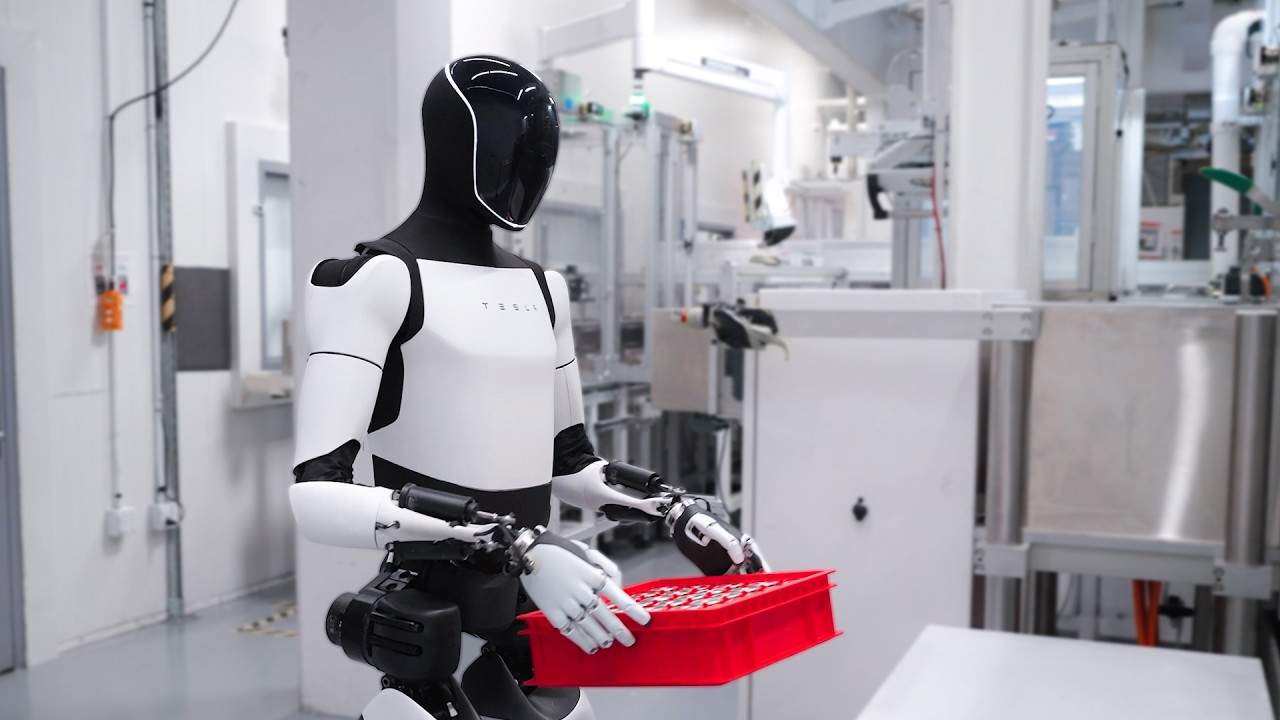
Tesla is preparing to make humanoid robots one of the key areas of its business. The company plans to launch external sales of Optimus in the second half of 2027; in the meantime, the robots are undergoing testing and training at Tesla’s facilities. Elon Musk regards Physical AI — artificial intelligence capable of acting in the physical world — as one of the cornerstones of the company’s future.
- Tesla plans to begin external sales of its Optimus humanoid robot in the second half of 2027.
- Before the product is launched, it will undergo training and testing within Tesla.
- Optimus robots are designed to carry out monotonous, dangerous and physically demanding work.
- Tesla is preparing to bring the new generation of Optimus, Gen 3, into production.
- Elon Musk considers robotics and Physical AI to be one of the key areas for Tesla’s future.
Optimus could go on sale as early as the second half of 2027
Updated commercialisation timetable Optimus This emerged following a meeting between Tesla representatives and JPMorgan analysts at the company’s factory in Fremont. Following the visit, it was reported that Sales of robots to external customers could begin as early as the second half of 2027.
This is consistent with the statement Elon Musk at the World Economic Forum in Davos in January 2026. At the time, the head of Tesla stated that the company expected to start selling humanoid robots by the end of 2027.
Musk emphasised that, before mass sales begin, Tesla wants to ensure that Optimus is highly reliable, safe and offers a sufficiently wide range of features. In other words, the stated timeframe remains the company’s plan, rather than a guaranteed launch date.
Why is Tesla developing Optimus?
Optimus is designed as a versatile humanoid robot capable of performing tasks that are monotonous, dangerous or undesirable.
In its Master Plan Part IV, Tesla explicitly describes Optimus as part of its strategy to bring artificial intelligence from the digital realm into the physical world. According to the company’s vision, autonomous robots should carry out routine tasks, freeing up more time for people to pursue other activities.
Tesla’s own factories became the first major testing ground for this technology. Musk had previously reported that some Optimus units are already carrying out simple tasks in the factories, and the next stage is set to involve mastering more complex operations.
In fact, companies Tesla enable companies to collect data on how robots perform in a real-world manufacturing environment, and to refine their software and mechanics before entering the external market.
Tesla is preparing the Optimus Gen 3 for mass production
The key model for large-scale production should be Optimus Gen 3. Tesla had previously informed investors that the third generation in particular was being developed as the first version of the robot designed with mass production in mind.
The company has begun preparing the production line and supply chain for the new generation of Optimus. In early 2026, Tesla announced its long-term goal of establishing production capacity to produce up to 1 million robots a year, although the actual volumes in the early stages are expected to be considerably lower.
Musk later acknowledged that scaling up production of the Optimus would be challenging. According to him, it could be Tesla’s most complex product in terms of organising production, as virtually all of the robot’s components are new.
Tesla is increasingly becoming an AI company
The Optimus robot is part of a much broader transformation at Tesla. The company is increasingly linking its future not only to electric cars, but also to autonomous transport, robotaxis, artificial intelligence and robotics.
Tesla refers to this as a transfer AI in the physical world: cars must be able to drive themselves on the roads, whilst humanoid robots must be able to carry out physical tasks in a real-world environment.
Musk has repeatedly made very ambitious predictions about Optimus and suggested that, in the future, humanoid robots could become one of Tesla’s biggest products. At the same time, the company has yet to prove that it is capable of turning its demonstration and test models into a reliable product that can be manufactured in the millions.
If the current schedule is adhered to, 2027 could be the first year in which Optimus begins to move from Tesla’s internal tests to real-world external customers.