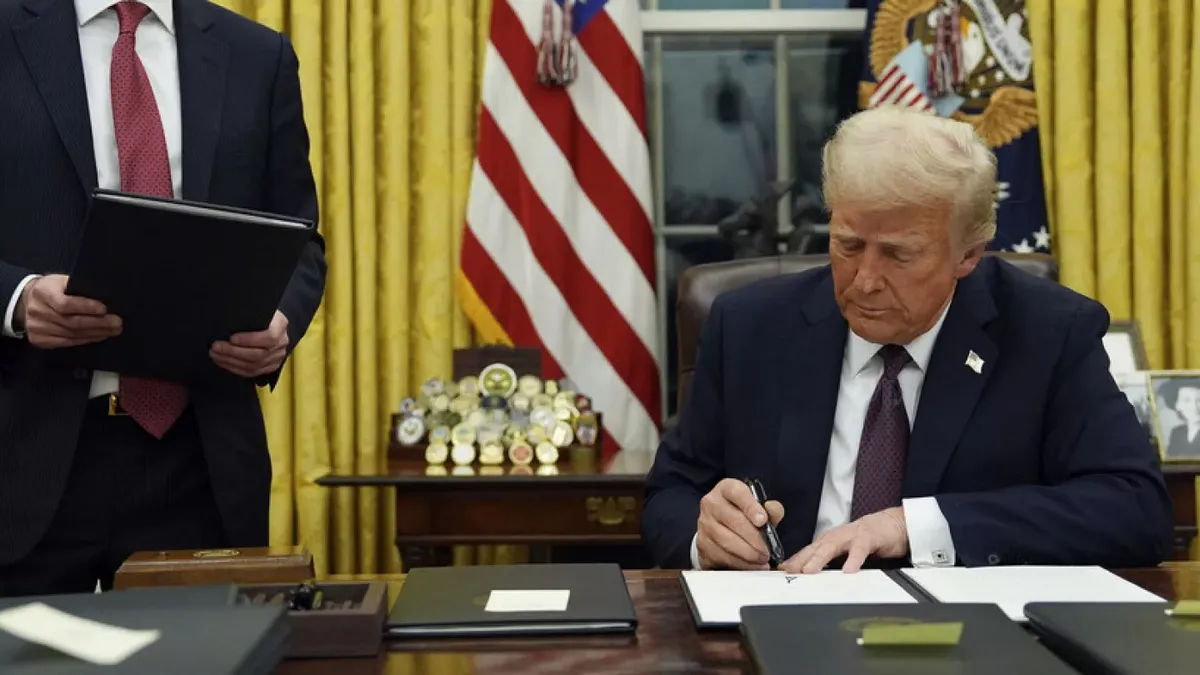
Sanctioning Russia and Iran Act of 2026. The legislation significantly expands sanctions against the Russian leadership, banks, the energy and defence-industrial sectors, and vessels that assist in circumventing oil restrictions. Separately, the Act empowers the US President to impose tariffs of up to 100% on major purchasers of Russian energy resources and up to 500% directly on goods from the Russian Federation. The White House officially confirmed the signing of the Act on 18 September.
- Donald Trump signed the Lindsey O. Graham Sanctioning Russia and Iran Act of 2026.
- Import duties on goods imported directly from Russia may amount to up to 500%.
- Duties of up to 100% are to be imposed on the largest buyers of Russian oil and gas.
- The restrictions also apply to vessels and companies that assist in circumventing oil sanctions.
- The US President is granted the power to grant exemptions from sanctions under conditions laid down by law.
- The Iran Sanctions Act has been extended until 2031.
Duties on goods from Russia under heading 500%
One of the toughest provisions of the new law concerns imports from Russia. The legislation requires the US President to increase tariffs on goods of Russian origin no later than 30 days after the law comes into force to a level that could reach 500%. The list explicitly includes crude oil, natural gas and liquefied natural gas, petroleum products, petrochemicals, coal and other goods. These tariffs may be applied in addition to other US duties and levies currently in force.
China and India may face tariffs of up to 100%
This specific mechanism is not directed against Russia itself, but against countries that continue to purchase significant volumes of Russian energy resources.
The law permits the installation of Duties up to 100% on all goods, … imported into the US from countries that are among the top five importers of Russian oil or gas and continue to make new purchases after the period specified by law. The mechanism also covers countries through which oil sanctions are being circumvented on a large scale.
Reuters notes that, amongst the countries that could potentially be affected by this mechanism, particular attention is focused on China and India due to their purchases of Russian energy resources. However, the mere fact that the law has been passed does not mean that the maximum rate will automatically be imposed on these countries.
Putin, Russian banks, oligarchs and the «shadow fleet»
The document sets out a sanctions regime targeting senior Russian officials. The text of the law specifically names the President of the Russian Federation, the Prime Minister, the Minister of Defence, the leadership of the Russian armed forces and a number of other high-ranking officials. Under sanctioned Russian oligarchs who continue to benefit from their ties to the Russian authorities also meet these criteria.
A separate section deals with the financial sector. The Act imposes restrictions on the Bank of Russia, Sberbank, VTB, Gazprombank and other financial institutions linked to the Russian state.
Measures against the so-called are also being stepped up the Russian shadow fleet. Sanctions may be imposed on vessels, their owners and operators, insurers and other entities involved in the transport of Russian oil or which assist in circumventing the restrictions in force.
The law simultaneously imposes restrictions on new US investment in the Russian energy sector and provides for sanctions against companies that help to sustain or expand Russian production of oil, gas, coal and other energy resources.
The US President retains the power to grant exemptions
Despite the scale of the package, the law leaves the US President considerable scope to implement it. The President may to refrain from applying a specific sanction, restriction or duty, but before doing so, he must certify in writing to Congress that such a decision is in the national interest of the United States, and explain the grounds for it.
The Act also provides for a mechanism for lifting sanctions. In particular, with regard to Russia, the Act links this possibility to peace agreement, adopted by the Government of Ukraine, the cessation of hostilities and Russia’s renunciation of actions aimed at undermining Ukrainian statehood.
Sanctions against Iran have been extended for a further five years
In a separate provision of the Act, Congress extended the validity of Iran Sanctions Act of 1996. Its term, which was due to end in 2026, has been extended to in 2031.
This sanctions regime applies, in particular, to Iran’s energy sector and weapons-related activities. The Trump administration supported a five-year extension of these powers whilst the bill was still making its way through the Senate.
The Russian section of the Act itself, unless it is amended or repealed earlier in accordance with the prescribed procedures, is to a five-year term.
Trump’s signature marked the bill’s passage through Congress: it had previously been backed by the Senate, and on 16 September the House of Representatives approved the bill by a vote of 262 to 159. The package now has the status of a US federal law.