On 8 October, the Russian Prosecutor General’s Office submitted requests to the Netherlands for the arrest and extradition of nine officials from the International Criminal Court. Moscow links the persecution to the court’s rulings concerning the Russian leadership, in particular the arrest warrant for Vladimir Putin. A Russian court had previously sentenced the defendants in absentia to prison terms.
Briefly about the main points
- Russia’s requests were sent to the Dutch Ministry of Justice and Security.
- The list includes former officials and current judges of the International Criminal Court.
- Russian sentences handed down in absentia carry prison terms of between 3.5 and 15 years.
- The ICC suspects Putin of war crimes against Ukrainian children.
- Dutch support for the ICC does not imply an automatic decision on the Russian Federation’s request.
Who is Moscow asking to be detained?
According to the Russian Federation’s Prosecutor General’s Office, the request was sent to the Dutch Ministry of Justice and Security, as well as to a number of other countries. The Russian side states that the individuals in question are the subject of international arrest warrants issued by its law enforcement agencies.
Moscow claims that court officials allegedly exceeded their powers by considering the issue of criminal liability of high-ranking officials of the Russian Federation. Russia is not a party to the Rome Statute and does not recognise the jurisdiction of the ICC.
- Piotr Hofmański — former chairman of the IOC.
- Karim Khan is the former Chief Prosecutor of the International Criminal Court.
- Lus del Carmen Ibáñez Carranza — Judge at the International Criminal Court.
- Tomoko Akane is a judge at the International Criminal Court.
- Rosario Salvatore Aitala — judge at the International Criminal Court.
- Sergio Gerardo Ugalde Godínez — judge at the International Criminal Court.
- Bertram Schmitt is a former judge at the International Criminal Court.
- Reine Alapini-Hansu is a judge at the International Criminal Court.
- Haikel Ben Mahfoud — judge at the International Criminal Court.
In absentia sentences handed down by a Russian court
On 12 December 2025, the Moscow City Court handed down sentences in absentia to all those involved in the case. They were charged, amongst other things, with the alleged unlawful prosecution and unlawful detention under the Russian Criminal Code.
The sentences ranged from 3.5 to 15 years. As reported by the Russian news agency «Interfax», Karima Khan He was sentenced in absentia to 15 years: according to the sentence, he would have to spend the first nine years in prison and the remainder in a strict-regime correctional colony.
Arrest warrants for Putin and Lvova-Belova
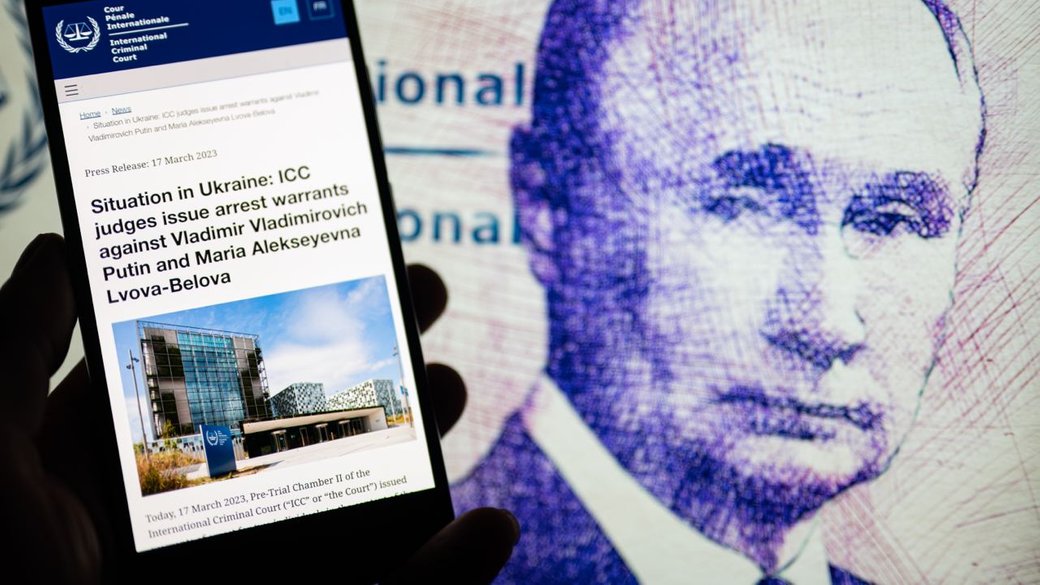
On 17 March 2023, Pre-Trial Chamber II of the International Criminal Court issued arrest warrants for the President of Russia Vladimir Putin and the Russian Commissioner for Children’s Rights Mariya Lvova-Belova. The court suspects them of war crimes relating to the unlawful deportation and transfer of Ukrainian children from the occupied territories to Russia.
The ICC has indicated that there are reasonable grounds to believe that such crimes may have been committed from at least 24 February 2022. With regard to Putin The court is also considering the issue of liability for failing to exercise proper control over civilian and military subordinates implicated in alleged crimes.
The chamber that handed down the ruling was composed of Akane, Aitala and Ugalde Godines. Ukraine had previously recognised the ICC’s jurisdiction over crimes committed on its territory, and the arrest warrants remain in force.
What are the legal conditions in the Netherlands?
The ICC is based in The Hague, and the Netherlands is a State Party to the Rome Statute. The Dutch Government has repeatedly expressed its support for the court’s independence and its work in investigating international crimes.
In a joint declaration with Ukraine dated 4 May 2023, the Netherlands welcomed the arrest warrants issued for Putin and Lvova-Belova and called on member states to facilitate their enforcement. In February 2025, the country, together with other states, also spoke out against pressure being exerted on judges and prosecutors at the ICC.
The mere fact that Russian requests have been submitted does not imply that the Dutch authorities have consented to the arrest or extradition. A decision on extradition will require the appropriate legal grounds and procedures.