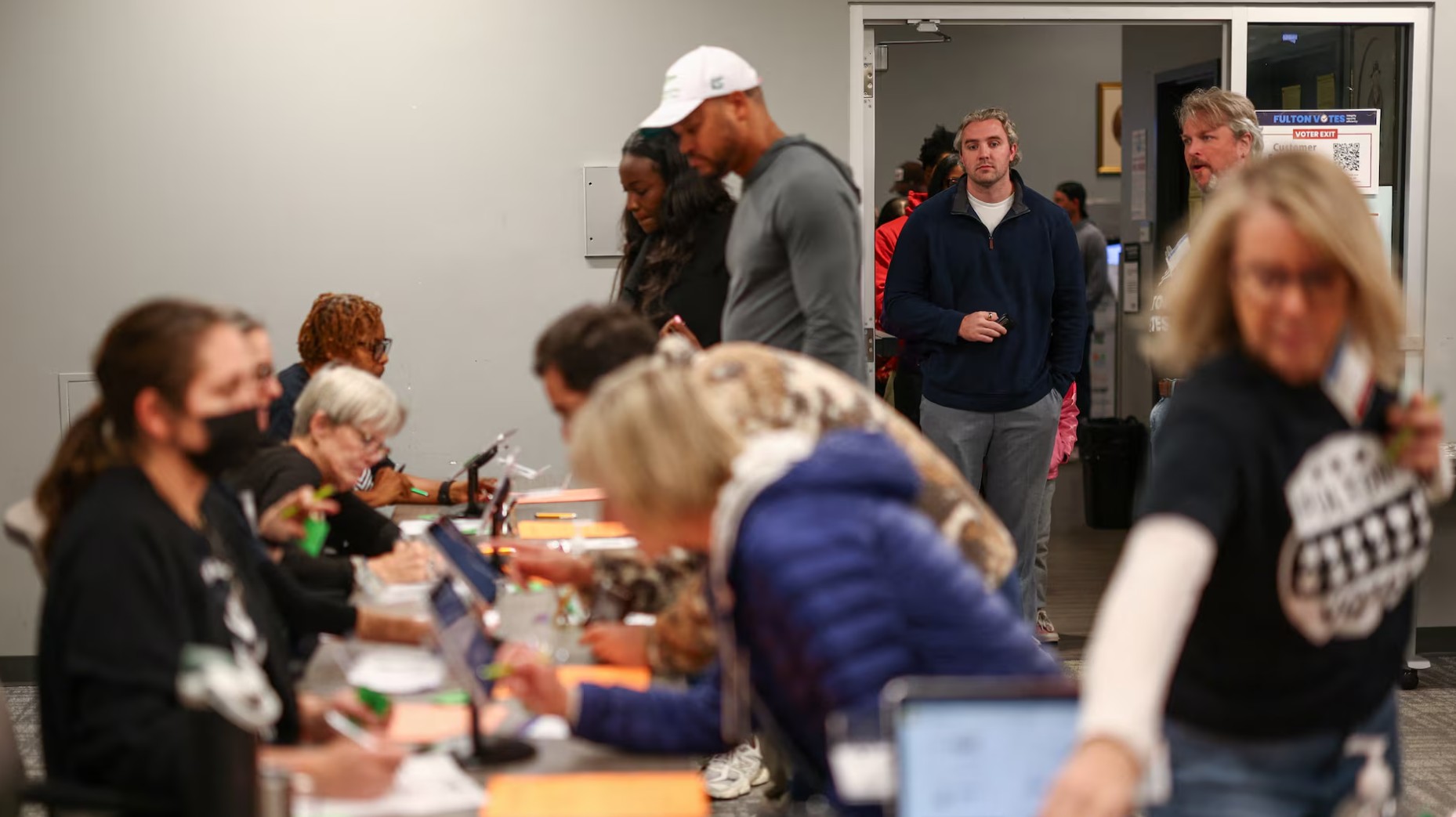
In the United States, voting began on 3 November in the mid-term congressional elections, which will determine the balance of power for the final two years of Donald Trump’s presidency. Americans are electing all 435 members of the House of Representatives and 35 senators. Polls suggest the Democrats have the upper hand in the race for the lower house, whilst the outcome of the Senate elections remains uncertain.
- Mid-term elections for both houses of Congress are taking place in the US on 3 November.
- Americans elect all 435 members of the House of Representatives and 35 of the 100 senators.
- Polls show the Democrats have the upper hand in the race for the House of Representatives.
- The US Department of Justice has sent around a thousand observers to all 50 states.
- The first results of the vote are expected on the night of 4 November, Kyiv time.
Americans are deciding whether the Republicans will retain their majority
At present, the Republican Party controls both houses of Congress, which enables the administration to Trump to introduce legislative initiatives with the support of fellow party members.
In the House of Representatives The contest is underway for 435 seats. To secure a majority, a party must win at least 218 seats. In the Senate, 35 out of 100 members are up for re-election.
For the Democrats, the main priority has become regaining control of the House of Representatives. The Republicans’ lead there is narrow, so even a change in the results in just a few constituencies could tip the balance of power.
In the Senate, the Republicans hold 53 seats, compared with 47 held by the Democrats and independent senators who work with them.
The battle for control of the upper house is centred on around ten states, a significant proportion of which traditionally support the Republicans.
In addition to Congressional elections, Americans are voting for governors in 36 states, members of local legislative bodies and on a number of regional initiatives.
The war with Iran and high prices have become Trump’s main problems
The election campaign took place against a backdrop of growing discontent amongst Americans over the cost of living, the consequences of the White House’s trade policy and the war with Iran.
Approval ratings Donald Trump’s approval ratings have fallen to their lowest levels of his second presidential term. A significant proportion of voters are dissatisfied with the rise in prices of fuel and everyday goods.
The President himself has been actively involved in the Republicans’ campaign, holding more than twenty campaign rallies since the beginning of October.
Trump urged his supporters to vote as if his name were also on the ballot paper.
In an interview with Fox News on 3 November, the President expressed confidence in the Republicans’ results and said he would be monitoring the vote count from the White House.
The Democrats have focused their campaign on criticising the administration’s economic decisions, rising prices and Washington’s foreign policy.
Michigan, Texas and Alaska have become the focal points of the fiercest battle
The Senate elections in Michigan, Texas, Alaska, Kansas, Maine, Iowa, Nebraska, Ohio and South Carolina are attracting particular attention.
In Michigan, Democrat Abdul El-Sayed is running against Republican Mike Rogers. On the eve of the vote, the situation became more complicated after Democrat Hayley Stevens, who lost the party primary to El-Sayed, unexpectedly endorsed his Republican opponent.
In Texas, Democrat James Talarico is running against Republican Ken Paxton. Paxton’s campaign has received financial backing from Elon Musk, who has spent hundreds of millions of dollars to help Republicans in their battle for Congress.
In Alaska, pre-election disputes have escalated into court cases. The Department of Justice has launched an investigation into reports that a ‘doppelgänger’ candidate may have been used to influence the vote. Democrat Mary Peltola has denied any involvement in the matter.
The US Department of Justice has sent a thousand observers to polling stations
On 3 November, the US Department of Justice announced the largest election monitoring operation in its history.
Around a thousand federal observers and agency representatives were sent to all 50 states.
According to the official explanation, their role is to monitor compliance with federal legislation on electoral rights, prevent the intimidation of voters and ensure that voting is accessible.
At the same time, the Trump administration’s interference in electoral disputes has drawn criticism from the Democrats.
In particular, the Ministry of Justice sought a court order to impose restrictions on the counting of certain ballot papers in California. The US Supreme Court rejected the administration’s request for an emergency injunction.
When will the results be announced, and what will they mean for Ukraine?
More than 57 million Americans have voted early even before the polling stations opened on 3 November.
The first results are expected after the polling stations close in the evening local time. In Ukraine, this will be in the early hours of 4 November. The final distribution of seats in Congress may not be known for several days if the results in closely contested constituencies are neck and neck.
For Ukraine, the elections are significant primarily because of Congress’s powers to authorise military aid, pass sanctions legislation and exercise oversight over the US administration’s foreign policy.
If the Republicans lose their majority in at least one chamber, the White House’s legislative agenda will depend on agreements reached with their political opponents. At the same time, the President will retain significant powers in the field of foreign policy and the right to veto bills.