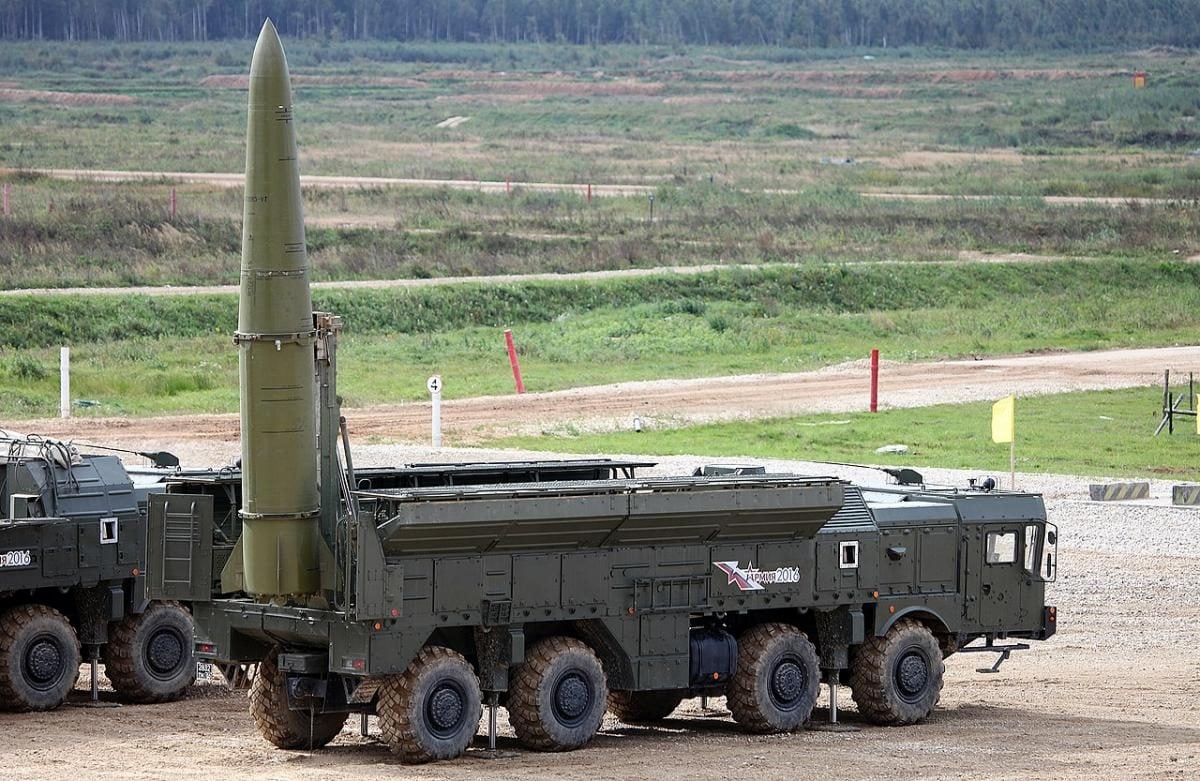
Russia is moving into a new phase of its missile war against Ukraine. It is no longer just a question of increasing the number of «Iskanders», X-101s or «Kalibrs», but of the systematic increase in range, the reduction in production costs and the shift from expensive, one-off weapons to mass-produced ballistic systems.
According to available intelligence, Moscow is working on the further development of the «Iskander-M» missile platform, with a prospective range of up to 1500 km. Test-firings of such weapons could begin as early as October–November, and the western regions of Ukraine could be among the potential areas for combat testing.
If successful, Russia intends to move to mass production of a promising missile, which is referred to in intelligence reports as «Uran-2»: initially around 20 units per month, and subsequently up to 50.
At the same time, it is important to distinguish between this promising programme and weapons that have already been confirmed. The Main Intelligence Directorate has officially established that Russia used a modernised version against Kyiv for the first time this summer 9M723-2, known by the code name «Iskander-1000». However, its confirmed range currently stands at up to 550 km, rather than 1,000 km. The name «Uran-2» and the missile’s specifications for a range of 1,500 km have not yet been disclosed in publicly available official sources.
- Russia is already deploying the upgraded 9M723-2 ballistic missile.
- The confirmed range of the «Iskander-1000» is currently up to 550 km.
- Intelligence reports suggest that work is continuing on a range of up to 1,500 km.
- Russia is already producing more than 200 cruise and ballistic missiles every month.
- Ukraine’s key priority is to scale up its anti-ballistic defence capabilities.
«The »Iskander-1000’ is no longer just a project — it has been used against Ukraine
The most significant change is that the modernisation of Russian ballistics is no longer merely theoretical.
On 27 August, the Main Intelligence Directorate officially announced that, during one of the summer combined strikes on Kyiv, Russia had used for the first time 9M723-2. The missile forms part of the new «Bora-M» system and differs from the basic «Iskander-M» primarily in its larger engine and corresponding launch system.
According to Ukrainian intelligence estimates, the basic 9M723-1 actually has a range of around 390 km, whilst the upgraded missile is capable of travelling up to 550 km.
That is precisely why the title «Iskander-1000»This is somewhat misleading. The Russian defence industry is indeed seeking to increase the range of this missile series; however, there is currently no confirmed combat flight of a production-model 9M723-2 over a distance of 1,000 km. Ukrainian experts believe that, in order to further increase the range, Russia is experimenting with higher-energy-density fuel, engines and a reduction in the warhead’s mass.
In other words, the process is a gradual one:
390 km → 550 km → a potential 1,000 km → a future system with a longer range.
And it is precisely this final link that poses the greatest threat.
Why does Russia need ballistic missiles with a range of 1,000–1,500 km?
At first glance, Russia does not need such a long range to strike Ukraine. Even from its current launch sites, a significant part of Ukrainian territory is already within the range of various types of missiles.
However, the greater range gives the Russian army several advantages at once.
First and foremost, launchers can move considerably further away from the Ukrainian border. This makes it more difficult for Ukrainian long-range weapons to detect and destroy them.
The second factor is the ability to attack western Ukraine without having to move launchers closer to Ukrainian territory. The Lviv, Zakarpattia and Volyn regions, as well as logistics hubs and infrastructure near the EU borders, are under constant ballistic threat, even from deep within Russian territory.
The third factor is — response time. A cruise missile can take tens of minutes or over an hour to reach its target. In ballistics, every minute counts. It is the Main Intelligence Directorate that emphasises that the flight time of Russian ballistic missiles It takes just a few minutes to get to Kyiv.
So, an increase in range is not just a higher figure in the specifications. It enables Russia to establish a remote and hard-to-reach the continuous-start zone, from which you can make calls to almost anywhere in Ukraine.
Russia has already restructured its production for a large-scale missile war
The most worrying aspect of the situation is not the emergence of the new missile itself, but the industrial infrastructure behind it.
According to the Main Intelligence Directorate, Russia is currently capable of producing more than 200 cruise and ballistic missiles every month. The main priorities were the «Iskander-M», the Kh-101 and the «Kalibr».
In July alone, the Russian defence industry produced:
- 65 9M723 «Iskander-M» missiles»;
- 87 X-101 missiles;
- about 50 RM-48U missiles for the S-400;
- 29 «Calibres».
And this is not production «for stockpiling». Russia is capable of both building up part of its arsenal and carrying out regular large-scale attacks.
As at the beginning of August, the Main Intelligence Directorate estimated the stock of 9M723 to be approximately 130 missiles, RM-48U – around 400, «Kalibr» missiles – over 450, «Zircon» missiles – over 120, Kh-101 – up to 100 units.
In July, Russia used 198 ballistic and hypersonic missiles the 9M723, RM-48U and «Zircon» types. This was the highest monthly figure in 2026.
Therefore, a scenario in which future combined attacks consist of hundreds of missiles and thousands of different UAVs no longer seems far-fetched.
Why Russia might abandon the «Kinzhal» programme»
Another telling trend is the reorientation of the Russian defence industry.
According to the Main Intelligence Directorate, from April 2026, the Russian Federation has suspended the mass production of «Kindjals» and redirected resources towards other types of ballistic and cruise missiles. This includes fuel, components, funding and production capacity.
This is an important signal.
«Kinzhal» is a complex and expensive system that requires not only the missile itself but also a specialised carrier aircraft. A ground-based, mobile, long-range missile is potentially cheaper to operate, easier to deploy on a large scale and does not rely on the MiG-31K.
The rationale behind a possible «Uran-2» is therefore clear: to provide Russia with a significant proportion of the «Dagger» programme’s capabilities, but in a more mass-produced ground-based platform.
There is currently no public evidence that «Uran-2» has already been approved as a replacement for the «Kinzhal». However, the trend towards shifting resources from the «Kinzhal» to more mass-produced missile systems has been confirmed by the Main Intelligence Directorate.
Ukraine’s main problem is not the range of its own missile
Against this backdrop, the question naturally arises: How will Ukraine defend itself against such a large number of ballistic missiles?
Today, the most effective means of countering «Iskanders» and other complex ballistic targets remains Patriot with PAC-3 interceptors. The Ministry of Defence explicitly states PAC-3 the most effective means of countering Russian ballistic missiles.
But there are two problems.
The first — number of batteries. The Patriot system can defend specific areas and targets, but at present it is not possible to provide coverage for the whole of Ukraine with these systems.
The second — number of interceptor missiles.
On 20 August, Zelenskyy stated outright that the situation regarding the interception of ballistic missiles is significantly worse than that for cruise missiles, and that Ukraine is in desperate need of additional missiles for the Patriot system. During that strike, around 90% cruise missiles were successfully shot down, whilst the situation with ballistic missiles was far more complicated.
In July, there was an even more telling incident: during one of its large-scale strikes, Russia launched 29 ballistic missiles, and Ukraine was unable to intercept any of them due to a lack of the necessary capabilities.
This is precisely where the crux of the entire Ukrainian strategy lies.
Ukraine needs its own long-range weapons. But they are no substitute for anti-ballistic defence.
The ability to strike a Russian factory 1,500 km away will not protect a residential building, a thermal power station or a substation from an «Iskander» missile that is already on its way to Kyiv.
Patriot is set to be just the first step
The positive aspect is that Ukraine is already moving towards establishing a separate anti-ballistic architecture.
In July, Ukraine and France agreed that the Ukrainian Armed Forces would become the first operational user of the SAMP/T NG. Ukraine plans to order four such systems. Pending the delivery of the new systems, France is also to supply two previous-generation SAMP/T batteries.
There are also plans to localise missile production in Ukraine Aster 30, and the first SAMP/T NG components, including the GF300 radar, are due to start arriving before the end of 2026. The deployment of the modules themselves SAMP/T NG is planned for 2027.
At the same time, a European-Ukrainian programme has been launched FREYJA to develop its own anti-ballistic missile interceptor. According to Zelenskyy, ten countries are already taking part in the project, and Ukraine is to produce its own missile and launcher, whilst its partners will assist with radars, sensors and critical components.
Separately, Ukraine is working on acquiring the technological capability to manufacture missiles for the Patriot system. According to the president, this capability is expected by the end of 2026.
All of this is a step in the right direction. But putting it into practice takes time, which Russia is trying to prevent Ukraine from having.
What Ukraine’s anti-ballistic shield should look like
It is not enough for Ukraine simply to acquire a few more Patriot systems.
Required a comprehensive system, consisting of at least five levels.
The first is the Patriot PAC-3 and SAMP/T/SAMP/T NG. They are intended to protect the largest cities, the nuclear power sector, critical energy infrastructure and government facilities.
The second is our own mass interception system. FREYJA and other Ukrainian programmes must move from the research and development phase to industrial-scale production. Ukraine cannot remain dependent indefinitely on the number of PAC-3s its partner is prepared to supply this month.
Thirdly — radar coverage and early warning. The sooner the launch is detected and the trajectory plotted, the greater the chances of interception and the sooner the public can be warned.
Fourth — the physical protection of critical infrastructure. The power system must be designed on the assumption that some missiles will penetrate the defences. Redundant components, spare transformers, the decentralisation of power generation and engineering defences all form part of air defence in the broadest sense.
Fifth — strikes against the very system of missile production and deployment. Launch sites, Russian defence industry facilities, component warehouses and logistics centres must remain priority military targets. This is not a substitute for air defence, but a way of reducing the number of missiles that air defences will have to intercept.
It is precisely this model that offers a chance of winning the economic race. It is simply not feasible in the long run to intercept every cheaper Russian missile with expensive PAC-3s.
Winter could put the system to the test
Russia is already showing the direction its strategy is taking.
More missiles. More ballistic missiles. More «Shahed» drones. More complex trajectories. Simultaneous strikes using various weapons from different directions.
The task is to overloading of Ukraine’s air defence system: to force the enemy to use up their expensive interceptors, create a shortage of ammunition, and then strike the most heavily defended targets with ballistic missiles.
From this perspective, the prospect of a 1,500 km missile is merely the next component of a system that Moscow is already building.
Therefore, the question of «whether the “Uran-2” in particular will be launched in November» is less important than the overall trend.
It is already clear: Russia is attempting to transform high-precision ballistic weapons from a scarce resource into a mass means of systematic terror against the home front.
What Ukraine needs to do right now
Ukraine must develop both its offensive and defensive capabilities simultaneously. However, in the context of the potential widespread use of new ballistic weapons, the priority must be precisely the protection of people and critical infrastructure.
We need additional Patriot systems and a stockpile of PAC-3 missiles – not just for a single attack, but for a protracted campaign. We need accelerated deliveries of SAMP/T and Aster 30 systems. We need to start manufacturing them in Ukraine. We need our own FREYJA system and other anti-ballistic solutions.
And we need to acknowledge a simple reality: Counter-strikes and missile defence serve different purposes.
A long-range Ukrainian missile can destroy a factory, an airfield or a launch pad. But it is the interceptor, shelters and a properly designed early-warning system that save lives during a specific attack.
Russia is already investing resources in the next generation of strike weapons. Therefore, for Ukraine, the next major defence project should not simply be yet another missile, but a fully-fledged national anti-ballistic defence system.