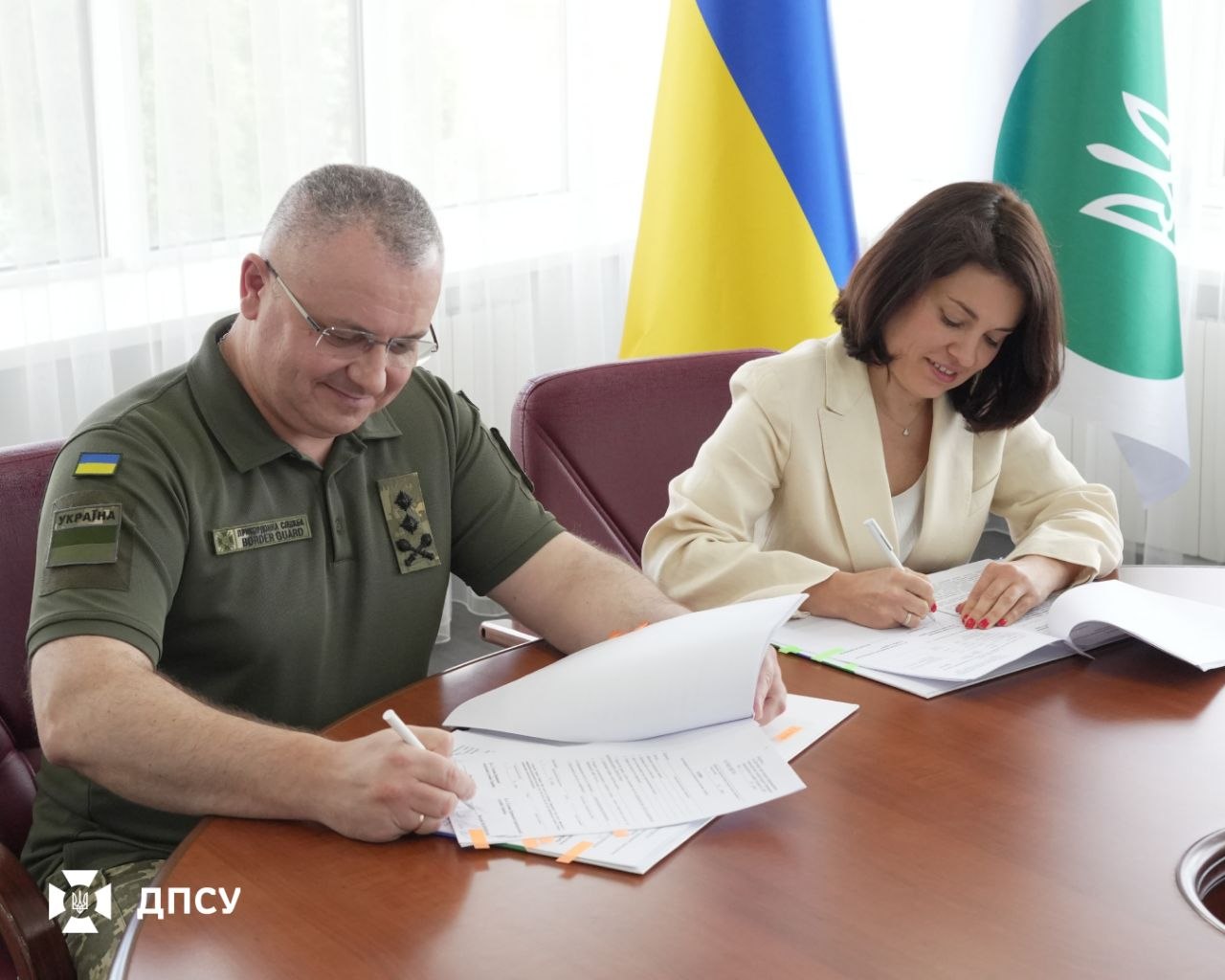
The State Border Guard Service and the State Tax Service have signed an agreement and a protocol on the automated electronic exchange of information. The documents were signed by Major General Valerii Vavryniuk, Acting Head of the State Border Guard Service, and Lesia Karnaukh. The agencies will transmit the necessary data via secure digital systems instead of paper correspondence and manual processing of requests.
Briefly about the main points
- The State Border Guard Service and the Tax Authority have signed an agreement and a protocol on the exchange of information.
- Requests will be transmitted via secure digital systems.
- Each request will be authenticated by an electronic signature and recorded in the system.
- The new mechanism does not alter the rules for crossing the state border.
- Automation should help to combat illicit schemes.
What does the new mechanism entail?
Automation is set to significantly reduce the workload on State Border Guard Service staff, who previously had to process enquiries and correspondence manually. For the Tax Service, the faster receipt of information should become a tool for combating «grey» imports, fictitious transactions and the shadow economy.
The mechanism does not introduce any additional checks or restrictions for citizens. Border crossing rules remain unchanged. Data will be transmitted via secure systems, and each request will be confirmed and documented by means of an electronic signature and system logging.
Part of the wider digitalisation of the tax authorities
Cooperation between border guards and tax and customs authorities has existed previously; in particular, it was governed by joint procedures. The new documents shift this specific exchange to a more automated format, which has the potential to reduce the time lag between the State Border Guard Service receiving relevant information and the Tax Service utilising it for risk analysis.
The initiative is in line with the National Revenue Strategy to 2030, which the government approved at the end of 2023. The strategy provides for the modernisation of tax and customs administration, digitalisation and the development of secure information systems. The automatic exchange of information itself does not imply automatic additional assessments or penalties: the information received may be used for analytical purposes and for further procedures laid down by law.
Data for identifying high-risk transactions
The practical value of the system will depend on how the Tax Authority uses the information obtained in its risk analysis. Faster data comparison may make it easier to identify discrepancies in foreign trade and related tax transactions.
On 16 July 2026, the State Tax Service announced that, following nearly 100 documentary audits of importers of second-hand cars, it had assessed additional tax of 1.2 billion UAH and reduced the VAT credit by almost 1 billion UAH. These results are not linked to the new protocol, but they illustrate the scale of the risks involved in import transactions.