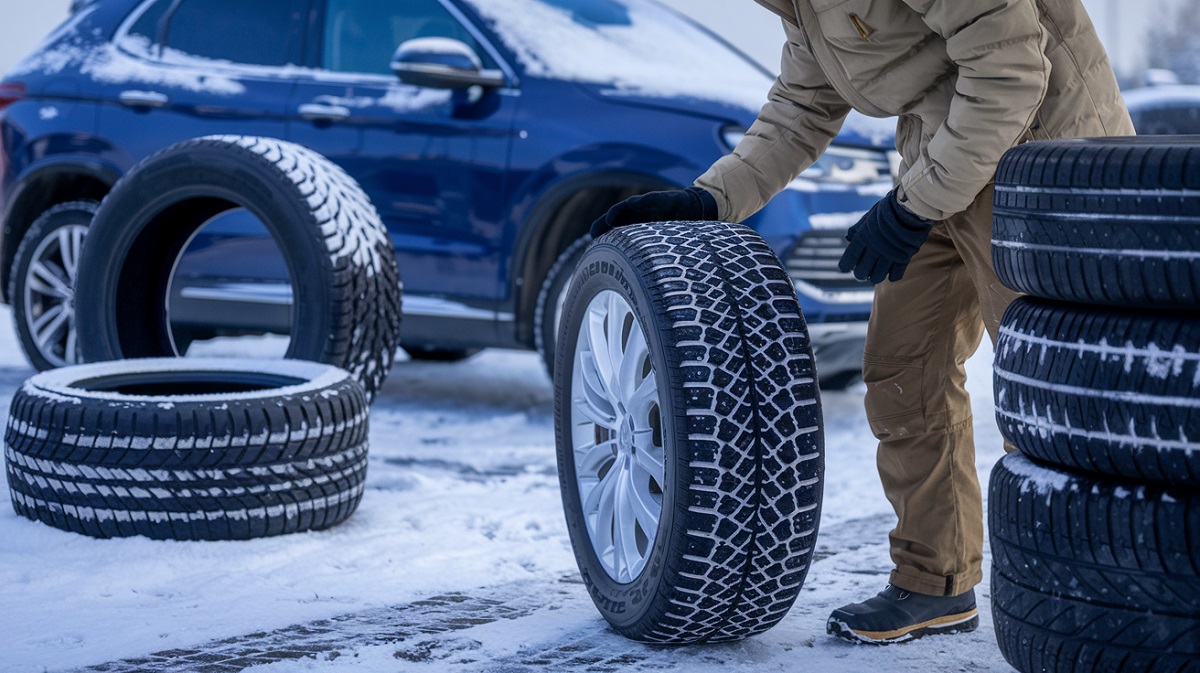
As the cold weather sets in, drivers start looking for winter tyres; however, basing your choice solely on the brand, price or tread depth is a mistake. Even expensive tyres can turn out to be a poor choice if they are not suited to the car or the driving conditions. Some models perform better on snow, others offer a shorter braking distance on wet tarmac, whilst some budget tyres fall significantly short of their competitors in terms of safety.
- Winter tyres should be fitted before the cold weather sets in and the first black ice appears.
- The tyre size and load index must comply with the vehicle manufacturer’s specifications.
- The 3PMSF marking confirms that the tyre has passed a standardised snow grip test.
- The ADAC recommends replacing winter tyres when the tread depth is around 4 mm.
When to switch to winter tyres
A common mistake made by drivers is to wait for the first snow or black ice. In fact, you should start preparing your car for winter earlier, when the average daily temperature consistently drops to around +7°C.
This is a guideline recommended by the Ukrainian Patrol Police. At low temperatures, the performance of summer tyres changes, and on cold, snow-covered or icy roads, they may not provide sufficient grip. However, a temperature of +7°C is not a strict physical limit: tyre performance also depends on the road surface, the weather and the specific model.
As of November 2026, there is no date set by law in Ukraine for the mandatory switch to winter tyres. Nor is there a specific fine for using summer tyres in winter. However, drivers are required to ensure that their tyres are in good condition.
How to choose the right size of winter tyres
Before choosing a manufacturer, you need to find out which tyres are approved for fitting to a particular car. The required specifications are set out in the owner’s manual and may also be indicated on the manufacturer’s sticker on the door frame or the fuel filler flap.
For example, labelling 205/55 R16 91H contains several characteristics at once:
- 205 — tyre width in millimetres;
- 55 — the height of the profile as a percentage of its width;
- R16 — radial construction and a 16-inch rim diameter;
- 91 — load capacity index;
- H — the tyre’s maximum speed rating.
You should not change the size of your tyres yourself simply to save money or improve the car’s appearance. Incorrectly fitted tyres can affect the car’s handling, speedometer readings and the operation of electronic safety systems.
For crossovers, electric vehicles and heavy vehicles, it is particularly important to choose the correct load index. If the manufacturer specifies reinforced XL tyres, this should also be taken into account when making a purchase.
European or Scandinavian winter tyres: which are better?
Driving conditions are one of the key criteria when making a choice. Winter tyres differ not only in their tread pattern, but also in the composition of the rubber compound and their performance on different road surfaces.
For city driving, where roads are frequently cleared of snow, it is usually advisable to consider European-style winter tyres. These are designed for cold tarmac, rain, wet snow and slush. When making your choice, you should pay particular attention to braking performance on wet surfaces.
For regions experiencing prolonged cold spells, on snow-covered roads and where black ice is common, Scandinavian-style friction tyres may be a better choice. Their design usually features a softer rubber compound and a large number of sipes to improve grip on snow and ice.
Studded tyres may offer advantages on certain types of ice, but they generate more noise and behave differently on dry tarmac. Furthermore, the rules governing their use vary from country to country, which is important to bear in mind when travelling abroad.
M+S and 3PMSF: what markings should be on winter tyres
On the sidewall of a winter tyre, you can see the letters ‘M+S’ and a symbol depicting a mountain with three peaks and a snowflake.
Inscription M+S stands for Mud and Snow. However, this label alone does not confirm that the tyre has passed standardised winter grip tests.
Instead 3PMSF (Three-Peak Mountain Snowflake) certifies that the tyres have passed tests for grip on compacted snow. It is this marking that you should look out for when buying winter and all-season tyres.
In addition, buyers can check the European EU Tyre Label. It provides information on fuel efficiency, wet grip and external noise. However, this label does not provide a complete picture of how tyres perform on snow and ice, so it should be supplemented with the results of independent tests.
Why the cheapest winter tyres can end up costing more
The difference between budget tyres and more expensive ones is not always obvious during normal driving. It is most evident in emergency situations — during sudden braking, manoeuvres or when traction is lost on a slippery road.
In September 2026, the German motoring organisation ADAC tested 32 models of winter tyres in two popular sizes. The results revealed significant differences between manufacturers, even within the same price category.
Of the 16 225/50 R17 tyres tested, only four received an overall «good» rating, whilst six performed poorly. The difference in braking distance on wet tarmac between the best and worst tyres exceeded 10 metres.
This means that the decisive factor should not be price or brand popularity, but balanced safety performance. Before buying, it is worth looking up test results for the specific size you need, as the same model may perform differently depending on the size.
How to check the date of manufacture and the condition of the tread
Even tyres that look new may have been in storage for a long time. The four-digit code at the end of the DOT marking helps to determine the date of manufacture.
For example, the code 3526 indicates that the tyre was manufactured in the 35th week of 2026. Age alone does not render a properly stored tyre unsuitable for use; however, before purchasing, it is advisable to find out how long it has been stored and under what conditions.
In Ukraine, the minimum permissible remaining tread depth for most passenger cars is 1.6 mm. However, this figure is a legal limit, not a recommendation for safe winter driving.
The ADAC recommends replacing winter tyres when the tread depth has worn down to approximately 4 mm. If the tread depth is any shallower, grip on snow, slush and wet roads may deteriorate significantly.
You should also check the sidewalls for cracks, cuts and bulges. ADAC experts advise against using winter tyres that are more than eight years old, even if they have sufficient tread depth, as the rubber compound loses some of its properties over time.
Is it possible to buy just two winter tyres, or should I opt for all-season tyres?
Fitting just two winter tyres instead of a full set creates a difference in grip between the front and rear axles of the car. This can lead to unpredictable behaviour when cornering or during emergency braking. A safer option is a set of four identical winter tyres.
All-season tyres may be a good compromise for drivers who mainly drive in town, cover short distances and rarely drive in challenging winter conditions. However, for regular journeys on snow-covered roads, mountain roads and in severe frost, specialised winter tyres are usually the more sensible choice.
Before fitting a new set, it is also worth checking the condition of the wheel rims and ensuring they are balanced. Even high-quality winter tyres cannot compensate for speeding or failing to maintain a safe following distance on a slippery road.