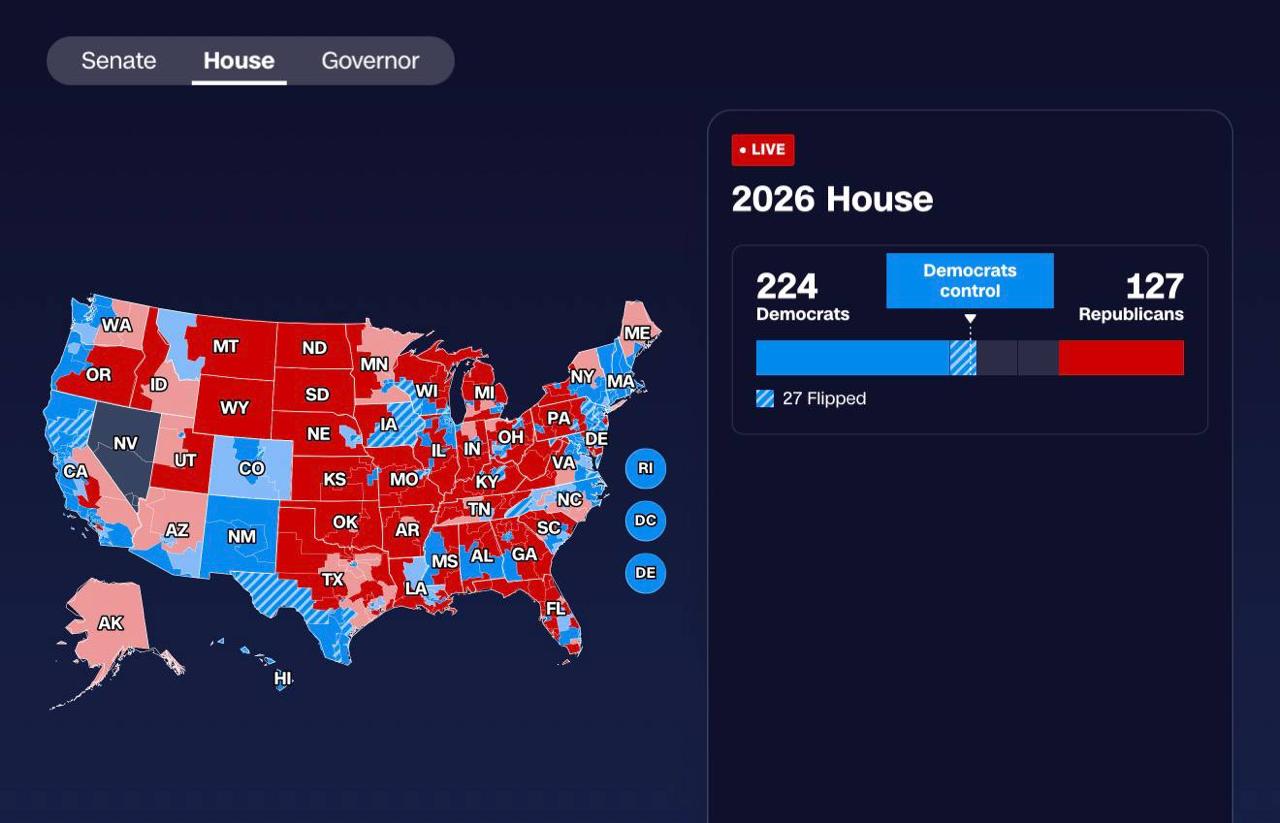
The US Democratic Party regained control of the House of Representatives and the Senate following the mid-term elections on 3 November. According to projections by leading US media outlets, the Republicans have lost their majority in both houses of Congress. President Donald Trump has stated his willingness to accept the results of the vote and to cooperate with the Democrats, whilst attributing his party’s defeat to the fact that he did not personally take part in the election.
- The Democrats have won a majority in the US House of Representatives and the Senate.
- According to CNN, the Democrats have surpassed the required threshold of 218 seats in the House of Representatives.
- In the Senate, the Democrats also secured enough seats to maintain control of the chamber.
- Trump has stated that he is prepared to accept the election results and to work with the Democrats.
- The new composition of Congress will limit the President’s ability to push through legislative initiatives.
The Democrats have regained control of Congress
The US mid-term elections have resulted in a shift in the political balance in Washington. The Democratic Party has secured a majority in both houses of Congress, depriving the Republicans of control over the legislature halfway through the president’s second term Donald Trump.
According to CNN, democrats surpassed the threshold of 218 seats required for a majority in the House of Representatives. According to a map published by a television channel during the count, they were projected to win 224 seats, compared with 127 for the Republicans. The allocation of the remaining seats was still being determined at that time.
The Democrats also secured the necessary majority in the Senate. The results of the races in states where the Republicans had previously held their ground proved decisive, notably in Texas, North and South Carolina, Ohio, Kansas and Iowa.
The Associated Press has confirmed the change in control of both chambers. The final allocation of all seats is still being finalised.
Trump agreed to accept the results, but attributed his defeat to his name not appearing on the ballot papers
Following the Republicans’ loss of control of Congress, Donald Trump gave an interview to *The New York Times* in which he stated that he was prepared to accept the results of the vote.
The President also expressed his willingness to work with the Democrats and suggested that agreements could be reached with the new majority.
At the same time, on his social media platform Truth Social, Trump attributed the Republican candidates’ failure to the fact that he himself was not standing for election. According to the president, had he stood for election himself, the party would have secured a resounding victory.
Thus, Trump He acknowledged the election results, but did not accept that they indicated a decline in support for his political course.
How will the new Congress affect Trump’s presidency?
With both chambers now under Democratic control, the White House’s operating environment will change for the next two years. The Republican administration will no longer be able to rely on its own majority to pass laws, make budgetary decisions and implement legislative reforms.
The Democrats will be able to set the agenda in Congress, chair key committees and launch parliamentary inquiries into the administration’s activities. The Senate will also play an important role in confirming presidential appointments.
At the same time Trump will retain the right to veto bills passed by Congress. To overcome this, a two-thirds majority in both houses is required; therefore, even with a Democratic majority, some decisions will require cross-party agreements.
The new Congress will take office in January 2027. Until then, the current members of the House of Representatives and the Senate will continue to exercise legislative power.