
Before an American manufacturer of furniture for hospitals, schools or offices can quote a price for an order, someone has to count every cupboard, worktop and shelf on the drawings. A set of drawings for a single large project can comprise several hundred sheets. For years, this work was done by hand. The Ukrainian team at COXIT has automated the process for Stevens Industries, the US’s largest manufacturer of cabinetry for commercial premises.
What is a cost estimator and why are they always running out of time?
In the US, such manufacturers receive orders through tenders. The main contractor sends a set of architectural drawings, and the manufacturer must quickly work out how many products are required in order to quote a price.
This is the cost estimator’s job. He goes through the drawings sheet by sheet, identifies each cabinet, determines its type and enters the details into a table. A single project takes between two and six hours. At Stevens, hundreds of thousands of cabinets go through the costing process every year, so even minor delays add up to weeks of work.
The company wanted to submit more quotations, but without having to expand its quotation department to do so. To achieve this, it needed a system that could read drawings automatically.
What exactly did they do?
COXIT has been working with Stevens since January 2024. The team working on the system consisted of a CTO, an ML engineer, backend and frontend developers, a DevOps engineer and a designer.
The process now looks like this:
- Loading. The sales manager uploads the project files to the web-based system themselves, without having to exchange emails with the estimators.
- Recognition. A proprietary machine learning model reads the drawings and identifies cupboards, worktops and splashbacks, before matching them against the manufacturer’s catalogue.
- Manual verification. The estimator reviews the result and confirms the quantity. The decision remains with the person, whilst the system takes care of the routine part.
- The table is ready. The output is a table in which each row corresponds to a single cabinet: the number of units to be manufactured, its location on the drawing, and the room in which it is situated. The table can be uploaded directly into the pricing system.
- See the specifications for further details. The system also reads text-based specifications and highlights the points that affect the price. For example, a concrete worktop involves different materials and labour, whilst formaldehyde restrictions mean additional requirements for hospitals and schools.
The system works in conjunction with Bluebeam, a programme that quantity surveyors are used to using to view drawings. For each project, it returns the original PDF, a processed PDF for review, and a spreadsheet.

What are the results?
Since 2025, the system has been operating daily at Stevens:
- A calculation that used to take hours now takes about 10 minutes;
- The model correctly recognises approximately 90% objects on actual working drawings;
- The largest processed set had 470 sheets.
Each new version of the model is checked against 51 sets of manually annotated drawings. This ensures the team knows exactly how well the model works with each type of cupboard. When a cost estimator corrects an error, that correction helps to improve the next version.
Why can’t you just upload a drawing to ChatGPT?
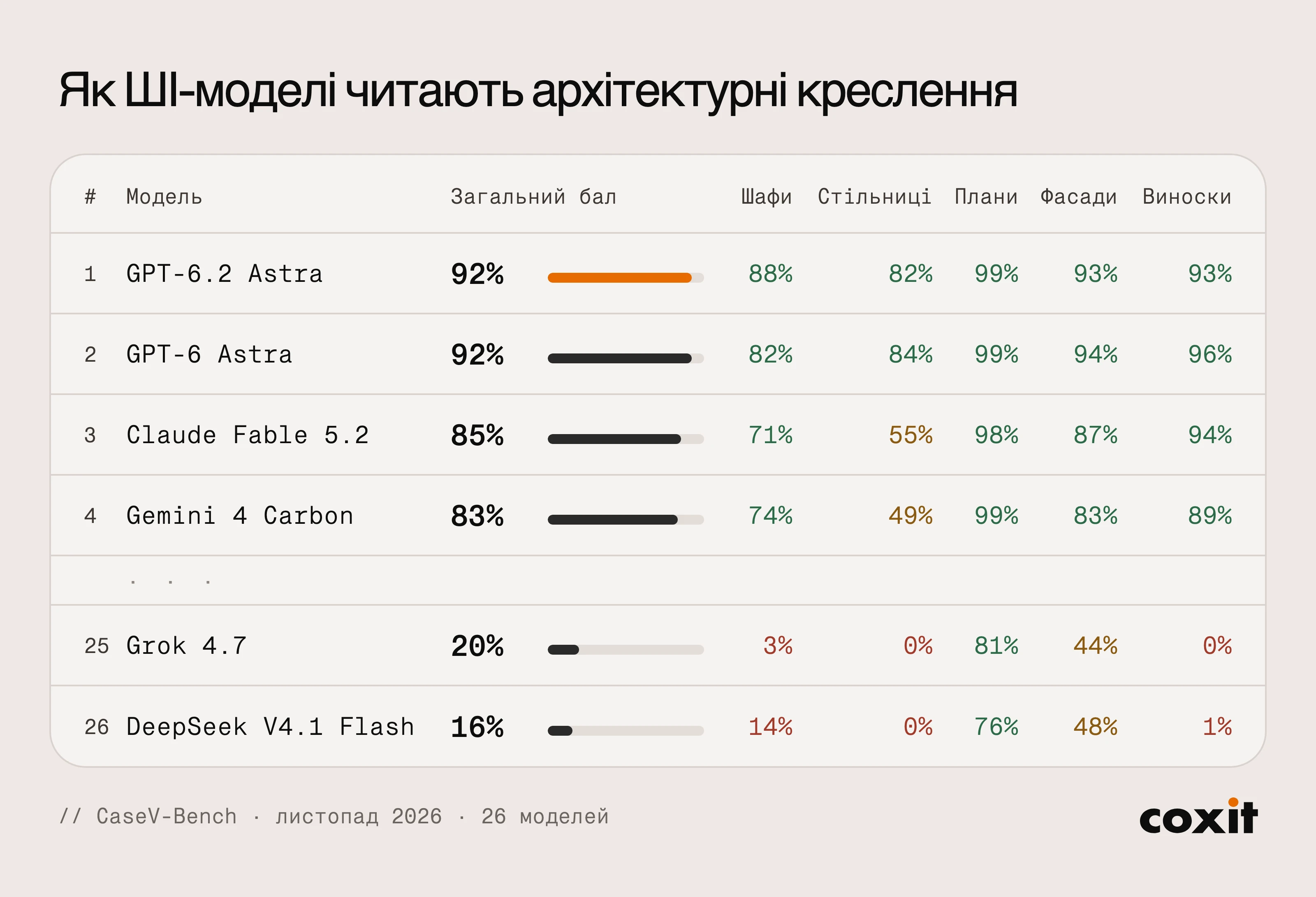
The first question that springs to mind is: why have a separate model when there’s ChatGPT, Claude or Gemini? To answer this question with figures, COXIT has created an open benchmark called CaseV-Bench. This consists of 120 sheets of architectural drawings from 9 real-world projects and 1,430 objects annotated by experts.
The results of the latest simulation run (November 2026) show just how different the models are:
- The top performers, GPT-6.2 Astra and GPT-6 Astra, both scored 92 per cent;
- Claude Fable 5.2 scored 85 per cent, whilst the Gemini 4 Carbon scored 83 per cent;
- Grok 4.7 scored just 20 per cent, whilst DeepSeek V4.1 Flash scored 16 per cent.
In other words, a model that is good at writing text is not necessarily good at reading drawings. The difference between models can be fourfold or more. For businesses where a calculation error means an incorrect price in a tender, regular checks against their own drawings are essential.
What lessons can we learn from this?
This story isn’t about AI replacing the quantity surveyor. The system has taken over the most tedious part of the job: leafing through hundreds of sheets of paper and counting cupboards. As before, the price is determined by a person. That’s why the system shows exactly where on the drawing it has found each cupboard, and the quantity surveyor can check the result in a matter of minutes, rather than having to count everything all over again.
Secondly: the quality of AI performance does not depend solely on which model is chosen. It must be assessed using your own drawings and checked with each new version, as is done for the Stevens on the 51st set.
COXIT is currently developing similar systems for other companies that count materials from drawings on a daily basis.
Find out more about how it works a system for calculating quantities from drawings, as COXIT explains on its website.