On 14 September, the relevant committee of the Verkhovna Rada recommended that the President’s draft law No. 16014 on separate criminal liability for organising fraudulent call centres be adopted in principle and in its entirety — in the committee’s version. The original version proposed prison sentences of between seven and 12 years for organisers, along with the confiscation of their property. The Verkhovna Rada has not yet adopted the bill.
Briefly about the main points
- The committee endorsed Bill No. 16014 as amended.
- The presidential proposal called for up to 12 years’ imprisonment for the organisers.
- The text as amended by the committee may differ from the original.
- Project No. 16013 focuses on schemes involving accounts and «drops».
- In August, law enforcement agencies shut down 94 fraudulent «offices».
What provisions did the presidential proposal put forward?
The presidential version of the bill provided for separate offences relating to the establishment or leadership of an electronic communications fraud organisation, participation in such an organisation, facilitating its operations, and recruiting new members. The initiative is aimed not only at operators, but also at those who set up, finance or control such organisations.
For individuals who knowingly participate in or facilitate the organisation’s activities, the presidential draft provided for a prison sentence of between five and ten years. Recruiting members carried a sentence of between three and five years’ imprisonment, whilst civil servants who assisted the activities of such organisations faced between eight and 12 years’ imprisonment.
What is the status of the document in the Verkhovna Rada?
The President submitted the bill on 2 September and designated it as a matter of urgency. The relevant committee recommended that Parliament support it in principle and as a whole, but proposed its own amendments.
Consequently, the sentences and other provisions set out in the original text cannot be regarded as final. As of 14 September, there is no record of the outcome of the vote in the chamber or of the law coming into force. Alternative Parliamentary Bill No. 16014-1 The committee recommended that it be rejected.
A separate project is intended to cover the financial aspect of the schemes
Along with No. 16014, the President submitted Project No. 16013 regarding illegal transactions involving payment instruments and bank accounts. It concerns measures to combat «drops» — people who, in return for payment, provide criminals with access to their accounts or card details.
The committee also recommended endorsing this document in principle and in its entirety, as drafted. The two draft bills cover different aspects of fraudulent schemes: the first concerns the organisation and operation of call centres, whilst the second concerns the use of financial infrastructure for illegal transactions and the transfer of funds.
Amid 411 raids targeting fraud rings
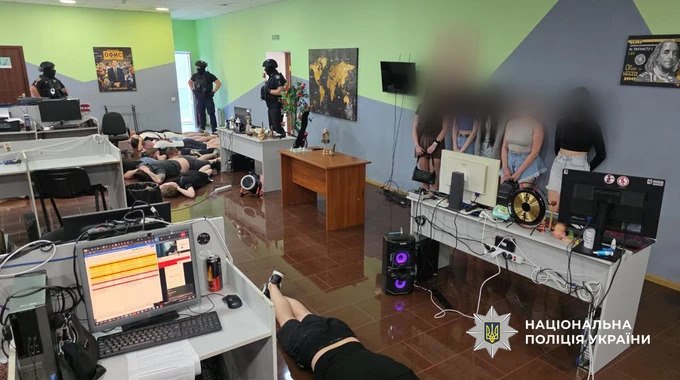
Legislative initiatives followed large-scale law enforcement operations. In the first half of August National Police and SBU They carried out 411 searches, shut down 94 fraudulent «offices» and served notices of suspicion on 26 suspects.
According to police reports, 1,794 equipped workstations were discovered at these locations. The investigation also revealed that some of the networks that were uncovered had defrauded not only Ukrainians but also residents of European Union countries.