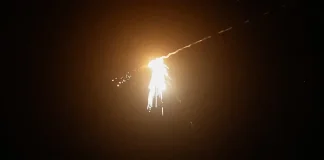
The Australian company Electro Optic Systems (EOS) is developing the Apollo high-energy laser system to counter drones and their swarms. With a power output of up to 150 kW, the system is capable of physically destroying drones at ranges of up to 3 km, disable their optics at distances of up to 15 km and, according to the manufacturer, engage more than 20 small UAVs per minute. EOS CEO Andreas Schwer stated on 11 September that the company’s current laser systems are already capable of shooting down 20–30 drones per minute, and that they aim to increase this figure to 50 in the future.
Apollo was developed specifically to counter swarms of drones
Apollo is a high-energy laser weapon developed by the Australian company EOS in response to the rapid proliferation of low-cost attack drones.
The system is designed to counter UAVs in categories 1–3 and can operate as part of a multi-layered air defence system.
Pros. official specifications EOS, the Apollo laser’s power is scalable within the range 50–150 kW. The system is capable of physically destroying drones at ranges of approximately 50 metres to 3 km. To disable the optical sensors, the stated range is up to 15 km.
The system provides 360-degree coverage and is capable of engaging even targets approaching almost vertically.
More than 20 drones a minute
EOS cites the speed at which targets are hit as one of the main advantages of laser weapons.
The official Apollo website states that it is possible to destroy more than 20 small UAVs per minute. It takes less than 1.5 seconds to re-acquire the next target.
In an article on the war in Ukraine published by EOS on 11 September, the company’s Chief Executive, Andreas Schwer, stated that current systems are already capable of shooting down approximately 20–30 drones per minute.
«The laser will be crucial, as it is capable of destroying more drones per unit of time than anything else.».
Looking ahead, EOS plans to increase performance to 50 goals per minute.
A shot costs just a few dollars
Another key advantage of the laser is the cost-effectiveness of interception.
Schwer stated that One shot from the laser system costs approximately $5–7. In fact, electricity is the main cost.
By way of comparison, using anti-aircraft missiles against low-cost drones can cost anywhere from tens of thousands to hundreds of thousands, or even millions, of dollars per interceptor.
According to the head of EOS, it is precisely this difference that makes lasers particularly promising in countering mass attacks by cheap UAVs.
When connected to an external power source, the Apollo should, in theory, have unlimited ammunition, as there is no need to reload the rocket or projectile for the next shot.
According to EOS, the system is capable of performing more than 200 hits.
The system can be transported in a standard container
Apollo fits into a structure the size of a standard 20-foot ISO container, which allows the complex to be transported quickly by lorries and its position to be changed.
The system comprises threat detection, target tracking, laser beam guidance and beam stabilisation capabilities.
EOS also states that Apollo is compatible with the command and air defence systems used by NATO countries.
Consequently, the laser can be used not as a standalone system, but as one of the components within the overall air defence system, alongside cannons, missiles and interceptor drones.
A NATO country has already placed an order for the Apollo
In August 2025, EOS received its first export order for its 100 kW-class laser system.
A contract worth €71.4 million was concluded by an unnamed European country — a NATO member state.
It provides for the supply of systems, spare parts, staff training and documentation. The contract is scheduled to be carried out in 2025–2028, whilst production takes place at EOS’s facilities in Singapore.
According to EOS, prior to the agreement being concluded, the laser underwent three years of field trials and numerous firing tests.
EOS takes into account the experience of the war in Ukraine
The war in Ukraine has become one of the prime examples of just how rapidly the role of drones on the battlefield is changing.
On 11 September, EOS published an article in which the company’s director stated that its anti-drone systems are already operational in Ukraine and the Middle East, where hundreds of drones and dozens of missiles have been intercepted in recent months.
At the same time, the company did not state that the Apollo laser in particular had already been deployed in Ukraine. We are talking about EOS systems in general.
Schwer noted that the company receives information from the military on the front line almost in real time and updates the software for its anti-drone systems approximately once a month.
According to him, traditional electronic warfare systems are gradually becoming less effective due to the proliferation of fibre-optic-based drones and autonomous UAVs with artificial intelligence algorithms.
The laser is set to become part of a multi-layered air defence system
EOS does not regard Apollo as a complete replacement for rockets or artillery systems.
The company is developing a system in which artificial intelligence identifies the type of threat and automatically selects the most effective means of engagement — a laser, an interceptor drone or a cannon.
This approach is particularly important during large-scale attacks, when dozens of drones of various types may be approaching at the same time.
According to EOS, it is the laser that may, in the future, become one of the cheapest and fastest ways of combating large swarms of UAVs.